



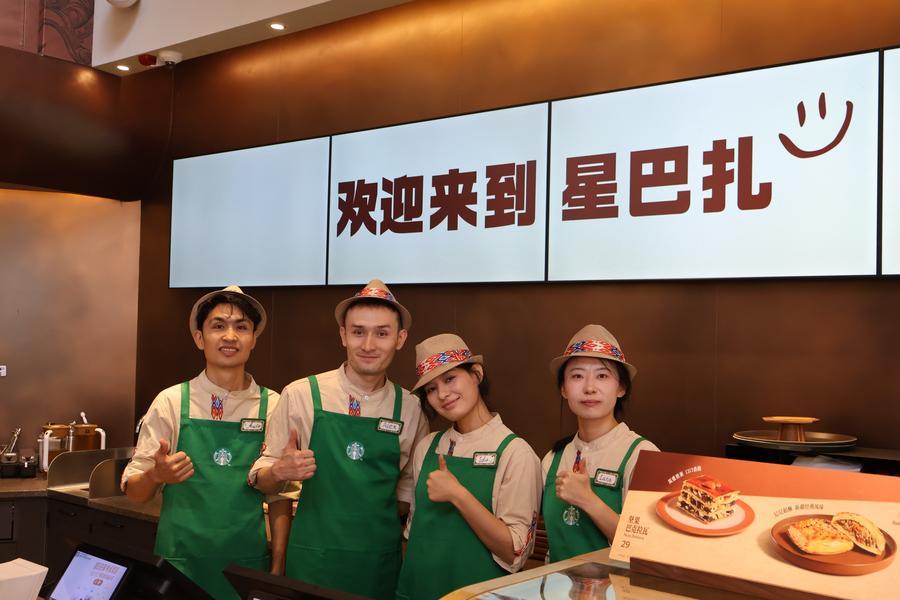
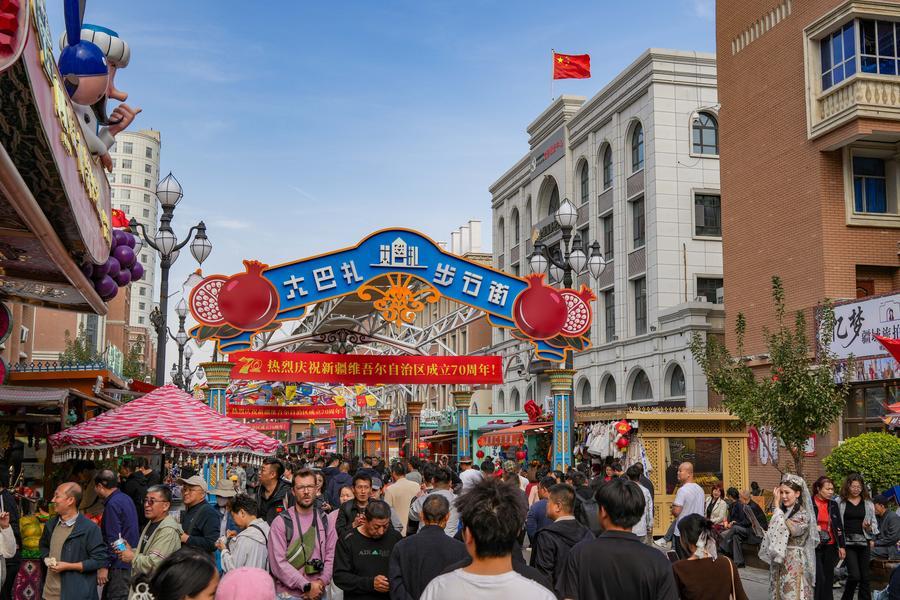
On a crisp early October evening, the line outside the Starbucks at the Xinjiang International Grand Bazaar in Urumqi snakes past stalls selling dried fruit and Atlas silk, a handwoven silk whose origins trace back nearly 2,000 years to the Hetian (Hotan) region. Tourists pose for photos beneath a canopy that echoes the layered rooflines of the traditional market. Inside, the scent of coffee mingles with the aroma of freshly baked lamb pastries, and on the second floor, a dancer twirls to the strains of a rawap, a stringed instrument, inviting customers to join.
"I came to Xinjiang for vacation and heard this was one of the first Starbucks stores here, so I had to check it out," Du Yishen, a visitor from Shanghai, told China News Service, sipping a lake-blue cheesecake latte inspired by Sayram Lake in Boertala (Bortala) Mongolian Autonomous Prefecture. She also bought a doll dressed in Atlas silk. "Everything feels complete," she said.
The store's nickname, Xingbazha, a playful blend of the Chinese name for "Starbucks" and the word "bazaar," fits its setting perfectly. It opened on September 29 alongside another location at Urumqi Tianshan International Airport, becoming the chain's first two outlets in Xinjiang.
The holiday crowd
The timing could hardly have been better. During the week-long National Day holiday (October 1-7), Xinjiang's tourism sector surged according to multiple indicators.
Urumqi ranked first among all Chinese cities for long-haul travel destinations, according to data from leading Chinese online travel agency Tongcheng Travel. The Xinjiang Ancient Ecological Park drew over 6,000 tourist visits daily, a 150-percent increase from normal levels, with its Akhal-Teke horse performances and intangible cultural heritage shows proving especially popular. The city's Hotan Second Street, a local favorite known for its food gems, recorded 190,000 visits over the holiday, peaking at 45,000 in a single day.
The Xinjiang International Grand Bazaar itself welcomed over 1 million visits in the first five days of the holiday, averaging roughly 200,000 per day. On just the first two days, foot traffic reached 410,000.
Bayingol Mongolian Autonomous Prefecture received 2.26 million tourist visits, generating more than 1.48 billion yuan ($221 million) in spending. In Hami's Yiwu County, the Yiwu Poplar Forest Scenic Area drew 52,500 visits over the holiday, with total revenue up 163.6 percent year on year and per-capita spending up nearly 224 percent.
International inbound tourism also gained momentum. From September through early October, four direct charter flights—jointly offered by Malaysian and Xinjiang travel agencies—brought an expected 1,100 Malaysian tourists to Xinjiang, with nonstop service from Kuala Lumpur cutting travel time to seven hours.
Xinjiang received 323 million tourist visits in 2025, up 8 percent year on year, with tourism spending rising 8.4 percent to 370 billion yuan ($52 billion), according to regional government data. This year's National Day holiday figures suggest that this upward trend has continued.
A cultural translation
Starbucks entered the Chinese mainland in January 1999, opening its first store in Beijing. As U.S. coffee culture took root and gained popularity, the chain steadily expanded its footprint across China. By September 27, the brand operated 8,342 stores on the Chinese mainland, up 331 from the end of fiscal 2025, according to its fiscal 2026 data.
The Grand Bazaar store is Starbucks' first intangible cultural heritage flagship in China, and it's the first time the company has led a store's design entirely from the architectural level. The exterior echoes the tiered, uneven canopy silhouettes of a traditional bazaar. The facade is clad in ceramic tiles in 11 colors drawn from Atlas silk, whose flowing patterns and hues are woven into the walls. The coffee bar is built from repurposed vendor carts from the bazaar and wooden dowry chests passed down through generations of Xinjiang families. On these old objects, designers hand-painted coffee flowers and coffee cherries.
On the second floor, an immersive performance called Dancing Bazaar was co-created with inheritors of the Twelve Muqam, a UNESCO-listed masterpiece of Uygur classical music. "Dancing in a coffee shop—that's something unique to Xinjiang," Alimjan Iminjan, a store employee, said.
The menu follows suit: pomegranate yogurt Frappuccino, apricot milk-skin Basque cake and crispy baked lamb buns. "Combining coffee culture with Xinjiang's folk customs and intangible cultural heritage is a refreshing and successful experiment," Mahliya Ahmat, a visitor from Kashi (Kashgar) Prefecture, told China News Service.
During the holiday week, one Xinjiang-inspired drink and three food items were offered at more than 2,700 Starbucks stores across 41 Chinese cities, bringing the region's flavors to consumers nationwide.
Beyond the coffee
The store's 20-plus employees include returning locals like manager Ma Ying, who previously worked in Qinghai Province and applied to transfer the moment she learned Starbucks was coming to Xinjiang. "I'm very happy and fulfilled," she said, now closer to her parents in her home region.
For Molly Liu, Chief Executive Officer of Starbucks China, the new cafés are part of a long-term strategy. "Entering Xinjiang is a further expansion of our store network, and allows us to engage deeply with this vibrant market and build sincere, lasting connections with our customers there," she said in a written statement, adding the company would continue to deepen its presence in Xinjiang and develop stores, products and experiences tailored to local demand.
The openings follow Starbucks' partnership with Chinese venture capital firm Boyu Capital to operate its retail business in China. According to the agreement, signed in November 2025, Boyu and Starbucks will operate a joint venture, with Boyu holding up to a 60-percent interest in Starbucks' retail operations in China, while Starbucks will retain the remaining 40-percent interest in the joint venture, continue to own the Starbucks brand and license the brand and intellectual property to the new entity.
Starbucks is not alone in looking to Xinjiang for growth. Domestic brand Luckin Coffee opened its first 11 stores in Urumqi in May 2024, while another Chinese chain Cotti Coffee had entered the Xinjiang market earlier through its franchise model.
"Brands choose to settle in Xinjiang because they value the visitor flow brought by the region's cultural tourism development, as well as the sustained momentum of consumer growth," Qiu Wei, an associate professor at the School of Economics, Xinjiang University of Finance and Economics, told China News Service. He added that Starbucks' dual openings are part of a wider trend of well-known consumer brands clustering in Urumqi, confirming that Xinjiang's business environment is continuously improving and its consumption potential is steadily being unlocked.
It also mirrors a broader policy push. Xinjiang has made the debut economy a key lever for boosting consumption, Zhang Yu, an official with the regional administration for market regulation, told Xinhua News Agency. The concept of the debut economy originates from the concept of the first-store economy, which refers to the inauguration of a brand's first store in a new market.
Zhang added that Xinjiang will continue to strengthen support policies for first stores, streamline approval procedures and optimize the business environment.
While Starbucks is seizing fresh opportunities in northwest China, it is simultaneously undergoing painful business adjustments in its home market. The company has announced plans to close 250 underperforming coffeehouses in North America.
Such corporate bets on China's domestic market are far from isolated cases. The State Administration for Market Regulation said China saw 35,000 newly established foreign-invested enterprises in the first half of 2026, up 7 percent year on year. Separate data from the Ministry of Commerce showed nearly 4,800 foreign-invested enterprises increased investment in China in the first six months of the year.
Xinjiang's broader corporate base is also expanding. The region had 2,647 registered foreign-invested enterprises by the end of June, up 6.91 percent from a year earlier, while the total number of registered market entities reached 2.73 million, according to official statistics.
For Starbucks, Xinjiang represents a promising new frontier for its China business. For the region, these new coffee outlets serve as another sign that development is bringing prosperity as well as greater parity with eastern parts of China. And for local residents and visiting tourists stepping inside Starbucks, it is simply a satisfying cup of coffee that blends global tastes with local cultural charm, enjoyed right here in Xinjiang.





