



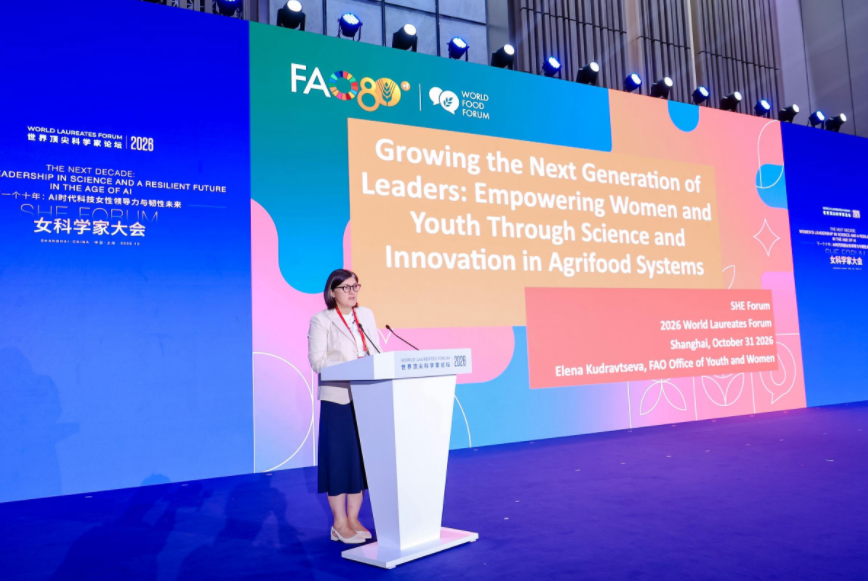
Editor's Note: On Oct. 31, Elena Kudravtseva, Food and Agriculture Organization of the United Nations (FAO) Office of Youth and Women (OYW) senior program officer (women), shared her insights with regard to the relationship between young women and agrifood systems at the SHE Forum. Held in Shanghai as part of the 2026 World Laureates Forum, the event covered the role of women in science and technology throughout the world as well as the contributions that they have made and influence that they have in these areas. In this exclusive piece, Kudravtseva discusses efforts that have been made by the FAO pertaining to gender equality, the role of AI and digital technologies in developing countries, and her vision for the next decade with regard to young women and agrifood systems.
The biggest barrier: unequal access to opportunity, not lack of talent
2026 is the International Year of the Woman Farmer. Achieving gender equality and women’s empowerment in agrifood systems has long been central to the work of the Food and Agriculture Organization of the United Nations (FAO). From the perspective of its Office of Youth and Women, one of the most pressing challenges is ensuring that young women are fully included in the generational renewal of agrifood systems.
Young women are already farmers, entrepreneurs, scientists, innovators, and community leaders, but evidence indicates that they continue to face barriers related to both their age and their gender. According to FAO flagship reports: The Status of Women in Agrifood Systems and The Status of Youth in Agrifood Systems, agrifood systems already belong to young people. Young people rely more on agrifood systems for employment than adults do (44% vs. 38%, respectively), while agrifood systems serve as a critical entry point into labor force participation for youth aged 15 to 19. Youth, and especially young women, are more likely to engage in precarious, low-skilled, poorly remunerated work, however. Young women account for nearly two-thirds of the youth throughout the world who are not in education, employment, or training, and women are less likely than men to own or have secure rights to agricultural land in 43 out of 46 reporting countries.
Young women often face disadvantages related to both age and gender. Persistent stereotypes continue to shape who is encouraged to study STEM subjects, who is seen as a scientist or innovator, and whose expertise is valued. As a result, many talented young women, particularly in rural areas and underserved communities, are excluded from opportunities long before they reach research institutions or innovation ecosystems.
The FAO, and particularly the Office of Youth and Women and the World Food Forum Global Youth Action Initiative, focuses on strengthening three pillars of generational renewal – capabilities, agency, and enabling systems for youth – which means investing in education and skills training; creating opportunities that enable young women to participate in decision-making; and advocating for the policies, institutions, and investments that help them reach their potential and thrive.
The FAO considers unequal access to opportunity to be the biggest barrier that young women experience with regard to agricultural science and technology rather than a lack of interest or ability. Far from a shortage of talent, ambition, or ideas prevailing, institutions, financing systems, and research ecosystems often fail to recognize, invest in, and retain talent. Too many talented young women are excluded from the networks, mentorship, financing, technologies, and professional pathways that would enable them to fully contribute to innovation. One of the greatest untapped sources of innovation in agrifood systems can be unlocked if that opportunity gap is closed.
The AI era: from accessing technology to shaping it
More than simply helping women access technology, it is imperative to ensure that young women can help shape the technologies that will transform agrifood systems.
Without deliberate action, AI and digitalization risk reinforcing existing digital, rural, and gender divides. Young women often face barriers related to connectivity, STEM education, digital literacy, and access to finance and professional networks. In many rural areas, these challenges are compounded by limited educational opportunities and unpaid care work.
From the perspective of the OYW, the solution again comes back to capabilities, agency, and systems.
A greater level of investment in STEM and digital education, mentorship, and leadership is required in order to help young women develop their capabilities. Young women farmers, scientists, entrepreneurs, and innovators should help define what problems technology solves, which innovations receive investment, and how solutions are designed and deployed rather than simply gaining access to and utilizing technology.
It should also be recognized that innovation does not begin in a laboratory. Farming communities have accumulated valuable knowledge pertaining to seed, biodiversity, ecosystems, and climate adaptation across generations. Science is strongest when it combines frontier technologies with local knowledge and experience. Innovation should not replace farmers’ knowledge – it should build on it.
It is necessary to ensure that young women have space to drive the research agenda, spearhead research and innovation, and participate meaningfully in innovation ecosystems and policy processes and that measures designed to ensure that young women have support structures that redistribute unpaid care work are also implemented so that they can strengthen their agency and influence. Achieving these outcomes also requires the engagement of men and boys and institutions that are willing to serve as allies, challenge stereotypes, and create more-inclusive environments for young women.
Finally, enabling policies and systems that provide affordable connectivity, access to finance, supportive institutions, and inclusive innovation platforms are also necessary.
Beyond scholarships: building the infrastructure required for young women to lead
Women, and especially young women, will be essential to the next generation of agrifood innovation. AI and digital advances are already influencing agrifood systems, and rapid changes are being made. Solutions to complex challenges impacting agrifood systems, from climate change and biodiversity loss to food insecurity and rural transformation, will be required in the next 10 years, and they will increasingly depend on science, technology, and innovation. Science should never be an end in itself. Its purpose in the context of agriculture should include improving the lives and livelihoods of the people who produce our food, which means connecting research back to farmers and recognizing different forms of knowledge, including traditional and local knowledge that has been passed from generation to generation and continues to sustain communities around the world.
From the perspective of the OYW, the question is whether the next generation of women scientists and innovators will have the support they need to enter into, remain inside of, and take on leadership roles and responsibilities within agrifood systems.
The FAO helps build such support infrastructure. It is working to expand opportunities for young women through policy engagement, education, mentorship, leadership development, research support, innovation and research challenges and accelerators, and the development of stronger connections to global scientific and policy networks via the World Food Forum Youth Initiative . The FAO believes that experiential learning, internships, and scholarships are an important starting point but that these undertakings alone are not enough. Too often, access to education is invested in without corresponding investment in retention, career progression, and leadership. A complete pathway spanning from education to leadership should exist for young women.
A dedicated fellowship and career accelerator program for young women in agrifood sciences is thus being explored via the Organization for Women in Science for the Developing World (OWSD). More than simply helping young women complete their studies, the program is intended to help them become leaders who can transfer innovation, technology, and policy solutions across countries and regions by combining doctoral opportunities with mentorship, leadership development, exposure to the FAO’s technical work, experiential and peer learning, participation in global conferences and policy processes, and access to international scientific and professional networks.
Achieving this vision requires collaboration. Governments, universities, research institutions, development partners, the private sector, and scientific organizations all have a role to play. Generational renewal in agrifood science will not happen automatically – it requires deliberate investment in the capabilities, agency, and leadership of young women.
Young women are already shaping the future of agrifood systems. It is imperative that their potential is collectively invested in and that opportunities, partnerships, and institutions that help them reach their leadership potential are created.
Elena Kudravtseva, Food and Agriculture Organization of the United Nations (FAO) Office of Youth and Women (OYW) senior program officer (women).





