



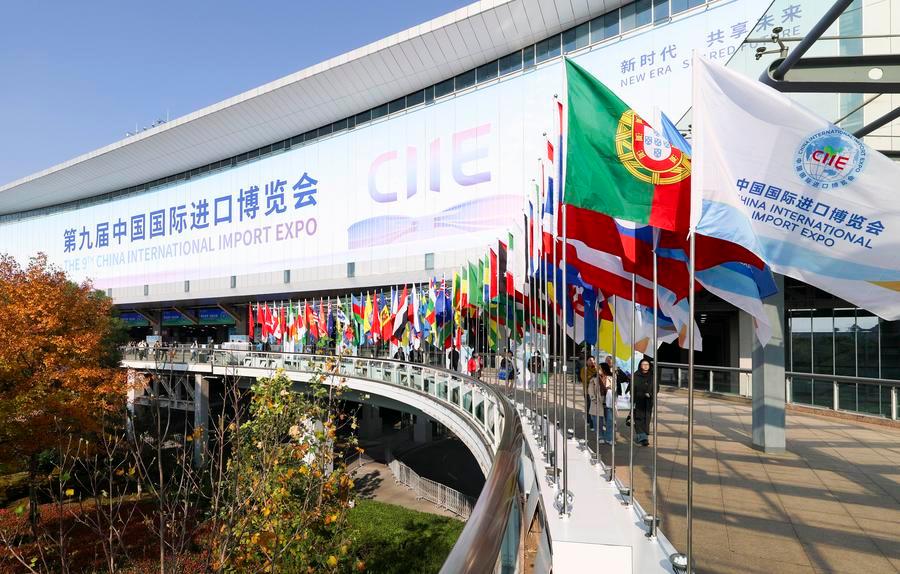
China International Import Expo (CIIE) in Shanghai closed with record deals in a year when China's purchases from the world are growing faster than its sales to it. The overcapacity debate has not caught up, and the countries selling into China have more riding on that gap than Brussels or Washington.
Every Western complaint about Chinese trade starts from the same figure. China's trade surplus reached 1 trillion U.S. dollars in the first ten months of this year. That headline tends to muffle the line printed just beneath it in the same customs release. Between January and October, China's imports rose 23.6 percent to 18.82 trillion yuan, while exports grew 17.6 percent to 25.99 trillion yuan. In October alone, purchases from abroad jumped 34.7 percent in yuan terms. Over the year as a whole, China has been buying from the world faster than it has been selling to it.
That was the ledger the ninth CIIE closed on in Shanghai on Tuesday. The expo recorded 85.45 billion U.S. dollars in one-year intended deals, a record high, from 4,142 overseas exhibitors representing 162 countries, regions and international organizations, more than 2,000 of which were first-timers.
The dominant narrative treats China as a country that only sells, a factory pushing its spare capacity onto everyone else's shelves. Brussels has spent the year in a simmering imbroglio with Beijing over car exports built on exactly that picture. The narrative is right about the size of the surplus. It is wrong about the direction of travel. For most of the countries that trade with China, the question that pays their bills is no longer how much China sells. It is how much China buys, and from whom.
Who is selling into China
Part of the imbalance Western capitals complain about comes from their own export controls. When Washington bars the sale of advanced chips and chipmaking tools, Chinese buyers cannot place those orders, and the gap widens by the business American firms were told to refuse. A Chinese surplus partly written in Washington makes an odd basis for a lecture delivered from Washington.
Where buying is allowed, the order book is fat. South Korea's exports to China jumped 133.6 percent to 26.98 billion U.S. dollars in October. It was the fifth straight month above 20 billion U.S. dollars, and semiconductors and wireless communications equipment did most of the work. China again outranked the United States, which took 24.9 billion U.S. dollars, as Seoul's biggest customer. For an economy that has spent a decade being told to cut its exposure to China, the irony is palpable: China's data center build-out has become part and parcel of South Korea's export boom. Some of that bill reflects the higher price of AI hardware. For the seller, a higher price is no statistical footnote. It is revenue, and it pays wages in Icheon and Pyeongtaek. Similarly, Chinese imports from Japan and Australia during the first 10 months of 2026 also rose by 26.1 percent and 40.9 percent respectively in dollar value. The import performance from Global South is also outstanding. During the same period, it rose by 28.1 percent from ASEAN, 20.3 percent from Africa and 22.5 percent from Latin America.

Africa's numbers are smaller and, for that reason, more telling. Since May, Beijing has removed tariffs on every product from the 53 African countries it has diplomatic relations with. By the end of September, China's imports from Africa were up 22.3 percent year-on-year. Ghanaian cocoa, which used to face Chinese duties of 8 percent to 22 percent, and Kenyan coffee from 8 percent to 30 percent, now enter at zero tariff. The October release confirms the pattern. Imports from Africa, Latin America and ASEAN all reached record highs for the period, and purchases from more than 150 countries and regions grew. The expo, for its part, gave the least developed countries 17 percent more free booth space than last year.
A manual for suppliers
Interestingly, the most practical document to come out of Shanghai was not a speech. The Hongqiao International Economic Forum, which runs alongside the expo, released its first Export-to-China Capacity Development Report. The report studies ten trading partners, including Colombia, Kenya, Spain, Thailand and Britain: what they produce, where their goods fit Chinese demand and how they could sell more of them. The forum now treats it as a second flagship report alongside its World Openness Report. China is already the main export destination for nearly 80 countries and regions, and has been the world's second-largest importer for 17 years in a row. A country interested only in selling would have no reason to write a manual for its own suppliers.
One more table would let the report settle the overcapacity argument better than any keynote. Last year's import expo closed with 83.49 billion U.S. dollars in intended deals. If the next edition showed how much of that became actual customs entries, broken down by the exhibitor's country of origin, a promise would become a receipt. It would also tell small exporters from Accra to Lima which doors in Shanghai open fastest.
The direction of travel
For Europe and the United States, the lesson is quite clear. China's trade is moving into the folds of Asia and the Global South for obvious reasons, and the countries on the other end increasingly meet China as a customer as well as a competitor. The World Openness Report found that global openness in 2025 posted its largest decline in nearly a decade, even as emerging and developing economies moved the other way. We must expect those economies to weigh Western calls for de-risking against an order book that keeps getting fatter.
China's imports are on course to pass 3 trillion U.S. dollars for the first time this year. Some 143 companies and institutions have already signed up for the expo's tenth edition next year. When the full-year customs figures arrive in January, most commentary in Europe will read the surplus first. The more revealing figure will sit one line below it.
The article reflects the author's opinions, and not necessarily the views of China Focus.





