



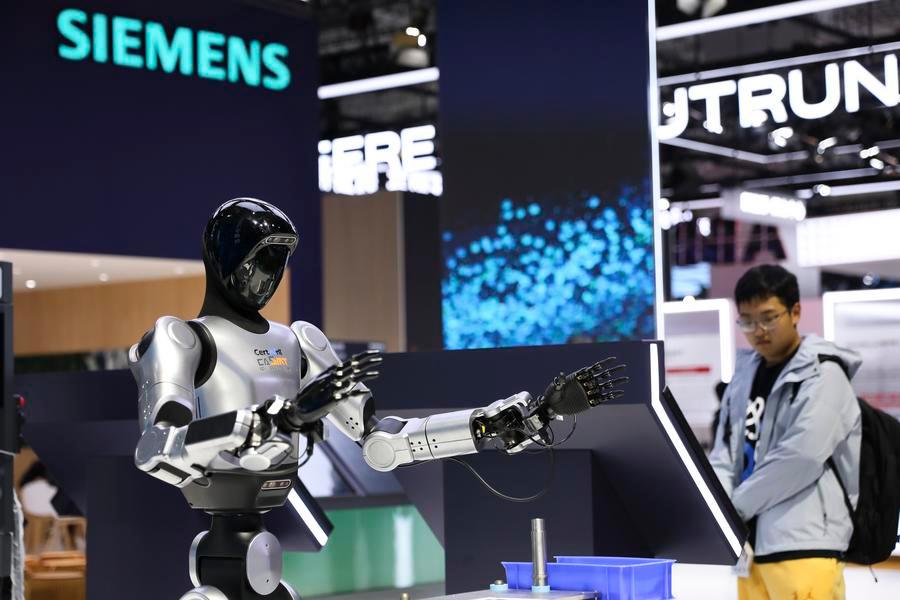
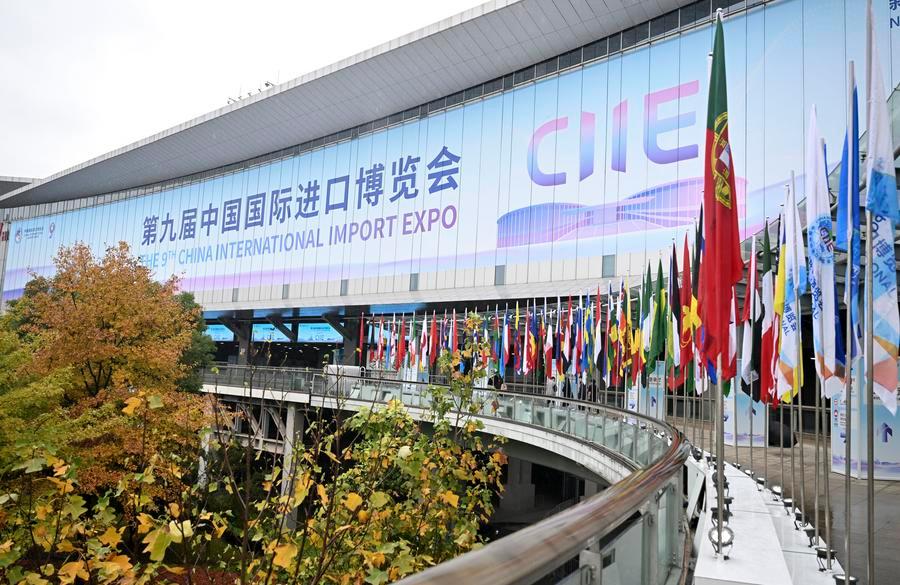
For six days in early November, Shanghai was bustling with a record attendance at the 9th China International Import Expo (CIIE). More than 480 representative exhibits made their global, Asian or China debuts at the popular expo, an all-time high, with a record presence of 162 countries, regions and international organizations, and 4,142 overseas participating enterprises, along with a first-ever 444,000 square meters in total exhibition space.
Against this backdrop, from November 5-10, an enterprising cohort of European businesses across diverse sectors used the expo as a launchpad to deepen their footprint in the world's second-largest economy.
Norway's seafood target 2035
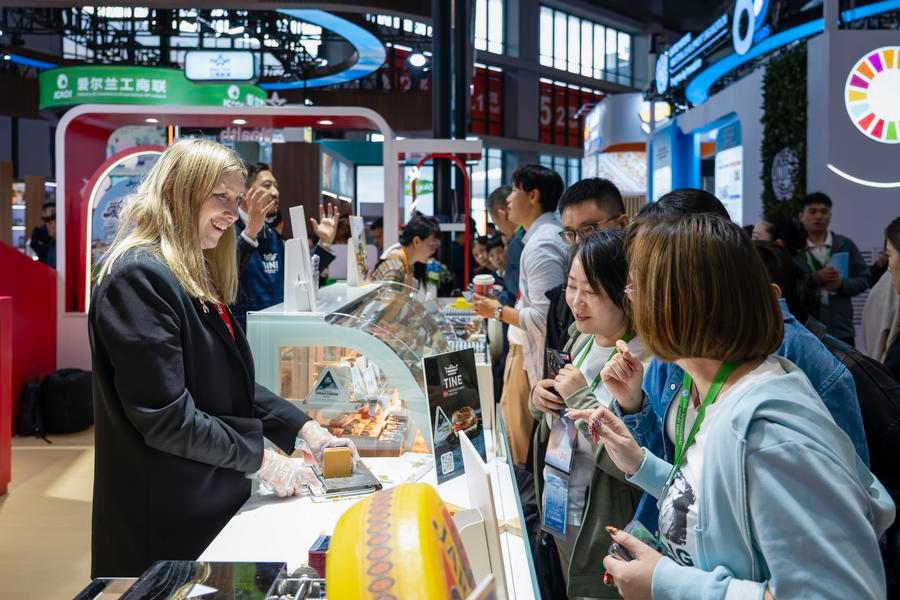
Among the standout announcements at this year's CIIE, the Norwegian Seafood Council (NSC) unveiled "Target 2035," an ambitious decade-long plan to double Norwegian seafood export value to China to RMB 20 billion (about US $2.9 billion) by 2035.
"By setting a new ambitious target, we have something to reach for," said Christian Chramer, CEO of the NSC, noting that the council has produced over 10 market reports in the past two years analyzing China's demographic shifts and seafood demand.
The announcement builds on the success of the previous "Target 2025" goal. China has become Norway's second-largest seafood export market this year, surpassing the United States and trailing only Poland. Salmon has been a key driver, with volumes growing 50 percent in 2024 and another 40 percent in the first half of 2025.
On the Chinese side, Yao Qifei, vice president of the China Aquatic Products Processing and Marketing Alliance (CAPPMA), said reliable quality and stable supply are now critical for international seafood trade to succeed domestically. Consumer preferences have shifted toward safety, traceability and sustainability, with growing demand for convenient, small-package products suited for family meals.
"Different market segments require differentiated product strategies tailored to specific scenarios and consumer groups," Yao said, adding that CAPPMA is ready to continue as a trusted partner for the Norwegian Seafood Council in China to tap into market potential and achieve mutually beneficial, long-term development.
Despite per capita salmon consumption in China being just 0.15 kg, far below other top markets, the NSC sees significant long-term potential as the country's middle-income group expands. China's seafood export volume reached about 4.5 million tonnes in 2025, valued at 145.3 billion RMB, underscoring the sector's growth momentum.
As rising income levels and better living standards become a reality, Chinese consumers' purchase habits are shifting from being mainly price-driven to a stronger focus on product quality. This quality-oriented consumption tendency is giving European exporters, including Norway's seafood industry, increasing confidence in the long-term prospects of the Chinese market.
"Resilience anchor" for global innovation
Beyond food, European high-tech and hardware enterprises are also doubling down on their China presence. At the 9th CIIE, Hanneke Faber, CEO of Logitech, told China Today that her company's core mission at this year's event came down to just one phrase – "Global Connections."
"I would say Global Connections is our primary mission. Meeting here with so many government officials, national, provincial, local, as well as both Chinese and international companies will give us new ideas and maybe result in new partnerships, so building that global connectivity. That's why we're here," Faber said.
Founded in 1981 as a Swiss mouse maker near Lausanne, Logitech later expanded to Silicon Valley. Today, it is a global design-driven hardware company whose keyboards, mice, headsets and AI-enabled meeting tools sit at the intersection of work, creativity and gaming.
Logitech has been in China since 1991, setting down deep roots over more than three decades. "For so many companies, China has become more important in different ways, not just manufacturing. It's also important as a market and very much as an R&D and innovation center. So I think in that context, CIIE plays a really important role – it facilitates trade against the backdrop of rising uncertainty in the global economy," Faber said.
A word that frequently enters her vocabulary is resilience. "We just keep performing because we're very resilient. I would call us an operations powerhouse, and China plays a critical role in that. Our team here is amazing," she said.
Logitech employs about 2,000 people at its Suzhou plant. Faber said it's a really important site for the company. "We have some of our smartest engineers there. They are busy with fabulous robotics and AI-enabled manufacturing. They're constantly innovating. I love visiting the plant. It's also a beautiful city."
Gaming is a new area where Faber sees much potential. Logitech leads the global market in gaming peripherals – mice, keyboards, and headsets. "Fifty percent of the global gaming market is in China, which leads in terms of gamers, and also in game development. So games like Black Myth: Wukong and Genshin Impact come from here and are very popular in China, and also outside of China. So gaming is near and dear to our hearts, and I'm always looking for new gaming inspiration."
According to Faber, she sees the process of "stable cooperation" in a pragmatic sense. Don't put all eggs in one basket, but instead embed core capabilities deep into the local ecosystem – R&D, supply chain, rapid response – serving Chinese consumers while feeding back to the global network. Logitech's strategy reflects a shared consensus among European high-tech enterprises – moving beyond treating China merely as an overseas sales market or production base. Instead, they are integrating into the local innovation ecosystem, building R&D centers, localizing supply chains, and aligning product research with Chinese consumers' evolving needs.
"We're a Swiss company. For companies like ours, we're always looking to be resilient in a global context. China is important in building that resilient footprint. Manufacturing in China is the core of our manufacturing. In an uncertain world, as a company, you have to try and build as much resilience into your systems as you can, and again China plays an important role in that for us," Faber told China Today.
Pharmaceutical cooperation
The strong appeal of the Chinese market is equally evident in the life sciences sector. As pharmaceutical cooperation gains momentum at this year's CIIE, Novartis from Switzerland stands out as a prime example of how European drugmakers are deepening their commitment to the Chinese market.
On November 7, Novartis and Guangzhou Pharmaceuticals launched a cooperation initiative under a Hong Kong-Macao drug and device connect program, bringing innovative radioligand therapies to the Greater Bay Area. The Swiss giant, attending CIIE for the ninth time, covers several key therapeutic areas in China: cardiovascular, renal & metabolic, immunology, oncology, and neuroscience.
Novartis has built a full-chain presence: three R&D centers in Shanghai, Beijing and Suzhou; two manufacturing bases including the operational Beijing Changping plant and the Zhejiang Haiyan radioligand therapy base set to open in 2027. Since 1987, it has secured over 120 drug approvals in China, with more than 100 clinical studies ongoing. From 2022, all new-drug development has been synchronized globally, and from 2026, all registration filings will follow suit.
Drawn by China's vast patient pool, continuously optimized business environment and robust innovation ecosystem, more European pharmaceutical enterprises are choosing to establish their long-term strategies in the Chinese market, turning the country into a vital engine for global medical innovation.
Stories at the CIIE clearly illustrate that as China continues to open its doors wider and upgrade its consumption and innovation ecosystems, the mutual trust and win-win cooperation between China and Europe will unlock even greater opportunities.





