



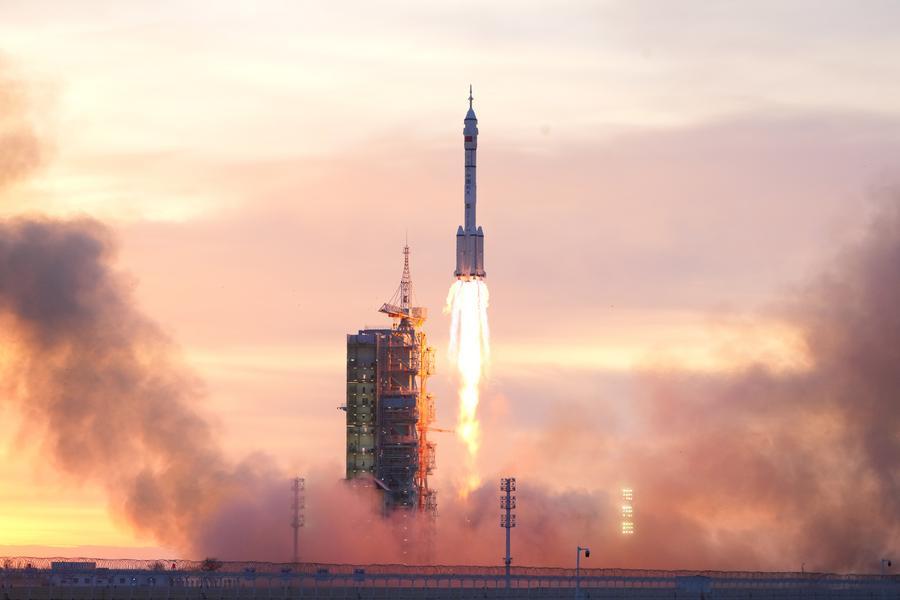
As the Shenzhou-24 crewed spaceship headed for China's Tiangong space station, one passenger stood out: Pakistani astronaut Muhammad Zeeshan Ali, the first foreign astronaut to visit the Chinese space station. His participation is a powerful symbol of China's commitment to sharing its achievements in space exploration and expanding international cooperation beyond Earth.
From independent development to major space achievements
Chinahas spent decades building independent capabilities, investing in space technology, and developing the infrastructure and expertise to support projects with other countries that share space exploration ambitions. In this decade alone, China has completed its own space station, returned samples from both the near and far sides of the Moon, landed a rover on Mars, and created the coldest man-made matter in the known universe.
At the center of China's space program is the Tiangong space station, a permanently crewed station that the country completed in 2022. Wang Qiang, Acting Director-General of the Center for Space Utilization at the Chinese Academy of Sciences, recently stated that the station has supported more than 160 research projects, resulting in about 1,800 academic papers. With a station in orbit year-round, China can conduct long experiments on its own schedule while also offering these capabilities to other countries.
The same pattern holds on the Moon and beyond. In 2024, Chang'e-6 returned the first samples from the far side of the Moon. Now, China intends to land astronauts on the lunar surface before 2030. Chang'e-7 and Chang'e-8 are designed to survey the south pole for water ice and to test the use of local resources. Chang'e-7 was initially planned to launch in August 2026; however, it was postponed because it did not meet launch conditions within this year's planned window. Chinese officials have not yet announced a new launch date. Together, both missions lay the basis for the International Lunar Research Station, planned for the 2030s. Farther out, Tianwen-2, which launched in May 2025, reached the asteroid Kamoʻoalewa this year and plans to return samples during an Earth flyby in 2027, while the Mars sample-return mission Tianwen-3 is scheduled to launch in 2028.
Behind these missions is a domestic space industry that produces rockets, spacecraft, satellites, and scientific instruments. The Long March 10A is planned as a lower-cost, reusable rocket to carry crews and cargo to the station. Building these systems domestically means China can design, launch, and operate complex spacecraft from beginning to end. This is why China can offer partners access to hardware and services it controls.
China's invitation to partners
As space exploration becomes more demanding and more commercially significant, international cooperation will be essential. China, for its part, is ready to share its space capabilities. Yang Liwei, China's first astronaut and now deputy chief designer at the China Manned Space Agency, described Tiangong as a future global research platform. He said cooperation proposals are welcome when they bring commercial, industrial, or educational benefits to both sides.
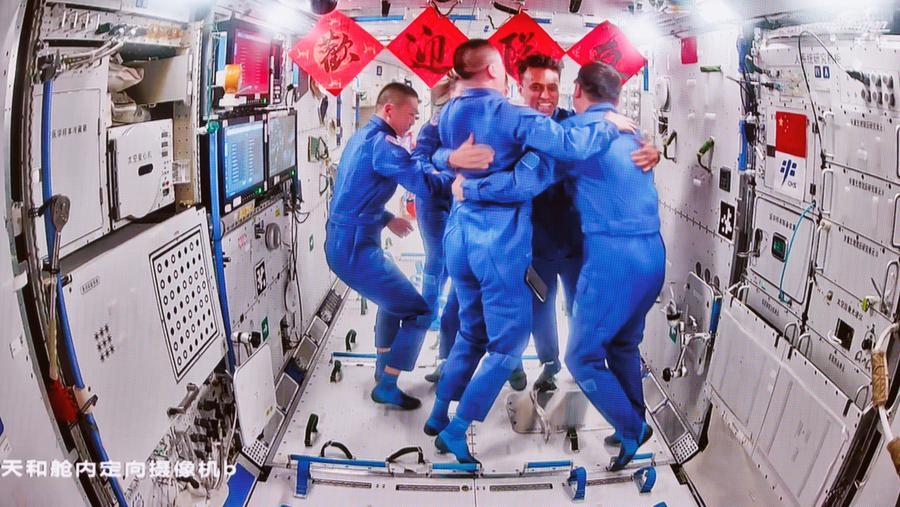
Pakistan is a clear example of international cooperation. Pakistani astronaut Muhammad Zeeshan Ali is expected to spend about a week aboard the Tiangong space station before returning to Earth. His participation in the Shenzhou-24 mission marks the first joint flight consisting of Chinese and foreign astronauts in the history of China's manned space program.
The invitation extends to the Moon. Wang Zhongmin of the Deep Space Exploration Laboratory said that China has signed more than fifty memorandums of understanding. About twenty countries have joined the International Lunar Research Station in differing roles, and twelve have signed on to a cislunar CubeSat constellation. The roles are scaled to each partner. Chang'e-7 is scheduled to carry instruments from Russia, Egypt, Bahrain, Thailand, Switzerland, and Italy. Chang'e-8, planned for around 2029, is set to carry rovers from Pakistan and Türkiye. These examples show that countries with different levels of space capability can contribute specialized instruments or robots without building a launch vehicle of their own.
Cooperation is also moving into commerce. On October 8, China Satcom and Türksat signed an agreement to jointly research, develop, and commercialize products. It covers drone communication systems, satellite-based Internet of Things (IoT) technology, and border monitoring, along with hardware that allows equipment in energy, agriculture, and logistics to be managed via satellite where mobile networks do not reach. More than six hundred commercial space companies now operate in China, according to Li Guoping of the China National Space Administration.
What greater cooperation could mean for the global space industry
Three benefits stand out. The first is access. More launch providers, satellite services, and research platforms give more countries a route into space without having to build everything themselves, as Pakistan's astronaut program and Türkiye's lunar rovers show. The second is cost. Shared infrastructure and complementary expertise spread the expense of research that is hard for one country to fund. A space station or lunar base that hosts many experiments produces more scientific research achievements from each launch. The third is commercial. Satellite communications, Earth observation, space-based computing and reusable launch systems are all areas where joint development can create economic opportunities and speed up innovation.
Outcomes will depend on funding, technical compatibility between systems, intellectual property protections, export rules in each partner country, and terms for accessing shared facilities.
With China as a partner, the international space community now has an opportunity to shape what comes next. Technological progress in the space industry could produce parallel programs that duplicate one another's infrastructure, or it could give countries more ways to combine their expertise on shared scientific and commercial goals.





