



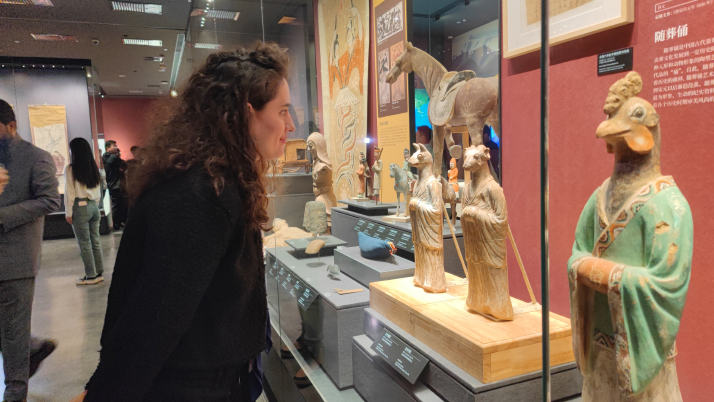
In Xinjiang, the past is not hard to find. It lies under the desert sand, on the walls of caves cut into cliffs and in the weave of a cloth buried for 2,000 years. What is hard is keeping it from light, from moisture, from the slow chemistry of air, and keeping it legible for the people who want to take a look.
For a long time, that work was quiet and mostly unseen. Then the visitors began to arrive, first by the thousands, then by the millions, and the work found itself with a new audience and a new kind of pressure.
Museum boom
Saying Xinjiang has seen a museum boom over the past two years is no exaggeration.
On August 11, the Urumqi Museum welcomed its millionth visitor of the year—20 days earlier than it hit that mark in 2025, and nearly three months earlier than in 2024. The trajectory speaks for itself: 773,000 in 2023, then over 1 million for the first time in 2024 at 1.14 million, and 1.407 million in 2025. And that's just one museum in the city. Also located in the regional capital, the Xinjiang Uygur Autonomous Region Museum has drawn more than 1.5 million visitors each year since 2023.
Across Xinjiang, the numbers are even more striking. A report on the region's museum development, released on May 18, shows that during the 14th Five-Year Plan period (2021-25), the number of museums rose from 101 to 150, more than 2,000 exhibitions were staged, and total visits exceeded 46 million. Museums rolled out 3,912 cultural-creative products, bringing in over 70 million yuan ($10.5 million) in sales, while 15,367 traveling exhibitions reached more than 5 million people in rural areas, urban communities and schools.
On October 1, the Xinjiang Uygur Autonomous Region Museum drew over 12,000 people on the first day of the National Day holiday (which falls on October 1-7 every year), including more than 100 international tourists.
So why the boom? Three reasons stand out.
On the supply side: new museums, new exhibitions, new techniques. In recent years, the second phase of the Xinjiang Uygur Autonomous Region Museum, the Yili (Ili) Kazak Autonomous Prefecture Museum and the Qiuci Museum in Kuche (Kucha) in Aksu Prefecture have opened.
"Return to Niya," a digital exhibition on the Niya ruins, opened at the Xinjiang Uygur Autonomous Region Museum on October 1 and is scheduled to run through October 2027. Using digital modeling, 3D reconstruction and immersive projection, the show recreates the ancient desert kingdom at the Niya site in Minfeng County, on the southern edge of the Taklimakan Desert—inside the museum. Visitors don't just look; they can actually do things. They can try their hand at a Han-Dynasty (206 B.C.-220 A.D.) loom to weave brocade, paddle a dugout canoe to fish, wander through a poplar forest or pause before a towering Buddha statue and let their imagination drift back nearly two millennia.
At the Qiuci Museum, the biggest draw isn't any single artifact but a circular screen: The dance-and-music motifs on a Tang-Dynasty (618-907) sarira box depicting the Sumuzhe dance have been restored digitally in high definition, and 21 dancers come spinning to life in light and shadow. The restoration is an artistic recreation that draws on historical documents, research on mural imagery and input from dance experts, all aimed at capturing the original look of Tang Dynasty Qiuci music and dance as closely as possible.
On the demand side: Tourists are looking for something else. They used to come to see the region's mountains, rivers and grasslands; now their itineraries include museums, ancient ruins and intangible cultural heritage workshops. Parent-child study trips have become a staple, and the Kashi (Kashgar) Museum draws over 2,000 visitors a day in summer—many of them Gen Z and Gen A.

When it comes to promotion, two things stand out: cultural-creative merchandise and cross-industry collaborations. Qiuci's signature diamond lattice—the rhombus pattern that covers the ceilings of Qiuci cave murals—appeared on limited-edition character skins in a hit Chinese video game.
At the Xinjiang Uygur Autonomous Region Museum, an armguard dating back to the Eastern Han Dynasty (25-220), embroidered with the phrase "five stars rise in the east, benefit China," has been spun into dozens of everyday items—scarves, refrigerator magnets and even a gold-stamped hair clip. In 2025, the cultural-creative shop alone brought in more than 20 million yuan ($3 million).
The museum's overall cultural-creative revenue climbed from just over 2 million yuan ($300,000) in 2022 to more than 20 million yuan ($3 million) in 2025.
Conservation efforts
A new museum can go up in a year, an exhibition can come together in a few months—but conserving a single fragile object often takes years.
The earlier-mentioned brocade armguard now sits in a smart display case with continuously adjustable, real-time control of lighting, humidity and temperature. The case itself is a conservation device: The warp threads in this Han brocade can no longer withstand even the slightest environmental fluctuations.
Behind that case is a larger system. In April 2023, the museum opened a 3,000-square-meter conservation center, a "hospital for artifacts," with dedicated studios for paper, textiles, murals and painted sculptures, metals and mixed materials, as well as a preventive monitoring center and an analytical lab. Its mandate extends beyond Urumqi: It is meant to serve as the region's largest conservation platform, providing technical support to museums across Xinjiang.
Then there is the most basic layer: the people. Across Xinjiang, 475 previously unstaffed national and regional heritage sites and Great Wall beacon towers are each assigned two caretakers: 950 in total, each paid 2,000 yuan ($300) a month, at an annual cost of 22.8 million yuan ($3.4 million) in total. They patrol the sites, report damage and, in some cases, have helped break up looting rings.
The Kizil Caves, first carved in the third century, hold nearly 4,000 square meters of surviving murals. Nearly 500 square meters of that—across 59 caves—was cut away and scattered overseas. Zhao Li, head of the Digital Technology and Documentation Information Institute under the Qiuci Academy, spent nearly two decades on a single task: gathering high-resolution images of nearly 500 mural fragments from more than 20 museums abroad and piecing them back together, fragment by fragment, on a computer, matching each fragment to its original position. By 2020, most of Kizil's dispersed murals had been digitally reconstructed in their original positions.
Inside the caves, conservator Yang Jie works at a different pace: clearing deposits with a small bamboo knife, rolling a cotton swab gently across the surface. Cleaning half a square meter of mural can take 10 days to a fortnight, and some paintings are so flaky that your breath could make them peel.
Cave 161 posed a harder problem. Its domed ceiling was buried under a thick layer of soot, the painting beneath invisible to the naked eye, and cleaning the soot rashly risked irreversible damage. The team used terahertz time-domain spectroscopy to see through the soot and read the hidden lines without touching the mural itself. The principle held: not to make the painting look pretty, but to make its information visible again, with the least possible intervention.
Measured that way, the museum boom looks different. Attendance figures count what arrives; conservation counts what survives. Every new gallery, every hi-tech case and digital reconstruction, every patrol across remote heritage ground serves the same goal: to slow time, so that these traces of the past may keep speaking.





