A Bridge of Stories and Systems
 Facebook
 Twitter
 Linkedin
 Google +
Going forward, I think the people—not the politicians—will shape the future of U.S.-China relations.
As China welcomes more global creators and influencers, new perspectives are emerging beyond familiar narratives. To better understand this shift, Beijing Review reporter Li Wenhan spoke with Molombo Thillot, Cultural Director and media correspondent for the American Communist Party, during his first visit to China. Edited excerpts of their conversation follow:
Beijing Review: You are an artist and a media correspondent for the American Communist Party. How do you balance creative work with political activism?
Molombo Thillot: From the outside, it might look contradictory—being an artist while also working in a political movement. But for Black people in the U.S., and for the Black radical tradition, it’s normal. Historically, our artists, thinkers and organizers were often the same people. Look at the Panthers: Some of the most recognized figures in that movement were also creators. They used art, music and culture to express political ideas. (The Black Panther Party was a revolutionary socialist organization founded in 1966 in the United States to combat racial oppression, advocate for civil rights and empower African American communities—Ed.)
For me, communism isn’t only theory or a stack of books. A lot of times, it’s community. It’s that feeling of building something together. And art is one of the easiest ways to connect with people on that emotional level. If I can reach someone through a song or a piece of art rather than handing them a dense book, that’s still political work—it’s just meeting people where they are.
My audience tends to be people who want to learn, but who don’t want politics presented as something angry or intimidating. I’m chill, positive, and I try to make these ideas feel human and accessible. Politics doesn’t always have to be heavy—it can be inviting.
In America, the words “communism” and “socialism” carry a lot of baggage. So I often talk about community building, mutual care and loving your neighbor. Because at the end of the day, what matters isn’t the label—it’s the values. Most people, regardless of politics, understand wanting food on the table, going to the hospital without fear or sending their kids to school without debt. Those are universal needs.
Sometimes I’ll ask people, “What do you want in life?” They’ll say, “Money.” But when you dig deeper, what they really want is security—like buying their mom a home or retiring their parents. That’s not greed. That’s love. So I ask: why do we need to hoard wealth just to feel safe? Why can’t society guarantee that kind of dignity?
If your community is thriving, you feel better too. No one likes walking past trash or seeing someone homeless on their street. Everyone would prefer living in a neighborhood where people have what they need. Even if you don’t “like communism,” you definitely like that idea.
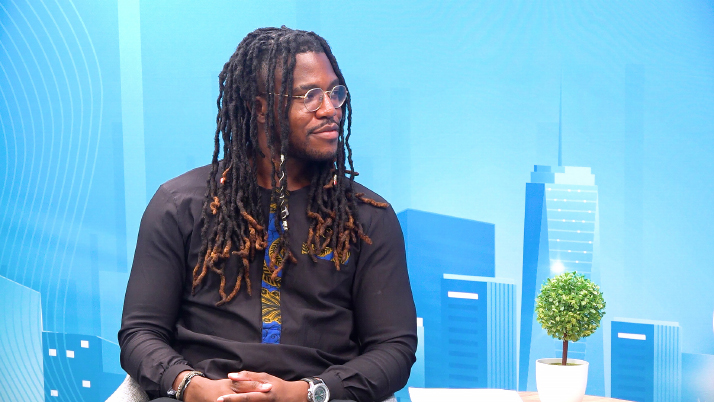
I grew up in middle America—Texas, the deep center of the country. People there want a better society, but many feel they don’t have real choices. It’s a low-trust environment. What we need is to rebuild trust and remember that we’re social beings. None of us can do life alone.
So whether through art or activism, I’m always trying to reconnect people to that simple truth: We need each other, and we’re stronger together.
As a first-time visitor to China, what has surprised you the most or been most different from your expectations—whether it’s the urban landscape, cultural atmosphere or interactions with people?
Honestly, almost everything surprised me. I’m a well-read American, and I always suspected that a lot of what our government and media say about China isn’t accurate. But being here confirmed it—and even went beyond what I imagined. China is beautiful. The cities, the architecture, the level of efficiency—it’s all on a different scale. And one of the first things I noticed walking around Beijing and Shanghai is how clean everything is. In Los Angeles, I’m always watching my feet so I don’t step on something. Here, I don’t even think about it.
I also felt a strong sense of community. In Shanghai, I visited a neighborhood community center, and I was blown away. It had everything: local history, services, study spaces, information for new residents. I’ve lived in Los Angeles for six years and still don’t fully understand my own neighborhood. The idea of a place where you can learn your whole community in one stop? We don’t have anything like that in the U.S.
Another thing: I didn’t see the kind of extreme poverty or homelessness that’s so common in major American cities. That alone tells you a better society is possible. China clearly puts serious effort into housing—so many apartment buildings, but instead of feeling small, you actually feel like part of a community.
The infrastructure impressed me too. Roads, metros, stoplights, everything is efficient and well-maintained. The high-speed rail? Amazing. We don’t have anything even close to it in the U.S. Even construction sites feel organized—always active, never chaotic. In America, a simple pothole can take one or two years to fix because of endless bureaucratic delays and private contractors negotiating for profit. Here, you get the sense that things are done quickly because there’s a unified purpose.
And that’s a huge difference. In China, the government has clear goals—five-year plans, long-term development, poverty eradication, technological progress, promoting culture. It’s utopian in vision but very practical in execution. You can feel there’s a plan for the future.
In America, there’s no grand project like that. Politics is just Democrats and Republicans undoing each other every four years. It’s a system built for gridlock—two groups of capitalists arguing over where to put money, with everyday people forgotten in the middle. There’s no bigger vision for human wellbeing.
Comparing the two makes me realize how deeply moral Chinese society feels, and how directionless my own country often is. Being here gave me a lot of hope. It shows that efficiency, planning and community care aren’t theoretical—they’re real, and they work.
How do you assess the current state of China-U.S. relations, and what do you think drives the tensions? What can both sides do to stabilize the relationship?
From what I see, as a cultural director and media correspondent for the American Communist Party, I say my observation of China-America relations is that it’s not as bad as it used to be. I would say it’s actually quite positive. A big part of that is China becoming much more confident and intentional in how it presents itself to the world.
The real problem isn’t the people—it’s the politicians. Many American leaders want conflict with China because they have no long-term vision for the country. Their only “plan” is keeping America on top, and China’s rise challenges that. So they stir things up—Taiwan, tariffs, hype about “threats”—all to create friction. But ordinary Americans don’t want conflict, and this year especially, more people are seeing the real China for the first time.
Influencers like IShowSpeed, Hasan Piker, Vijay Prashad and many others have visited China and seen a society that actually treats people like human beings. Their audiences back home see that too. Little by little, the mystery is gone, and the propaganda loses its power.
China, on the other hand, has been very steady and very strategic. It understands soft power now—culture, community, hospitality. That approach humanizes China for everyday Americans in a way politics never could.
I also think Black Americans in particular feel a natural connection with China. That’s been true for generations. There’s a sense of mutual respect that doesn’t exist in many other relationships we have.
The deeper issue is that American leaders can’t accept equality. China isn’t trying to be “number one” over everyone—it just wants to be treated as an equal. But U.S. politicians are used to being the only superpower. They like trading with China, but they don’t like the idea of sharing global influence.
Going forward, I think the people—not the politicians—will shape the future of U.S.-China relations. China is building friendships across Africa and the Global South, strengthening its connections. Chinese people will be fine. It’s Americans who need to adjust their mindset and learn that a world with equals isn’t a threat.