Smoke and Mirrors on the Taiwan Question
 Facebook
 Twitter
 Linkedin
 Google +

The U.S. has few cards left to play. As China’s comprehensive national power continues to grow, Washington can no longer guarantee dominance in the Western Pacific.
Traditionally, the U.S. president releases the National Security Strategy (NSS) report at the end of the first year of each term. As a core strategic document guiding U.S. domestic and foreign policy, it influences federal budget allocation and policy priorities, thus drawing considerable global attention.
Beyond Latin America and domestic security, the Indo-Pacific region ranks as the next strategic priority, with the Taiwan question featuring prominently. Across just three paragraphs, “Taiwan” appears eight times—reflecting concerns that extend well beyond security and defense to encompass the semiconductor supply chain. The report emphasizes Taiwan Island’s critical position in the global semiconductor industry, framing it as essential to the technological and industrial security of the U.S. and its allies.
Compared to the previous version, the report adopts a markedly more aggressive posture on the Taiwan question. It asserts that preventing cross-Straits conflict is “best achieved by maintaining overwhelming military superiority,” explicitly elevating “deterring conflict in the Taiwan Straits” to a national strategic priority. It further pledges to build military forces capable of defeating “acts of aggression” anywhere along the “first island chain”—a U.S. geopolitical concept referring to the arc of islands stretching from the Aleutian Islands in the north Pacific Ocean, through the Japanese archipelago, the Ryukyu Islands, and China’s Taiwan Island, down to the Philippines in the Western Pacific. The report also calls on U.S. “allies and partners” within the “first island chain” to grant U.S. forces greater access to ports and facilities, increase their own defense spending, “and most importantly to invest in capabilities aimed at deterring aggression.”
These are far from empty words. Recent developments demonstrate active responses from U.S. “allies and partners” in the region: Japanese Prime Minister Sanae Takaichi’s statement in November that armed conflict in the Taiwan Straits would trigger Japan’s exercise of collective self-defense rights, and the Taiwan authorities’ announcement of a $40-billion plan to build “T-Dome”—an air defense system modeled after Israel’s Iron Dome—both signal concrete alignment with U.S. strategic priorities.
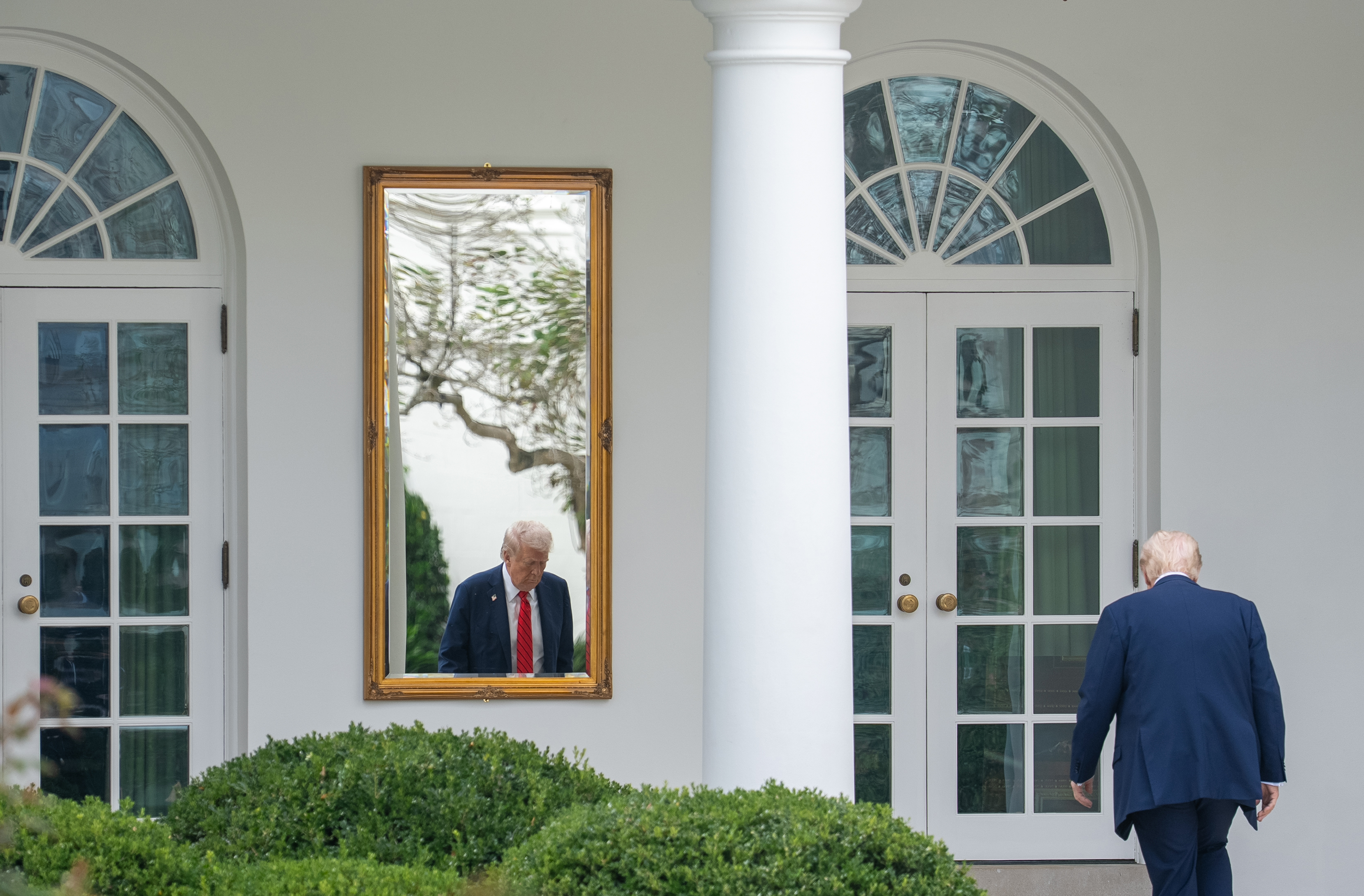
Notably, the Trump administration has recently sent increasingly contradictory signals on the Taiwan question. On one hand, during a November 25 phone call with Chinese President Xi Jinping, Trump acknowledged that the U.S. understands the importance of the Taiwan question to China. Yet just one week later, on December 2, he signed the so-called “Taiwan Assurance Implementation Act (H.R. 1512)”—a measure that mandates periodic State Department reviews to lift restrictions on “U.S.-Taiwan interactions,” deepens “U.S.-Taiwan military ties,” and promotes Taiwan’s participation in international organizations. This approach directly challenges the One-China principle and has drawn strong opposition from China.
From China’s perspective, the Taiwan question is at the very core of China’s central interests, the bedrock of the political foundation of China-U.S. relations, and the first red line that must not be crossed in China’s relations with any other country. For the Trump administration, which seeks to improve China-U.S. relations, testing China on this issue is not an appropriate choice.
On the other hand, the NSS reaffirms that the U.S. opposes unilateral changes to the status quo in the Taiwan Straits by either side—continuing its longstanding declaratory policy of seeking to “maintain the status quo” across the Straits. However, a telling detail emerges in the terminology: Unlike the Biden administration’s 2022 report, which consistently used “PRC” (People’s Republic of China), the Trump 2.0 strategy exclusively employs “China,” which it may think is a broader, more encompassing designation.
Yet this terminology may also reveal a deeper American calculus on the Taiwan question: The U.S. has few cards left to play. As China’s comprehensive national power continues to grow, Washington can no longer guarantee dominance in the Western Pacific. If the U.S. cannot contain China within the “first island chain,” the most pragmatic course may be to extract maximum strategic value from the region—and ultimately use the “first island chain” itself as leverage in negotiations with China.
This also explains why Washington has pressured Japan, the Republic of Korea and especially Taiwan region to relocate semiconductor manufacturing to the U.S., while simultaneously expanding arms sales throughout the region. On the Taiwan question, the U.S. is engaged in strategic bluffing—needing to appease domestic China hawks and the military-industrial complex, while projecting confidence to its allies. In reality, however, Uncle Sam is searching for an optimal exit strategy. Yet the mixed signals it sends are drawing its so-called “partners” deeper into a geopolitical vortex.