A Sweet Bond: From Chilean Orchards to Chinese Tables
 Facebook
 Twitter
 Linkedin
 Google +
The significance of the friendly China-Chile relations is that it proves countries of different sizes, different systems and far apart can indeed establish a high level of mutual trust and maintain a focus on common development through mutual respect, equality and mutual benefit.
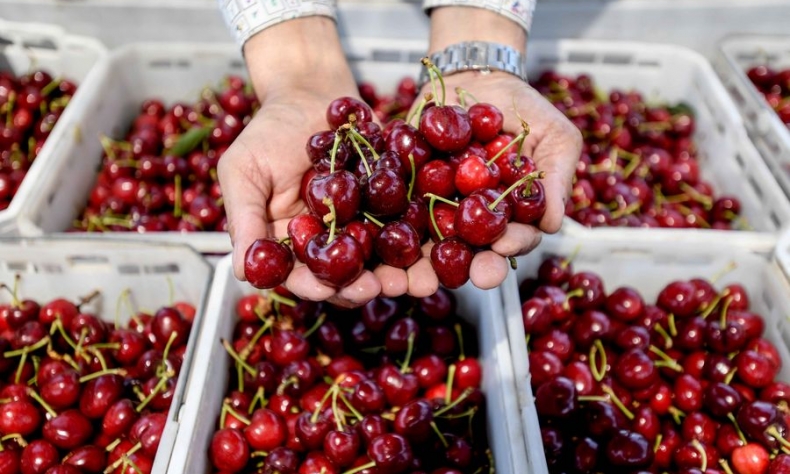
The peak sales season for Chilean cherries in China commenced on December 5, highlighted by the arrival of the first Cherry Express vessel for this year’s cherry season at Nansha Port, Guangzhou, capital of Guangdong Province in south China, laden with roughly 370 containers. The event was launched by Frutas de Chile (“Fruits from Chile”), the Latin American country’s principal fruit export organization, with a documentary premiere in Guangzhou to kick off the 2025-26 season.
To many Chinese, Chilean cherries symbolize both Chile and the robust friendship between the two countries. As China’s top supplier, providing over 90 percent of cherry imports, Chile’s seasonal harvest from November to February arrives just as domestic production ends, coinciding with the Spring Festival, China’s largest annual celebration and a time for family gatherings. This “direct supply from southern orchards to northern festival tables” is more than a mutually beneficial business; it is a people-to-people bond. The sweet journey from farm to dining table underscores the deep warmth of bilateral cooperation.
The two countries formally established diplomatic relations on December 15, 1970. Chile was not only the first South American country to establish diplomatic ties with China, but also achieved a number of “firsts:” It was the first Latin American country to sign a bilateral agreement with China on the latter’s accession to the World Trade Organization in 2001, to recognize China as a full market economy and to sign with China a bilateral free trade agreement. Over the past 55 years, the relations between both nations have developed steadily and never fluctuated due to changes in the international geopolitical landscape.
Political mutual trust is the foundation of China-Chile friendship. The two countries have established an intergovernmental permanent committee. The China-Chile Joint Economic and Trade Commission has held 21 meetings so far, and the China-Chile Joint Committee on Intergovernmental Cooperation in Science and Technology has held 10. The two countries have also established a mechanism for strategic dialogue for economic cooperation and coordination, which has held four meetings to date.

All these demonstrate the close ties and frequent, smooth communication between the two governments. On May 14, President Xi Jinping met with Chilean President Gabriel Boric, who was in China to attend the Fourth Ministerial Meeting of the China-CELAC (Community of Latin American and Caribbean States) Forum in Beijing. Xi stressed that China is ready to work with Chile to consolidate political mutual trust, uphold mutual respect, treat each other as equals, pursue mutual benefit and win-win results, enhance exchanges on governance experience, firmly support each other on issues related to their respective core interests and major concerns, and safeguard their respective sovereignty, security and development interests. Boric said that Chile attaches great importance to its relations with China.
China-Chile economic and trade cooperation maintains strong momentum, with China serving as Chile’s largest global trading partner, export destination and import source. This partnership grants Chile access to a vast market and technological support, deepening collaboration across sectors. Amid a new technological revolution, bilateral cooperation continues to strengthen in emerging fields such as the digital economy and green energy.
The two countries maintain a high degree of synchronization in the United Nations, Asia-Pacific Economic Cooperation and other international organizations, and jointly safeguard multilateralism. They also conduct close exchanges in fields including astronomy, Antarctic scientific research, culture and education. On November 28, the Confucius Institute, a non-profit public educational organization that partners with local universities worldwide to promote Chinese language and culture, at Chile’s University of Magallanes was inaugurated. It is currently the world’s southernmost Confucius Institute by latitude and Chile’s fourth.
Looking back on 55 years of wide-ranging exchange between the two countries, Chile has a forward-looking perspective among Latin American countries on cooperation with China, while China also considers Chile an important partner.
The significance of the friendly relations between the two countries is that it proves countries of different sizes, different systems and far apart can indeed establish a high level of mutual trust and maintain a focus on common development through mutual respect, equality and mutual benefit.