The Island That Can
 Facebook
 Twitter
 Linkedin
 Google +
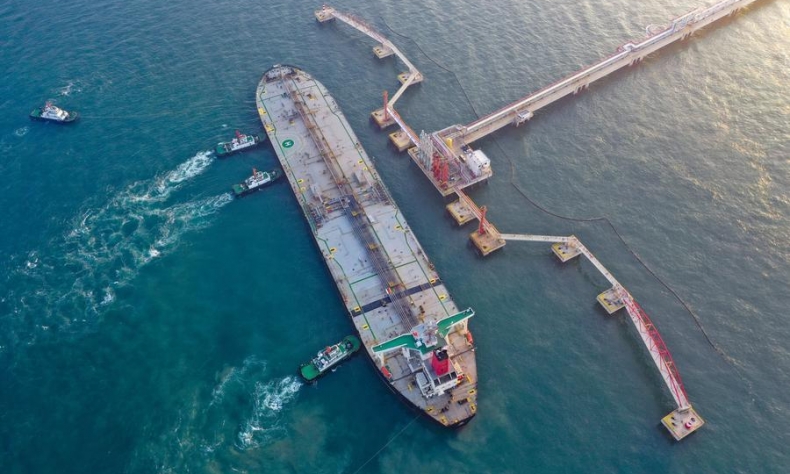
By facilitating the flow of data, talent and capital, Hainan aims to become a key junction in the global network of trade and opportunity.
A new frontier has been drawn in Hainan—not in concrete, but in policy. The southern island province, the world’s largest free trade port (FTP) by area, officially began operation as a fully independent customs territory on December 18, 2025.
At the Dun & Bradstreet (D&B) China office in Haikou’s Fullsing Internet Industrial Park, a large screen displays real-time requests for global corporate verification. D&B’s China President, Wu Guangyu, recently approved an application for a D-U-N-S Number—a unique nine-digit identifier for businesses, which stands for data universal number system. It can help potential partners and lenders learn about a business.
“When the Hainan Free Trade Port master plan was announced in 2020, we recognized tremendous potential demand,” Wu told Beijing Review. “Many international firms want to enter Hainan, and just as many local companies are preparing to expand overseas.”
The launch of the island-wide customs operation does not signal a closing off, but rather a new frontier of openness. Through policy innovation, Hainan is strengthening core industries such as technology, healthcare, digital services and cultural tourism. The goal is to build a hub for new quality productive forces—a term that refers to China’s push toward innovation-driven, technology-led and high-quality growth across all economic sectors. By facilitating the flow of data, talent and capital, Hainan aims to become a key junction in the global network of trade and opportunity.
The confidence of being unique
Not long ago, Josef Gregory Mahoney, a professor of politics at the School of Politics and International Relations at East China Normal University and Executive Director of the International Center for Advanced Political Studies, emphasized in an interview with newspaper Hainan Daily: “You sometimes hear people say that it’s not far-fetched to imagine Hainan becoming a next Dubai. In fact, Hainan will never be a next Dubai,” he said. “Hainan is unique because it will be the world’s largest free trade port. It creates unique, unparalleled opportunities for investment as well as what we can rightly assume will be further liberating policies.”
This uniqueness is translating into tangible policy dividends. Starting December 18, the scope of zero-tariff policies has been greatly expanded—the vast majority of imported goods, from high-end scientific research equipment and biomedicine raw materials to daily consumer goods and production materials, will now enter Hainan exempt from tariffs, import value-added tax, and consumption tax.
Furthermore, enterprises registered and operating in Hainan are subject to a corporate income tax rate of 15 percent. Compared to the common 25-percent rate in other parts of the Chinese mainland, this is highly competitive. The individual income tax policy is also attractive. For high-end and urgently needed talents working in Hainan, the portion of their individual income tax burden exceeding 15 percent is directly exempted—a policy with clear advantages for attracting global talent.
Hainan also implements the country’s shortest negative list for foreign investment, a list that clearly defines sectors or industries where foreign investment is restricted or prohibited, lowering barriers for foreign capital in sectors like finance, education, healthcare and culture. This is more than just a change in tax numbers; it means a hesitant investment project could become profitable because of it.
A port for data
The establishment of D&B in Hainan is considered a landmark event. The 180-year-old U.S.-based commercial data services provider set up a key Chinese operational node in Haikou in 2022. “As a hub for Hainan’s digital economy, Fullsing Internet Industrial Park is the best platform for us to connect with clients,” Wu explained.
To date, D&B Hainan has issued D-U-N-S Numbers to over 160,000 enterprises. More notably, relying on Hainan’s special policy of “secure and orderly cross-border data flow,” D&B can process global data from its Hainan base, including data from nearly 260,000 Hong Kong enterprises.
“We anticipate that after the launch, trade volume will become very brisk, and demand for D&B’s future products will also flourish,” Wu said. “With the operation of the Hainan FTP, D&B will also welcome more ecosystem partners from our industry to jointly create more data application scenarios.”
In a livestreaming studio in Fullsing Internet Industrial Park, Pakistani host Usman has just finished a late-night broadcast. Benefiting from Hainan’s policies on secure, orderly cross-border data flow and relaxed regulations for foreigners working in China, he has become a well-known cross-border live-commerce host in the park, experiencing firsthand an open business environment that facilitates buying from and selling to the world.
This evolution is anchored in coherent policy frameworks. In late 2024 and early 2025, regulations supporting the digital economy and cross-border data flow took effect, followed by the release of a cross-border negative list. “The negative list covers five major fields: deep-sea, aerospace, seed industry, tourism and duty-free retail,” a local cyberspace affairs official told Beijing Review. “Compared to a positive list, a negative list is more convenient and helps optimize the business environment for the digital economy.”
Wu Qingji, Industrial General Manager of the Fullsing Internet Industrial Park, confirmed this trend with data: “Over the past few years, our park has cumulatively served over 100 overseas investment projects, with a total outbound investment filing amount exceeding $3 billion, mainly concentrated in the Internet and new energy-related industrial chains.”
The skies and the deep sea
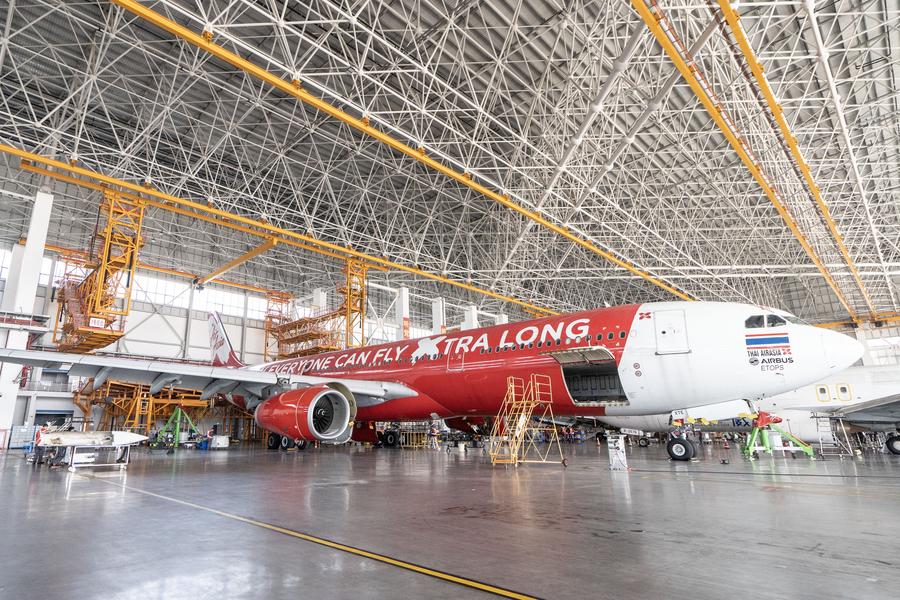
Changes brought by the customs operation are also appearing in physical spaces. At the one-stop aircraft maintenance industrial base in the Haikou Airport Comprehensive Bonded Zone, workers from Haikou Airport Aircraft Maintenance Engineering Co. Ltd. are currently performing a full-body repaint on a wide-body jet for Qatar Airways.
“Bonded aircraft maintenance is a game-changer!” Wang Haiye, General Manager of the company told newspaper People’s Daily. “Inbound repairs are exempt from deposit requirements, the bonded aviation materials supermarket is well-stocked, and our wide-body repainting speed is over twice as fast as that of our counterparts.” The quality service led Qatar Airways to finalize a three-year cooperation agreement.
In the first 10 months of this year, the value of bonded maintenance at Haikou Airport Comprehensive Bonded Zone surged to 47.86 billion yuan ($6.8 billion), up 71.8 percent year on year. This growth is fueled by streamlined processes—from pilot supervision for temporary repairs to fast-track customs clearance—enabling Hainan to serve as a global hub for aircraft maintenance. Through such institutional innovation, the free trade port is accelerating the flow of people, goods and capital across the island.
Meanwhile, in south Hainan, opening up is advancing in another dimension. Yazhou Bay has gathered top national agricultural research capabilities, building a “Silicon Valley for the seed industry” to safeguard national food security. Relying on the Institute of Deep-sea Science and Engineering under the Chinese Academy of Sciences, the province is forging ahead into the blue economy, including deep-sea technology and marine pharmaceuticals. Also, every launch at Hainan’s Wenchang Spacecraft Launch Site is propelling the rise of China’s commercial aerospace industry.
Wider openness
Data from the Boao Lecheng International Medical Tourism Pilot Zone shows it has taken the lead in introducing over 520 kinds of internationally innovative pharmaceuticals and medical devices. From January to October, the zone received 564,900 medical tourism visits, an 81-percent year-on-year increase.
“Within the FTP context, international personnel flow is more convenient,” Yan Lukai, Director of the Medical Tourism Department under the pilot zone’s administrative bureau, said. “Hainan’s unique climatic and environmental advantages are important factors attracting domestic and international patients. The favorable climate aids patient recovery. Meanwhile, advantages in product import and export make medical costs and the introduction of medical technical talent more competitive.”
At the Sanya Traditional Chinese Medicine Hospital (Sanya TCM Hospital), foreign tourists can also experience acupuncture and massage. The hospital has established four AI-powered remote consultation platforms and set up three TCM centers overseas, achieving integrated development of culture, tourism and wellness. In the first 10 months of this year, the hospital treated 8,288 foreign patients, a 40.83-percent increase year on year.
Hainan’s cruise and yacht industries are entering a golden age of high-quality growth, driven by pioneering policies such as zero tariffs for yachts, simplified entry for private vessels, and multi-port clearance for foreign cruise ships. These measures are attracting top-tier international resources and building practical expertise to support the continued evolution of the FTP.
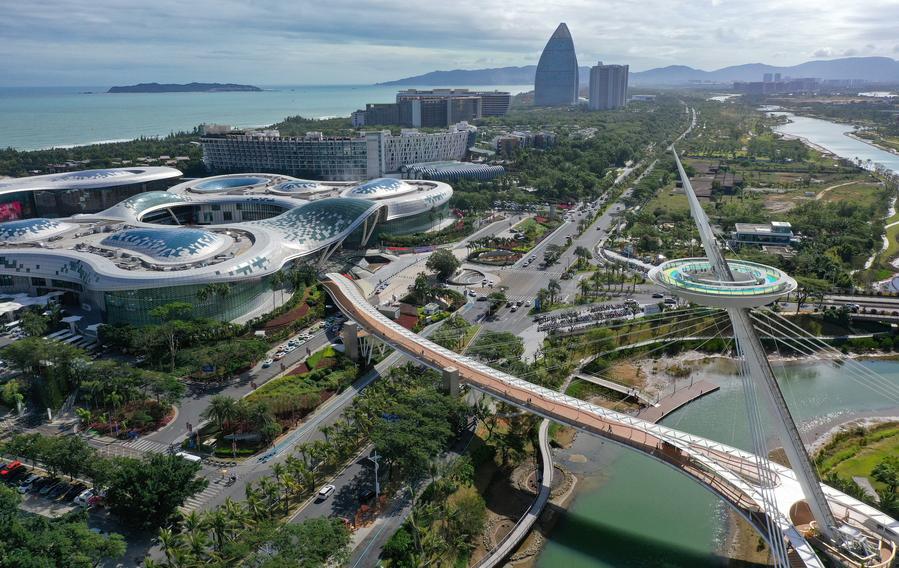
A telling example came on the morning of November 24, when the Norwegian Endeavor—carrying over 1,800 international passengers—docked at Sanya Phoenix Island International Cruise Terminal. Using an expedited clearance system for large ships, passengers cleared customs in just 10-15 seconds on average. Hosting China’s first dedicated cruise hub, Sanya has cultivated a mature ecosystem, with more than 20 related enterprises now established and over 30 international cruise lines regularly calling at its port.
From January to October, Sanya recorded over 190,000 yacht voyages and welcomed 1.07 million yacht tourists, both representing a year-on-year growth of more than 15 percent—a clear sign of a virtuous cycle taking shape. With the full launch of the FTP, policies like multi-port cruise access and zero tariffs on imported yachts will provide continued momentum, propelling Sanya’s cruise and yacht industries to new heights.
Underpinning all these measures is a robust legal framework. The Hainan Free Trade Port Law enacted in 2021 has codified key policies into national legislation, granting the island greater autonomy for reform. This rule-of-law foundation provides the stability and predictability highly valued by international capital. Mechanisms for international commercial arbitration and mediation are being strengthened in parallel.
The construction of the Hainan FTP is guided by a clear three-step blueprint: initial establishment by 2025, greater maturity by 2035, and full completion by mid-century.
The independent customs operation was launched without fanfare, yet its impact is already tangible, in automated tax processing, real-time data exchange, adjusted international flight schedules and more global conversations.
“For people who are coming to this place now and building positions here, it will position them well for the growing opportunities inevitably coming,” Mahoney said in his interview. That future is already taking shape. As the hands of history turn, a new tide rises over this land of endless summer. For Hainan, this is not an ending—it is where the story truly begins.