China’s Expanding Horizon: How a Fast-Rising Space Sector Is Changing the Global Orbit
 Facebook
 Twitter
 Linkedin
 Google +

China’s commercial space industry has grown from early experiments into one of the busiest in the world.
China’s space program is moving forward quickly, thanks to a clear national strategy and a fast-growing commercial sector. What started as a careful, government-led project has become a lively mix of scientific research, new technology, affordable launch services, and bold missions to other planets. With a permanent space station in low-Earth orbit, continuing missions to the Moon and Mars, reusable rockets in the works, and busy launch centers in Hainan and Gansu, China is catching up in a field that used to be led by the United States. By combining long-term planning with quick action, China is changing both its own path and the global space landscape.
From low earth orbit to deep space
China’s Tiangong Space Station is now the center of the country’s human spaceflight goals and shows its scientific progress. Finished in 2022, Tiangong orbits at about 340 to 450 kilometers above Earth and hosts rotating crews of taikonauts who run experiments in areas such as microgravity, materials, space medicine, cold-atom science, and climate research. Its modular design means new labs and systems can be added over time, growing China’s research abilities in space without stopping current work. Since China fully funds and runs Tiangong, decisions are made faster and with more independence than on the International Space Station, making Tiangong a lasting presence in low Earth orbit.
China’s activities in space now have reached the Moon as well. The Chang’e missions have put China at the forefront of lunar exploration, achieving the first soft landing on the far side of the Moon and bringing back samples. Future missions similar to Chang’e-7 and Chang’e-8 will explore the lunar south pole and test new technology for a possible future base, the International Lunar Research Station. These projects show China’s goal of creating permanent lunar facilities that can support its own science and work with other countries.
China is also making progress in exploring Mars. After landing the Zhurong rover in 2021, China is planning the Tianwen-3 mission to bring back samples from Mars, with a launch expected in 2028 and a return around 2031. If successful, China would be one of the first countries to collect Martian soil and rock, helping scientists learn more about Mars’s geology and possible past life. China is also working on missions similar to Tianwen-2 to collect samples from asteroids and is considering exploring the outer planets, showing its aim to achieve more in deep-space science.

Launch infrastructure and the commercial ecosystem
A big reason for China’s progress is its reliable ability to launch equipment into space. Key sites like the Wenchang Space Launch Site and the Jiuquan Satellite Launch Center support both government and commercial missions.
Wenchang is China’s newest launch site, located on Hainan Island. Its position near the equator lets rockets carry heavier loads. Wenchang is used for launching China’s biggest rockets, including several Long March models. Important parts of the Tiangong station and major missions to the Moon and Mars have launched from here. The site has become a key aerospace center, with facilities for building, testing, and integrating rockets for both government and private projects.
While Wenchang is used for heavy-lift missions, Jiuquan, near the border between Inner Mongolia and Gansu, is leading China’s commercial launch growth. It was once mainly for crewed missions, but now private companies like LandSpace, with its methane-powered Zhuque-2E rocket, and Galactic Energy, which runs Ceres-1 rockets, use Jiuquan to launch satellites for both Chinese and international customers. New companies such as iSpace, Space Pioneer, and Deep Blue Aerospace are testing engines, reusable technology, and new rockets here to launch more often and lower costs. Although reusing the first stage is still being developed, these activities show China’s focus on affordable commercial space infrastructure.
Wenchang and Jiuquan each play different roles: Wenchang handles heavy, complex missions, while Jiuquan focuses on quick, commercial, and new launch types. Together, they show that China’s launch activity is growing rapidly and supporting a more diverse space economy.
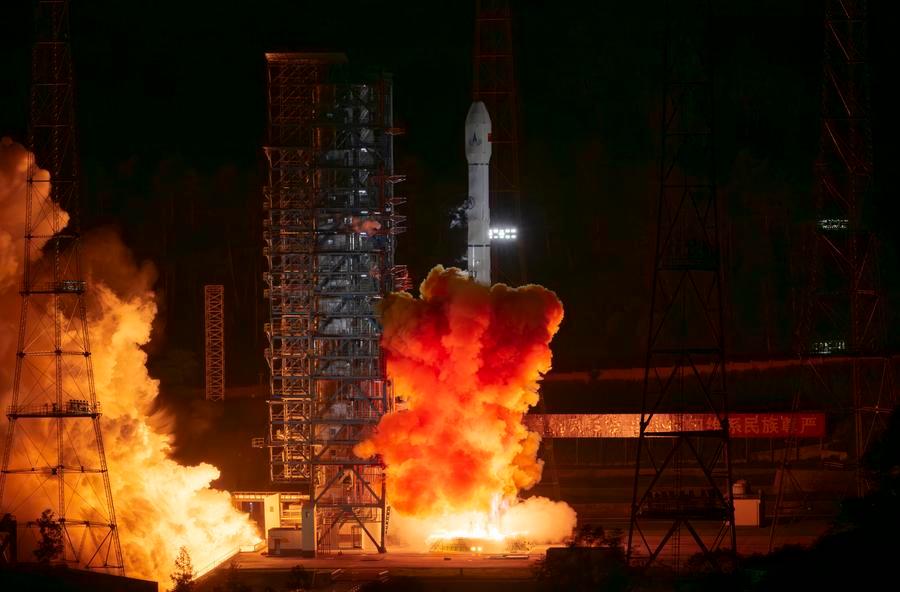
Xichang and Taiyuan are also key satellite launch centers in China. On December 9, 2025, China successfully launched from Xichang Satellite Launch Center the CZ-3 rocket which sent the telecom satellite 22 to orbit. On December 16, 2025, again, China successfully launched from Taiyuan Satellite Launch Center the CZ-4 rocket and sent the resource satellite ZY-3 to orbit.
Commercial satellites and dual-use capabilities
China’s commercial space industry has grown from early experiments into one of the busiest in the world. Thanks to regulations that encourage private investment, local government programs, and partnerships with big state-owned companies, private firms now play key roles in launching rockets, building satellites, providing remote sensing, developing propulsion systems, and providing in-orbit services. Many of these companies are working on reusable rockets to make launches much cheaper.
Satellite technology is another key part of China’s commercial space growth. Companies and research groups are launching remote-sensing satellite groups, hyperspectral and radar satellites, and new communication networks that aim to compete with global broadband systems. These satellites help with things like environmental monitoring, farming, logistics, and climate research, and also provide secure communication and defense abilities. As it gets cheaper to launch and build satellites, China is becoming a global provider of affordable, dual-use space services, making it easier for other countries to get cost-effective solutions.
Charting a new competitive orbit
China’s government and commercial space programs are working together more closely than ever. Results from Tiangong, experience from Moon and Mars missions, the strong launch sites at Wenchang, Jiuquan, Xichang and Taiyuan and the drive of private companies all feed into a cycle of growing skills and new ideas. China’s progress comes not just from big goals, but from actually carrying them out — through frequent launches, quick improvements, and a mix of government planning and private innovation.
As the world changes, China is becoming a major player in the next phase of space exploration and business. The competition is now about more than just getting to orbit — it’s about building the systems, partnerships, and business models that will determine the future of space. With more frequent launches, new scientific discoveries, and a strong commercial sector, China is at the forefront of this new space era.