The Rise of Embodied Intelligence: How China Is Shaping the Future of AI in the Physical World
 Facebook
 Twitter
 Linkedin
 Google +
There may never have been a better time or place in history to be a tech hardware entrepreneur than one in China right now.
The Chinese equivalent of Oxford’s “Word of the Year” was announced this month. Near the top of language magazine Yaowen Jiaozi’s list of defining phrases was “embodied intelligence” (ju shen zhi neng).
This term, which refers to AI that exists in a physical space (think: robots, autonomous vehicles, drones), tells you exactly where the national conversation and investment are headed in China.
The “intelligence” part of that equation has achieved world-class status in 2025. The year started with Chinese AI startup DeepSeek releasing foundational models. The year ended with open-source models from Chinese developers accounting for roughly 17% of global downloads, surpassing the U.S. share of 15.8% for the first time.
But what is more remarkable than these software triumphs is the national drive to embed this intelligence in the real world. That focus is why Yaowen Jiaozi elevated the term to a defining phrase.
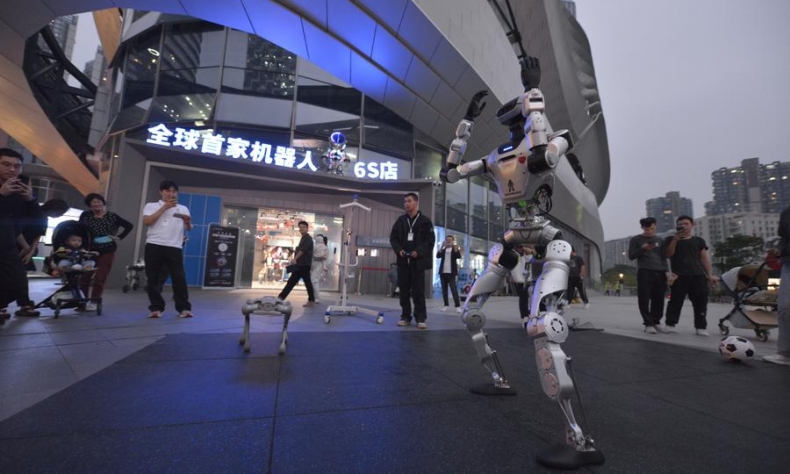
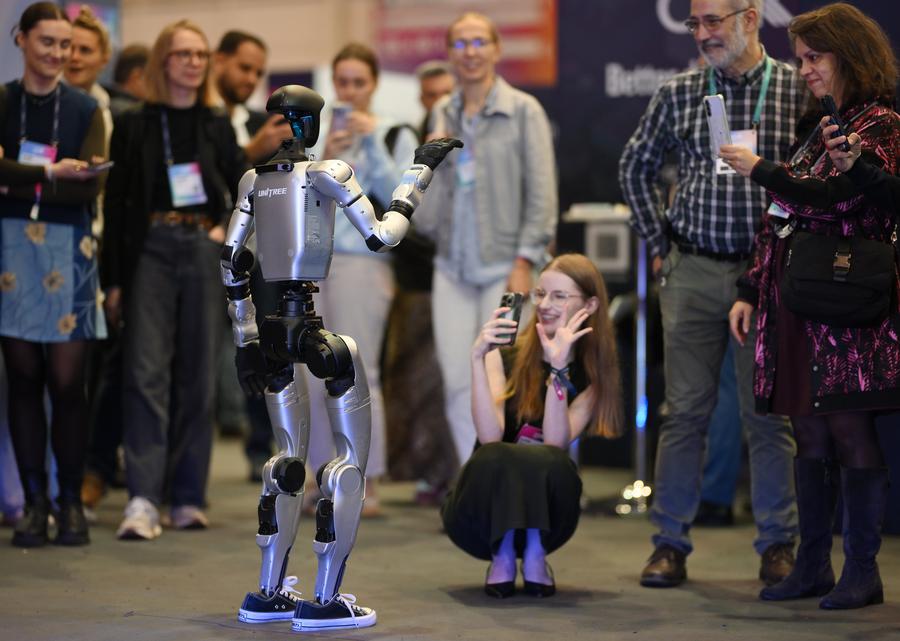
It has been a consequential year. Chinese robotics firm Unitree has captured global attention with its humanoid robots. The World Humanoid Robot Games in Beijing showcased capabilities that would have seemed like science fiction a few years ago. Autonomous driving systems are spreading fast. Then there’s the “low-altitude economy,” which basically means drones doing everything from deliveries to agriculture. It’s projected to hit $211 billion this year.
So why is China pulling ahead?
I found myself thinking about this at the XIN Summit in Shenzhen last month, a conference dedicated to the city’s thriving AI hardware sector. The exhibitor floor told the story: robotic hands, AI-powered massage rollers, smart fish tanks. AI crammed into everything imaginable. Then it hit me: There may never have been a better time or place in history to be a tech hardware entrepreneur than one in China right now.
That’s a strong claim. But consider what’s converging: a government that treats startups as a policy priority, supply chains dense enough to go from sketch to prototype in days, and a public that’s excited about automation rather than anxious. Ambitious founders exist everywhere. But very few have ever had a runway like this.
This marriage of state planning and entrepreneurial drive is the structural force that will make 2026 the inflection point for China’s embodied AI sector.
Let’s start with government support. Beijing is putting concrete backing into AI hardware enterprises. Tax deductions for companies’ R&D costs, a 500 billion yuan ($69 billion) fund targeting AI and digital projects, and a range of local government initiatives are among a few examples.
More critically, the 15th Five-Year Plan (2026-2030) for Economic and Social Development, places “new quality productive forces” at the center of China’s development strategy. This translates directly into innovation-driven, technology-powered growth. For AI hardware startups, there is now guaranteed alignment between policy priorities and market opportunity.
The second pillar, especially for hardware startups, is China’s supply chain, which is unparalleled anywhere on earth.
Within a 40-kilometer radius of central Shenzhen, you can source virtually any electronic component, access rapid prototyping, and find manufacturers who specialize in small-batch runs. What takes weeks elsewhere happens in days here.
Think about what this means in practice. For a California-based hardware startup, sourcing components means navigating international logistics, managing time zone differences and enduring extended lead times. A Shenzhen startup needs only to take a trip across town. Chinese teams can test, fail and iterate at a pace their American counterparts simply cannot match.
There is a final factor that’s harder to quantify and not really talked about, public trust and enthusiasm for AI.
China is a welcoming place for new tech. Compare that with the U.S., where skepticism runs deep. Gallup found that only 23% of Americans trust businesses to use AI responsibly. Just 6% think AI will be “very positive,” according to a YouGov survey.
This has very real consequences, ranging from slow adoption to, occasionally, arson. Waymo robotaxis in Los Angeles have been repeatedly vandalized. Several were set ablaze during protests this year after becoming a target of public anger.
While Waymo doesn’t release precise figures, the resulting cost of damage, insurance liability and security upgrades surely represents a nontrivial cost of doing business in American cities. These are headwinds that Chinese competitors, such as WeRide and Pony.ai, simply don’t face on their home turf.
The friction extends to the low-altitude economy. A man in Florida shooting down a Walmart delivery drone in 2024, believing it was spying on him, is a clear indicator of the public resistance and regulatory trouble ahead for America’s deployment of drone systems. Funnily enough, while “embodied intelligence” was one of China’s words of the year, Oxford went with “rage bait.” The term describes online content designed to stoke outrage. The kind of stuff that nurtures the paranoid worldview of someone who sees a Walmart drone and reaches for a shotgun.
Physical AI systems require public buy-in to operate at scale. Without broad public acceptance and credible guarantees against vandalism, physical AI systems cannot be deployed at scale even if the technology itself is ready.
So, if I had to place a wager, here’s where I’d put my chips: The U.S. will remain competitive in AI development. But the integration of that software with physical systems (the embodied layer) decisively favors Chinese entrepreneurs operating within their unique ecosystem.
By 2026, this asymmetry will become visible not just in statistics but in the actual robots, vehicles and autonomous systems deployed across cities and factories. The gap will be hard to miss.
Jay Ian Birbeck is a freelance writer based in Guangzhou.