Where History Comes Alive
 Facebook
 Twitter
 Linkedin
 Google +
Today, Xinjiang has become a living model for the coexistence of civilizations and the intermingling of identities with its unparalleled historical richness and cultural diversity.
Located in the heart of the vast Asian continent, along the legendary stretch of the ancient Silk Road, Xinjiang stands as one of the most prominent and important cultural hubs. It was not merely a transitory stop but witnessed a deep interaction and unique blending of multiple great cultures over thousands of years.
Xinjiang has long represented a pivotal historical nexus, embracing the human, civilizational and intellectual currents that passed through this celebrated trade route, connecting ancient China with Europe and the Middle East.
For centuries, Xinjiang was not just a logistical transit point, it evolved into a permanent home for cultures that settled there, leaving their rich imprint. This cross-pollination contributed to the formation of a civilization with a unique character—multi-rooted and diverse in identity, rich in its human content, and distinct in its architectural and social composition.
Today, the region has become a living model for the coexistence of civilizations and the intermingling of identities with its unparalleled historical richness and cultural diversity.
Xinjiang’s composition
Upon our arrival at the Kashi (Kashgar) Laining International Airport, there was no time to waste. As soon as we exited the arrivals gate, we were welcomed by Anyi, a local tourism promotion representative, with a warm smile. She immediately guided us toward the luxury car designated to transport us to our hotel, signaling the start of a well-planned exploratory journey.
During the drive from the airport to the hotel, I was immediately struck by a unique linguistic and visual phenomenon: the diversity of languages on the street signs and main roads. They were written in standard Chinese, alongside a language written in Arabic script, and sometimes English.
This diversity was not just a fleeting linguistic difference; it was strong, tangible evidence of a long history of coexistence and deep demographic mixing among the peoples of the region.
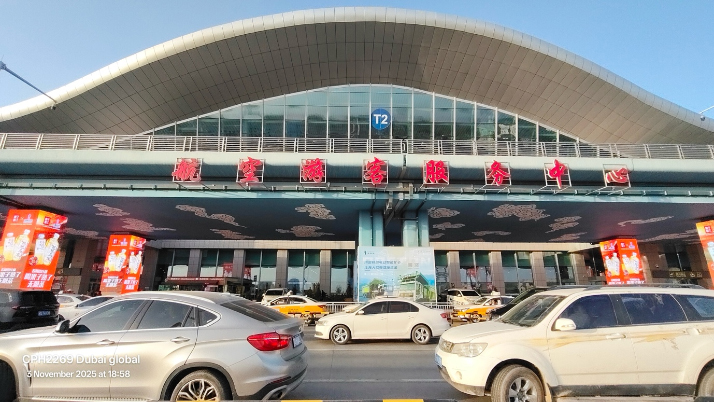
We asked Anyi about the reason for this extensive linguistic variety. She then shared a piece of information vital to understand the region’s composition: The majority of its residents are descended from multiple minorities. Some are the descendants of the peoples who traveled the Silk Road artery and settled over time in this fertile region, and they still use their own languages.
Upon reaching our hotel, we found ourselves in a vast, integrated tourist complex, surrounded on all sides by meticulously landscaped green gardens. The hotel comprised several interconnected buildings, including equipped conference halls and various service facilities catering to all needs. The rooms were spacious and carefully designed, with the interior blending contemporary modernity with the authentic local architectural character.
I was experiencing hospitality carefully considered to the highest degree, revealing a profound culture that values and excels at welcoming guests—a trait for which the Chinese have been generally known for centuries.
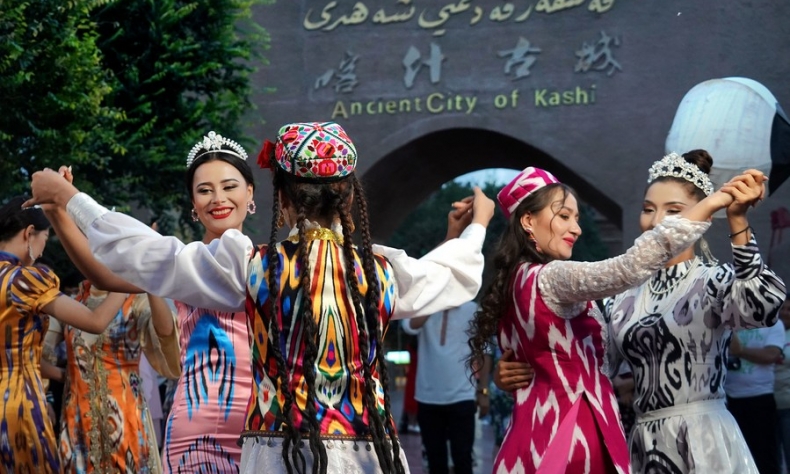
Our first exploratory visit was to the charming square of the Ancient City of Kashi, where a massive, traditionally styled and opulent gate welcomes visitors. What made the visit exceptional was not the structure alone but the impressive daily ceremony held just before the main gate is opened to the public.
Almost every morning—unless the weather is rainy, preventing gatherings—musical and dance troupes, dressed in their elaborate folk costumes, line up to present a lively artistic performance that simulates the city’s rich history and inherited folk tales in a creative and captivating spectacle.
We witnessed a performance related to the fabled character Juha, or Mullah Nasruddin as he is known in Persian culture, who is called Al-Afandi in the local Uygur heritage. A man with a satirical wit, he resolves the problems of the villagers with his wisdom.
The scene was met with admiration and appreciation from everyone, representing a cultural and humorous extension that transcends borders and nationalities in a shining example of shared heritage.
A model of coexistence
Upon entering the Ancient City of Kashi after the gate opened, we discovered another world awaiting us, a series of traditional shops specialized in copper manufacturing and intricate handicrafts. Skilled artisans worked with precision, carving complex patterns with astonishing accuracy.
Perhaps the inherited craftsmanship, with such a high degree of precision and skill and passed down through generations, is what sets Chinese workers apart in their trade. We also visited a number of preserved heritage houses, which demonstrated the residents’ commitment to preserving the details of their daily lives and passing them down to future generations.
One of the most notable and important stops on our journey, reflecting China’s commitment to preserving cultural and religious diversity, was the visit to the Xinjiang Islamic Institute.
This monumental establishment, founded in 1983, is a complete city in itself, housing modern facilities for educating and graduating qualified preachers and imams, in addition to a large mosque. The institute provides a complete living environment for students, offering three meals alongside accommodation in student dormitories.
The central authorities provide fixed monthly allowances to all students and also cover all operational and financial obligations, providing a stable educational environment that supports the dissemination of moderation.
One experience that enriched our perspective on local culture was the visit to the Kashi Prefecture Hospital of Traditional Chinese Medicine. This advanced facility uses exclusively traditional medicine and natural herbs. The doctors possess long experience in natural therapy and prescribing herbs, following documented scientific studies on the therapeutic properties of the plants used in the region.
This type of treatment is not limited to physical healing; it gives the patient a deep sense of reassurance and confidence in the power of nature, reflecting the region’s strong connection to its ancient health heritage, which represents an authentic part of its identity.
The visit to the museum dedicated to the fight against terrorism and extremism was one of the most important stops for deepening the geopolitical understanding of Xinjiang. This massive museum documents the history of the difficult events in the region, presenting documents and evidence unknown to many.
I left the exhibition with the impression that the widespread and often adopted media image of Xinjiang does not accurately reflect the actual and complex reality. This makes a visit to this place imperative to understand the truth of what transpired and the security challenges the region faced.
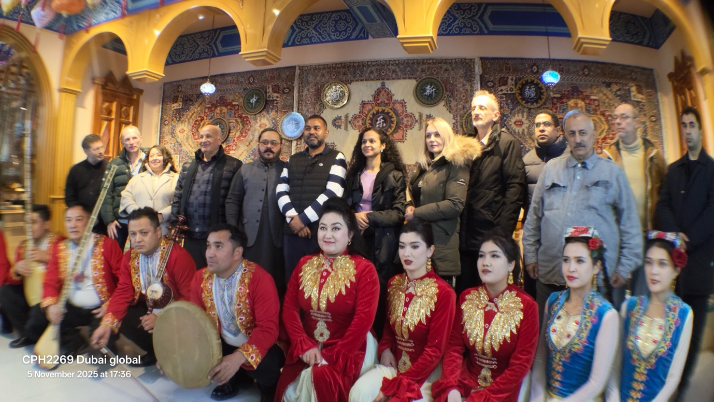
No trip to Xinjiang would be complete without a visit to Tuwankewukushake, a village in Shufu County known for making Uygur musical instruments. Upon entering the outdoor plaza, you are immediately greeted by live musical performances and dazzling folk dances.
Inside the museum in the village, the instruments are handcrafted with consummate artistry, and you have the opportunity to watch the makers at work. There are detailed explanations about the history, origin and complex manufacturing methods of each instrument. They are not merely instruments but an artistic craft whose roots extend back hundreds of years, telling the story of a rich musical culture.
The visit to Tianchi Lake was one of the most beautiful stops on the journey offering space for contemplation. This is a captivating natural lake formed from snow on the towering peaks of the Tianshan Mountains. The clear blue waters surrounded by trees still covered with a light layer of snow, with a warm sun illuminating the place, created a rare natural tableau. Riding a boat across the lake was an unforgettable experience.
The spectacular conclusion to the trip was a grand theatrical show, A Thousand Memories of the Silk Road, with spectacular artistic design, choreography and flawless execution by the dancers. This high level drew attention to the artistic and cultural renaissance in the region.
I left China with the feeling that what I discovered is but a small point in a vast civilization spanning thousands of years. This first journey to this vibrant region made me look forward to returning again to explore more of its ancient history, its living heritage, and, most importantly, to interact with its friendly people.
The author is founder and CEO of the Dubai Global News Media Group.