The U.S. War on Caracas
 Facebook
 Twitter
 Linkedin
 Google +
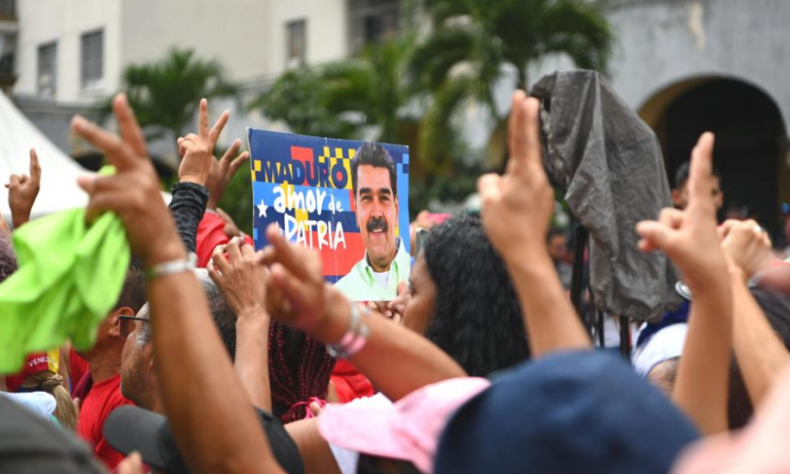
As the events in Venezuela unfold, it is indispensable to remember that this assault is not simply on Venezuela and its government; it is an assault on all of us who fight for sovereignty and against hegemonism.
The U.S. bombing of Caracas, Venezuela, and kidnapping of its democratically elected president Nicolás Maduro in the early hours of January 3, of course, violated an international law regime that the U.S. Government has never had much respect for. Nonetheless, the openness of the discourse surrounding the U.S.’ imperial bellicosity is novel in the modern era.
The campaign against Venezuela began with discourse about drug trafficking and the Cartel de los Soles, an entity whose existence is unsubstantiated. The hollowness of these justifications was quickly apparent, as online commentators would make note that there are no labs to make drugs in Venezuela, and no significant volume of drugs flows through the country into the U.S.
A comparable strategy can be seen in U.S. accusations against China regarding fentanyl. In both cases, unsubstantiated drug-related narratives are deployed to legitimize coercive measures against a sovereign state.
All about oil?
The social media reaction to the U.S. Government’s discourse focused on the fact that Venezuela has the largest proven oil reserves in the world. Describing Venezuela as Iraq 2.0 has been popular in U.S. social media discourse in recent weeks as the Trump administration’s belligerence has escalated. This is a war that has been ongoing—primarily through sanctions—since the Chavista revolution led by former President Hugo Chávez in 1999.
As the discourse of these alternative economic motives became dominant on social media, a shocking turn of the imperial narrative occurred. In a post made on U.S. President Donald Trump’s own social media platform, Truth Social, in mid-December 2025, Trump admitted that the whole affair is about Venezuela’s oil, spinning the narrative in ways that are hard to imagine anyone actually accepting.
Trump listed the theft of U.S. oil as one of the main reasons Venezuela needed to be invaded. One might ask: “Did the Venezuelans come down to Texas and steal America’s oil?” The answer, of course, is no.
The oil Trump is referring to is Venezuelan oil, which was controlled—before the Chavista revolution—by major U.S. oil companies. These companies made more than 90 percent of the profits from the oil wealth that lay below Venezuelans’ feet. It was this regime of looting that the Chavista governments put an end to, reclaiming sovereignty over Venezuelan resources and using the wealth made from this industry to invest in the country’s people.
There was no theft of American oil. The Venezuelans simply retook their own oil, which American corporations had grown rich plundering.

High stakes
While economically, of course, the basis of these operations is regaining U.S. control of Venezuelan oil and natural resources, politically, something much deeper is at stake. The attacks on Venezuela are an assault not just on its sovereignty, but on the principle of sovereignty itself. This includes any semblance of sovereignty the American people—more than 70 percent of whom oppose war in Venezuela—might have had.
The American war machine is threatened by a world in which peoples are free and sovereign. It doesn’t seek to negotiate through win-win relations as China does, but through unilateral trade, imposing the interests of its companies on foreign countries.
The U.S. Government wants a Venezuela, or Cuba, or China, that submits to its will. The U.S. does not want countries to stand up for themselves and affirm their own interests. This struggle exemplifies the essence of the current geopolitical period of transition the world is in.
If a sovereign Venezuela is toppled, the whole movement for a multipolar world is set back, and a lifeline is given to the dwindling power of U.S. unipolarity. It is absolutely essential to remember that the warmongers will not stop at Venezuela. The U.S. authorities also have Colombia, Cuba, and other sovereign countries in the region and beyond on their list of states they’d like to topple.
Now is the time for the forces that uphold sovereignty and multipolarity to stand together. This needs to be a real, concrete unity. It cannot be merely symbolic in nature. The unity that the forces of hegemonism share is not symbolic; it is material. Insofar as the unity of the free peoples of the world does not rise to the same level as the unity of those who seek to enslave humanity, we will never be truly free and sovereign.
As the events in Venezuela unfold, it is indispensable to remember that this assault is not simply on Venezuela and its government; it is an assault on all of us who fight for sovereignty and against hegemonism.
In these times, it is important that we remember the words of the apostle of Cuban independence, José Martí, who said the following to the peoples of America, using nature and ancient European folklore as a metaphor for collective resistance: “The trees must stand in formation so that the seven-league giant cannot get through.”
The author is an adjunct professor of philosophy at Southern Illinois University, Carbondale, the U.S., and secretary of education of the American Communist Party.