Davos: When Actions Speak Louder than Words
 Facebook
 Twitter
 Linkedin
 Google +
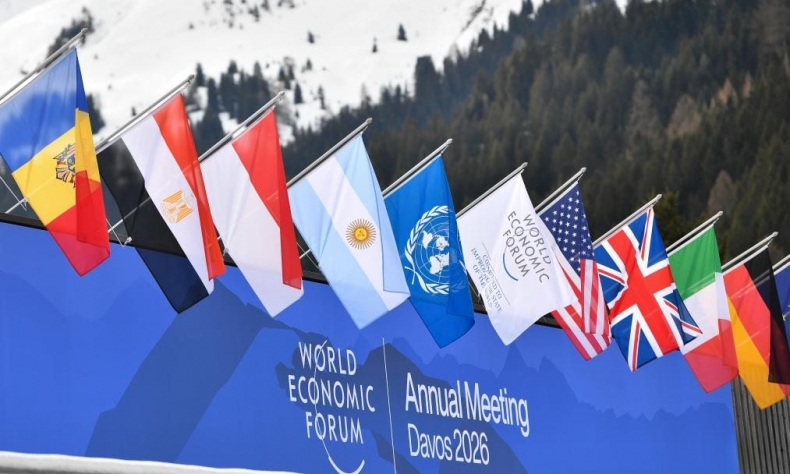
Multiple signs suggest this year’s WEF marks a geopolitical and geo-economic inflection point.
China’s role as a key player in shaping global development and trends stood out at the recently-concluded World Economic Forum (WEF) annual meeting in in Davos, Switzerland.
In contrast to the incomprehensible threats issued by U.S. President Donald Trump before, during and after the Forum, China’s Vice Premier He Lifeng addressed the assembly of 65 heads of state and over 1,000 CEOs with a sober, substantive presentation. Overall, the five-day meeting from January 19-23 underscored a remarkable shift: China, once on the periphery of globalization, now stands as one of its principal champions and a leading force for multilateralism, a role the United States appears to have receded from under Trump’s agenda.
This divergence was crystallized in the two leaders’ speeches. Trump’s speech reiterated a ruthless zero-sum worldview, interspersed with unsubstantiated claims. He Lifeng’s speech, by contrast, was concise and got straight to the point. He outlined the steady progress of the Chinese economy, which has grown at an annual growth rate of approximately 5.4 percent over the past five years, contributing around 30 percent to global economic growth. Furthermore, he highlighted the strategic direction of China’s 15th Five-Year Plan, which charts the course for the nation’s next phase of development.
While touting his economic record, impressive in certain aspects, though its five-year average remains less than half of China’s, Trump also dismissed the green energy transition as a “scam,” without citing any congressional legislation to support his claim.
In his address, He Lifeng emphasized that China will continue to implement the new development philosophy, centered on innovation, coordination, green growth, openness, and shared benefits, and accelerate the establishment of a new development paradigm. This paradigm is defined by domestic circulation as the mainstay, with domestic and international circulations reinforcing each other, underscoring China’s commitment to deeper integration with the global economy.
Vice Premier He Lifeng brings a consistent and reliable voice to the international stage, one that reflects China’s steady dedication to constructive global engagement. While concerns such as trade tensions may be acknowledged by attendees at the Forum, these are not seen as insurmountable. Rather, they are issues that can be addressed through negotiations and dialogues among responsible nations. It is worth noting that China is now a major trading partner of more than 160 countries and regions worldwide.
He Lifeng also expressed China’s readiness to work with all other countries “in a spirit of openness and cooperation to advance sci-tech innovation, empower the world economy and address global challenges in such areas as AI governance.” This commitment is reflected in China’s tangible strides in technology; nearly a year after the release of open-source AI model DeepSeek R1, China has demonstrated its capacity to drive cutting-edge innovation within a new economic framework, which has been watched closely by researchers and policymakers worldwide.
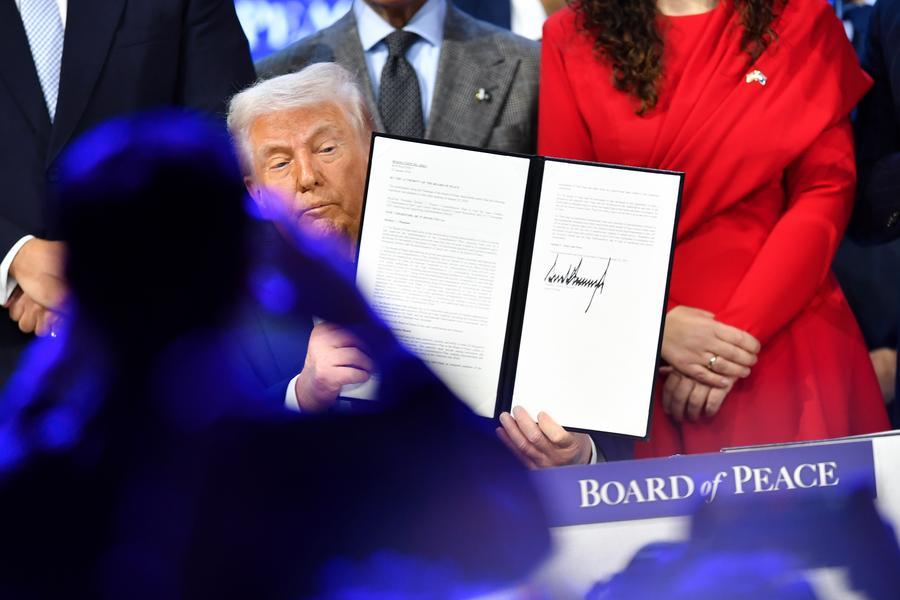
In stark contrast stood the rhetoric of Donald Trump. In both his main speech and his “Board of Peace” initiative – which appears to compete with the UN’s role – he launched unusually harsh criticisms against European civilization, EU institutions, and the leadership of several EU countries. He further invoked 19th-century imperialist language by threatening to “take over” Greenland, claiming it was vital to U.S. Arctic defense strategy and resource extraction. Against this backdrop of paternalistic and provocative statement from Trump and his cabinet members at Davos, it came as no surprise that Christine Lagarde, President of the European Central Bank, walked out during U.S. Secretary of Commerce Howard Lutnick’s dinner speech on January 20. Lutnick had criticized Europe’s renewable energy policy, a statement booed by many. Earlier, in a Financial Times op-ed, Lutnick had declared, “We are here at Davos to make one thing crystal clear: With President Trump, capitalism has a new sheriff in town.”
During the WEF in Davos, China’s Vice Premier He reaffirmed the country’s longstanding commitment to reform, opening up, and international cooperation. He emphasized the importance of mutual listening, mutual learning, and strengthened trust among nations, noting, “It is timely that we listen to each other, learn from each other and build stronger trust with each other.” He further outlined China’s concrete steps to enhance its market rules and institutional safeguards, promising to “provide more opportunities for all other countries.” Specifically, the Vice Premier stated that China will actively expand domestic demand, allowing the world to share the opportunities presented by its vast market, and will accelerate sci-tech innovation, sharing the fruits of its innovation-driven development globally.
The positive reception of China’s stance was reflected in the Swiss authorities’ formal expression of wishes to speed up negotiations on upgrading the free trade agreement with China.
This aligns with the broader international sentiment, as illustrated by a November 2025 study from the European Council on Foreign Relations (ECFR) and Oxford University’s “Europe in a Changing World” research project. The study, which surveyed respondents across 21 countries, found that many people around the world expect China’s global influence to grow over the next decade, with an increasing number viewing Beijing as an ally or necessary partner.
This perception is not built on economic metrics alone, though China’s stature is clear: it is the world’s leading economy in terms of GDP measured in purchasing power parity (PPP) and led the world in patent applications in 2024. Beyond these tangible achievements, what truly shapes China’s growing global role is its attitude – how Beijing understands its achievements and, most importantly, its demonstrated willingness to engage in multilateral dialogues and uphold its opening-up policy.
The most acclaimed speech by a Western leader at the event came from Canada’s seasoned Prime Minister, Mark Carney, a former governor of both the Bank of Canada and the Bank of England, and the leader of a nation deeply linked to the United States by history and geography. He is widely known for his dictum: “We take the world as it is, not as we wish it to be.” Shortly before arriving in Davos, Carney concluded a landmark visit to China, resetting bilateral relations with President Xi Jinping and establishing what is now hailed as a “new strategic partnership.” He declared in Davos that the U.S.-led, rules-based international order is experiencing a definitive “rupture” rather than a transition, signaling the end of the post-WWII era. He argued that the era of American asymmetric advantage and hegemony is over, necessitating a shift toward a more multipolar world. Multiple signs suggest this year’s WEF marks a geopolitical and geo-economic inflection point.
Concurrently, January saw a series of high-level visits to Beijing, including South Korean President Lee Jae-myung, Pakistani Deputy Prime Minister and Foreign Minister Mohammad Ishaq Dar, Canadian Prime Minister Mark Carney, and Finnish Prime Minister Petteri Orpo. These are just a few examples of a broader trend of leaders from across the globe engaging with China.
The year’s official WEF motto, “A spirit of dialogue,” indeed serves as a much-needed inspiration for 2026 and beyond.
Augusto Soto is director of the Spain-based Dialogue with China Project and former global expert in the United Nations Alliance of Civilizations.