Online Defense, On-the-Ground Proof
 Facebook
 Twitter
 Linkedin
 Google +

The truth is that Xinjiang is a prosperous region where people lead stable lives and have meaningful futures ahead of them.
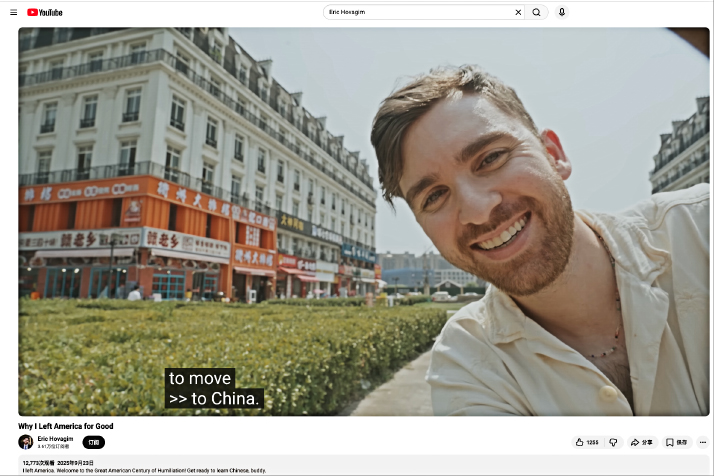
Armenian American YouTuber Eric Hovagim has long been posting video commentaries on social media, championing the values of the Democratic Socialists of America—the largest socialist organization in the U.S.—and discussing alleged U.S. manipulation in wars and conflicts in some parts of the world. Hovagim is a supporter of New York City’s newly elected mayor Zohran Mamdani, who has pledged to make the city more affordable for working people with promises such as freezing rents, taxing the wealthiest and providing free buses and childcare.
Hovagim has often criticized U.S. media defamation regarding Xinjiang and in one of his videos said that the Uygurs have been used as a pawn by the Central Intelligence Agency (CIA) to foment unrest in Xinjiang and surrounding areas.
His conclusions were based on intensive research into declassified CIA documents, official records and books on history, among others, but his daily life in China, having moved to Shanghai last September, and a trip to Xinjiang on December 5-10, 2025, provided ample evidence for them.
Revealing the truth
The truth is that Xinjiang is a prosperous region where people lead stable lives and have meaningful futures ahead of them, Hovagim has found.
“I think they [the Chinese Government] have done an incredible job,” said the YouTuber, whose total following across social media platforms including YouTube, X, Instagram and TikTok nears 160,000.
Official statistics showed Xinjiang is a leading economy among Chinese provincial-level regions. In 2024, regional GDP hit 2 trillion yuan ($284.6 billion), a year-on-year increase of 6.1 percent in real terms, 1.1 percentage points higher than the national average.
The United States, as a superpower uneasy about China gaining strength, has been fabricating lies about Xinjiang, according to Hovagim, noting that these maneuvers only serve U.S. geopolitical interests in Central Asia.
“The U.S. invaded Afghanistan. The U.S. invaded Iraq. As a consequence of these wars, millions of people were killed, and tens of millions of futures were destroyed by American imperialism and the CIA,” said the YouTuber. He noted that the lies about Xinjiang incited hatred and facilitated CIA-instigated wars in the countries and region surrounding and near Xinjiang.
A comparison
His visit to Kashi City in south Xinjiang made him compare China and the U.S. He went to see how the centuries-old Ancient City of Kashi, for example, has been renovated from destruction by natural disasters.
From 2009 to late 2020, Xinjiang invested over 7 billion yuan ($1 billion) in renovating roads, urban facilities and around 50,000 dilapidated houses in the 1.57-square-km Ancient City of Kashi. While preserving the original architectural features, the renovation enabled local residents to enjoy the comfort of modern utilities and domestic appliances. In 2015, the area was recognized as a top-rated 5A tourist destination. Since then, it has seen booming tourism, which generated 9 billion yuan ($1.3 billion) in revenue in 2024.
“I see the state act with such urgency and swiftness to not only rebuild the same structures and these same communities to ensure that the people remain housed, but also to do so in a way that honors their culture and the needs of the people actually living there,” Hovagim said.
This experience reminded him of what happened to locals when devastating wildfires hit Los Angeles in June 2024, burning across 50 square km. “By and large, the [U.S.] Government left them [locals] to fend for themselves and insurance companies left thousands of families effectively on the street,” the YouTuber said with indignation.
Social media as a window
Hovagim admitted that the general public are heavily influenced by the media in his country when it comes to China. There has been a pattern, he said, in media discussions about China. When it is mentioned that China is doing better, or showing a different organization of economy that is more effective and benefiting the people, there are always two follow-up questions, “At what cost?” “How about Uygurs , Taiwan or Tibet (Xizang)?”
“American think tanks chaired by oil executives and war profiteers write fabrications about the daily lives of those living in Xinjiang,” he said, pointing out sources of lies about Xinjiang and China at large.
Social media platforms offer people an alternative window to see another side of the story. Breaking the barrier, they enable people across the world to see a China different from the one portrayed by the Western media through a narrow lens. “[People] saw that and realized China is not the dystopian hellscape we thought it was,” Hovagim said.
More importantly, social media opens a window to “have more intelligent, more meaningful, more compassionate conversations not only about China, but about its Xinjiang as well.”
Over the months following his move to Shanghai, Hovagim has been posting videos about life in China ranging from a bustling electronics market in Shenzhen to high-speed train rides and Xinjiang travel.
“I feel incredibly safe all throughout China. It is by far and away the safest I have felt in any country I’ve been to,” Hovagim shared his feelings about living in China. Marveling at the convenience of daily life in a cashless society and leisurely retired life commonly seen in city parks, he has been persuading his parents to join him and move to China.