The Boomerang Effect of Donald Trump’s Tariffs
 Facebook
 Twitter
 Linkedin
 Google +
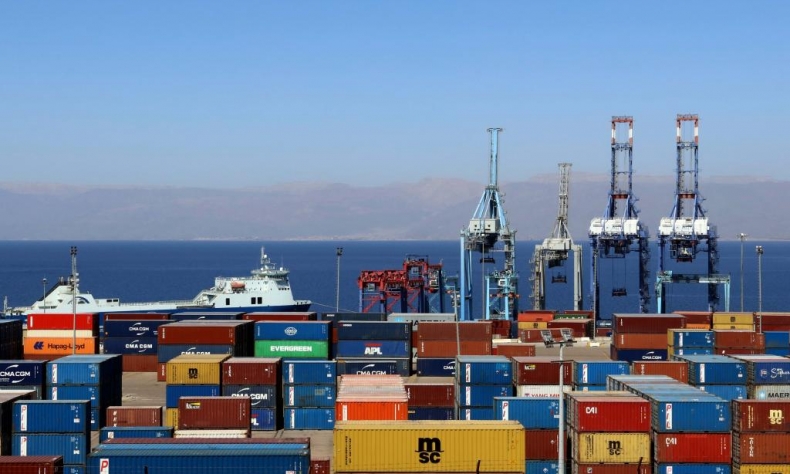
While some countries are closing their markets, China remains committed to economic opening.
When U.S. President Donald Trump announced the worldwide tariffs on U.S. imports, he said that April 2 would be America’s “liberation day.” He also said that the country was the victim of greedy trading partners and that, from then on, it would resume industrial policies to regain the economic vigor of the manufacturing sector. Trump also stated that he would make America great again and that the tariff revenues would be invested in rebuilding the country’s economic structure.
Nine months later, a significant portion of American society has yet to see the promised benefits of the trade war that began in April last year. The hardest-hit sector was food, with price climbing well above the official inflation rate, especially for everyday staples such as coffee, beef, fruits, and fish. While the CPI for December 2025 was 2.7 percent, food price inflation was 3.1 percent. On the other hand, the offer of employment did not keep up with the supply of workers. According to a CNN report on January 30, the rate of new job creation was below the demand for workers. At the beginning of 2025, there was roughly one vacancy for every unemployed worker. By November, the ratio had fallen to 0.92 vacancies per job seeker.
The industrial sector was also negatively affected. According to a September 2025 New York Times article, the largest U.S. agricultural equipment company, John Deere, which had posted record profits in 2024, saw its revenues fall sharply after Trump’s tariffs and trade policies. In August 2025, John Deere reported that net income in the second quarter was down 29 percent from a year earlier. Higher tariffs, mostly on steel but also on aluminum, have cost the company an extra $300 million, with nearly another $300 million expected by the end of the year. The company laid off 238 employees at plants in Illinois and Iowa.
The tariffs also impacted John Deere’s customers, as the trade war weighed on grain producers who relied on overseas markets — especially China — as their largest buyers. With the lack of prospects for the sector, many investments were postponed, especially the purchase of new tractors and harvesters, John Deere’s specialty.
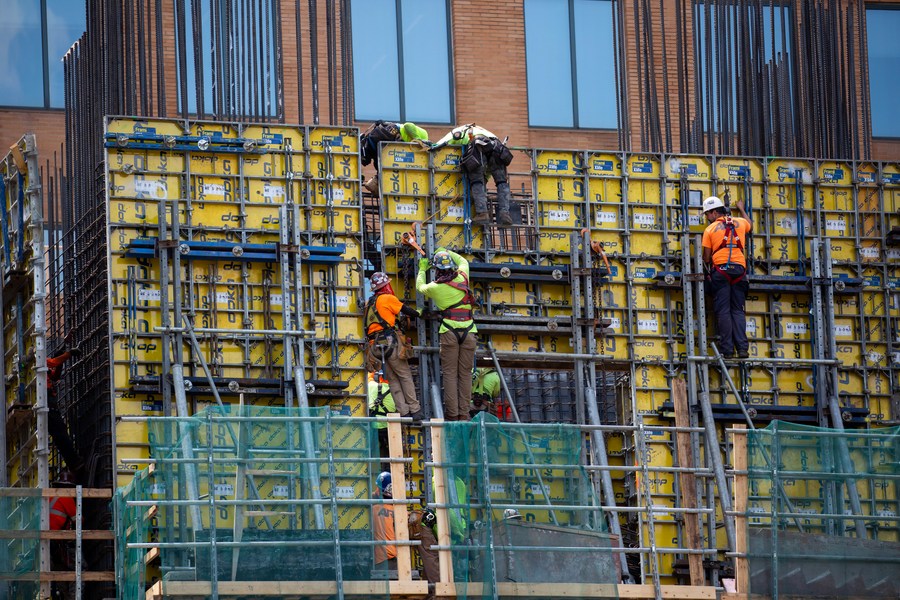
Donald Trump’s policy is based on a false assumption that industrial unemployment and the loss of competitiveness of U.S. industry are due to globalization and unfair international trade. Globalization has been designed by the elites of the United States since the late 1970s, when the Trilateral Commission advocated opening markets to address the profitability crisis of the country’s multinational companies. By relocating low-added-value industrial production overseas and building vast global supply chains, companies were able to secure lower labor and manufacturing costs. In general, since the early 1980s, wages have been under control, and the price of consumer goods has fallen precipitously. Hundreds of millions of people entered the consumer market and the profits of multinational companies rose astronomically.
The model, however, led to an enormous concentration of income that prevented the growth of demand in proportion to supply. At the same time, financialization diverted capital away from the real economy by offering higher returns. As a result, asset bubbles and economic crises have occured more constantly. In the case of the United States, the social segment most affected was precisely that of blue-collar workers, industrial workers, a social base that voted for Trump in the expectation of returning to the golden days.
The “America First” policy, in many ways, has disorganized the world economy, sidelined international organizations, led some governments to adopt protectionist policies and put the process of globalization at risk. In addition, Trump’s tariff policy has paved the way for all kinds of economic blackmail, political coercion, and direct threats to the sovereignty of other countries. However, the disruption also spurred new trade agreements, such as agreements between Mercosur and the European Union, between India and the European Union, and the strengthening of rapprochement among the main European countries with China and Canada. In fact, Trump’s policy is like a boomerang, as the negative effects are coming back to those who created it.
Before the 2008 global financial crisis, the elite of the United States considered its country as indispensable and the great guarantor of international stability. Following the collapse of Lehman Brothers, the United States became part of the problem rather than the solution. In fact, it was China that kept the wheels of the global economy turning, reorganizing its economy through large-scale investment in infrastructure, domestic market expansion, the Belt and Road Initiative, and scientific and technological innovation.
Chinese brands today are associated with quality, design, and innovation. You can’t get around China, for example, when it comes to clean and renewable energy, artificial intelligence, and manufacturing.
Finally, it is important to emphasize that China and other countries in the Global South are committed to reforming global governance institutions to reinstate fair and democratic rules for coexistence among nations. While some countries are closing their markets, China remains committed to economic opening, exemplified by China International Import Expo and the “high-quality opening”. While some countries use their currencies as political weapons, China and other countries intensify payment and settlement in local currencies to reduce the financial costs of transactions. While some countries reaffirm a selfish approach, China proposes an inclusive and harmonious global order. We live in very challenging times, where rules are being replaced by the “law of the jungle”. But it is precisely these times of crisis that create the foundations for a better future.
The article reflects the author’s opinions, and not necessarily the views of China Focus.