The Panama Ruling
 Facebook
 Twitter
 Linkedin
 Google +
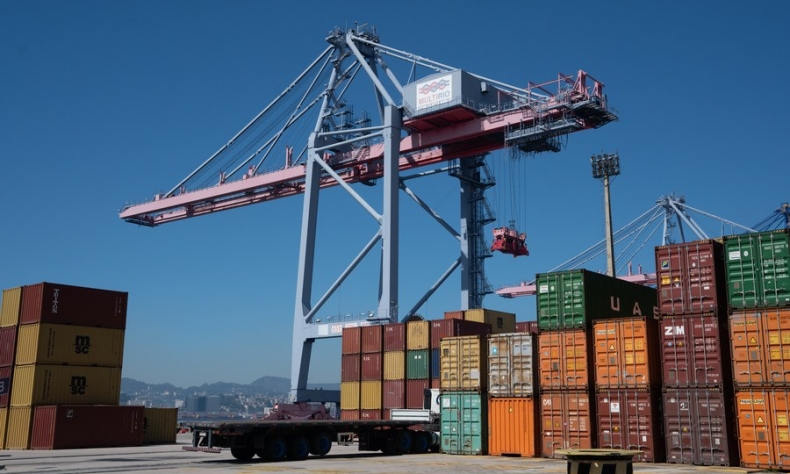
China-Latin America cooperation expands that autonomy by diversifying partnerships and reducing vulnerability to any single external power.
On January 29, Panama’s Supreme Court reached the decision to annul the licenses of a Hong Kong-based company to operate ports at either end of the Panama Canal. The decision, reached amid threats from the United States, has been widely presented as a victory for U.S. President Donald Trump against China in his own “backyard.” In reality, it exposes Washington’s desperation. Unable to compete with China in the free market, it resorts to imperialist bullying of third nations to try to stave off the rise of Chinese-Latin American trade and cooperation, and the subsequent displacement of the U.S. along the way.
In 2000, total trade between China and Latin America amounted to roughly $12 billion. In 2024, China-Latin America trade reached $518.47 billion, according to Chinese customs data.
This is not cyclical growth, nor is it a temporary spike. It is a structural realignment of Latin America’s external economic relations. China is now the largest trading partner of almost every Latin American country. These ties are rooted in production, logistics, energy and increasingly manufacturing—sectors that shape long-term development rather than short-term financial flows.
Washington, through threats and coercion, can apply pressure to individual governments or institutions, but it cannot reverse the material forces driving this shift. The Panama ruling should be read in this context: U.S. policy toward Latin America has shifted from economic leadership to pathetic and ineffective attempts at temporary political obstruction.
Seen against this backdrop, the Panama ruling reflects a familiar colonial reflex. When Washington cannot compete economically, it reframes economic cooperation as a security issue. Ports become threats, trade becomes infiltration and courts become arenas for geopolitical signaling.
Yet these paranoid tactics are ultimately defensive. They do not offer Latin America development alternatives, nor do they address infrastructure gaps, industrial needs or energy transitions. They merely attempt to slow a process that is already well underway.
Developments in Argentina and Brazil are just two striking examples of what has been happening across the whole region as the U.S. is displaced as the primary trader in its own “backyard.”
Brazil illustrates how far China-Latin America cooperation has come in recent years. China has been Brazil’s largest trading partner for more than a decade, absorbing massive volumes of soybeans, iron ore and oil that underpin Brazil’s export economy. But the relationship is entering a new phase.
In 2024, Chinese electric vehicle giant BYD began construction of a major manufacturing complex in Bahia state, ironically on the site of a former Ford plant abandoned during U.S. industrial retrenchment. The project is designed to reach an annual capacity of 300,000 vehicles by the end of 2026, employing tens of thousands of people in the area.
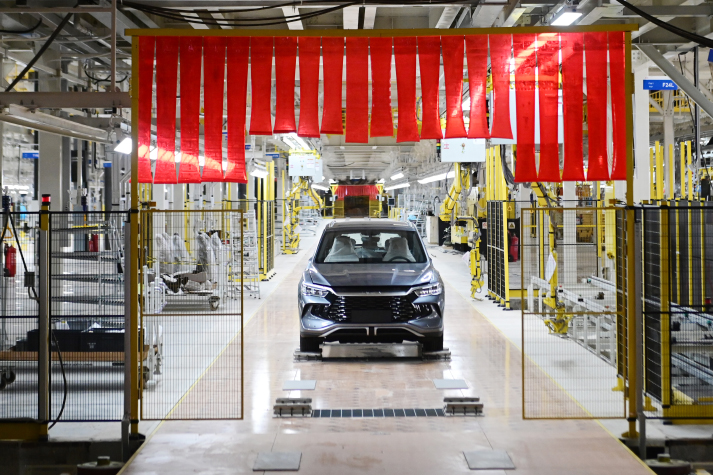
This is not speculative capital. It is embedded industrial investment that ties local labor, logistics, and technological upgrading to long-term cooperation. The contrast is telling: where U.S. firms exited, Chinese firms have entered—not as extractive intermediaries, but as producers anchoring new industrial ecosystems. This is precisely the kind of engagement Latin American economies have always sought.
In November 2024, Argentina renewed and extended the activated $5-billion currency swap line with China, a critical tool for stabilizing Argentina’s foreign exchange reserves amid chronic balance-of-payments stress.
At the same time, China has expanded purchases of Argentine soybeans, reinforcing its role as a crucial export destination at a moment when Argentina urgently needs hard currency.
BYD entered the Argentine market in 2025, benefiting from government measures allowing electric and hybrid vehicles to be imported tariff-free.
This is what defines a megatrend: Cooperation continues and expands, regardless of the political manipulations imposed by Washington.
China’s engagement in Latin America is not driven by coercion or ideological export. China supplies capital goods, manufacturing capacity, infrastructure financing and increasingly green technology. The resulting integration is dense, multi-layered and impossible to unwind. Trump can threaten sanctions, regime change or even war, but the forward march of progress continues regardless.
China-Latin America cooperation expands that autonomy by diversifying partnerships and reducing vulnerability to any single external power.
These are not trends that can be reversed by court rulings or diplomatic pressure. The decision by Panama’s Supreme Court may temporarily satisfy Washington’s desire to give the appearance of control over those it regards as its inferiors, but it will not alter the trajectory of the region.
This transformation has only just begun.
The author is a Bolivian journalist, a former staff writer at Venezuelan news network teleSUR.