Washington’s Unprovoked Aggression Against Iran Is Totally Illegal
 Facebook
 Twitter
 Linkedin
 Google +
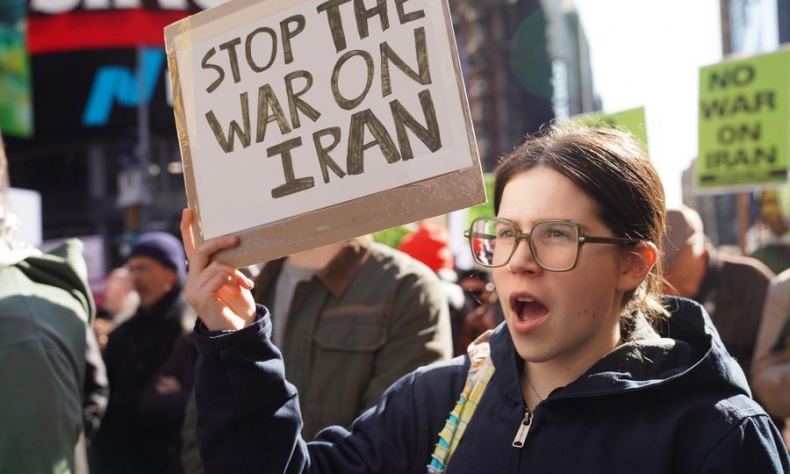
The United States-Israel war of aggression against Iran must be brought to an end as soon as possible and a just solution for the Gulf region set into place.
Washington’s aggression against Iran is illegal and destabilizes the world. It is no surprise that the United States imperialism joins the expansionist Zionist state in this unprovoked war of aggression. When will it end, and what are the consequences?
Iran has a population of 90 million, its territory is the size of Western Europe, and it plays a significant geopolitical role in Eurasia. The United States, covertly and overtly, has opposed the Islamic Republic of Iran for five decades.
From the legal standpoint, the unprovoked United States-Israeli war falls into the category of a war of aggression. This is illegal under international law as embodied in the United Nations Charter.
The international community in the last century was traumatized by the Nazi German regime and the Japanese militarist regime and their aggression in World War II. So, the United Nations Charter responded in a specific way to the crime of aggression. The Charter stipulates explicitly that all UN member states, large or small, are equal in their state sovereignty, and no force is allowed in tackling differences between sovereign states. The Charter also provided for the legitimate self-defense of a sovereign state in the face of aggression.
The United States and Israel violated the Charter, and the UN Security Council did not approve or authorize the joint United States-Israeli war against Iran. Thus, Iran, as a sovereign state and member of the United Nations, has the right to the self-defense it is now undertaking.
Significantly, President Donald Trump and his administration also violated the United States Constitution. Under the Constitution, the power to declare war lies with the legislative branch of government, the Congress. The power to conduct war, after war is declared by Congress, lies with the executive branch of government in the person of the president. The president is the commander-in-chief of the armed forces, which emphasizes the principle of unity of command in wartime.
Trump’s war is a “war of choice” and not a “war of necessity.” Trump, in violation of the Constitution, attacked Iran without the prior approval of Congress. Such required approval can be in the form of a declaration of war or in the form of an authorization of the use of force.
This is important because, under the Constitution, a United States president can be impeached for high crimes. Taking the country into war in violation of the Constitution is arguably impeachable as a high crime.

This legal dimension is important with respect to the internal political situation in the United States. The internal political situation today is complicated. As is well-known by now to the entire world, United States politics and foreign policy are dominated by the Israel lobbyists. The Israel lobbyists consist of both Jewish Zionists and Christian Zionists.
Billionaire Jewish “Big Donors” place hundreds of millions of dollars of financial contributions to both parties into campaigns at the state and national levels. In Congress, the Israel Lobby is said by watchdog groups to fund over 350 Congressmen and women and some 80 senators. Campaign contributions are matters of public record under the Federal Election Commission.
Trump is heavily financed by the pro-Israel Big Donors, and his cabinet is packed with pro-Israel figures like Secretary of State Marco Rubio and Secretary of Defense Pete Hegseth, and both ardently support war against Iran.
In recent months, owing to the Gaza crisis and the assassination of youth evangelist Charlie Kirk, American politics is dividing over the issue of Zionism and support for Israel. Public opinion, particularly among youth, has shifted against Israel, and over half the country now opposes Israel’s behavior in the Middle East.
This means that Trump is vulnerable to impeachment on the war issue aside from being vulnerable to allegations of criminal activity, to the revelations of the Epstein Files scandal, and to other matters.
Politically, the situation for Trump and for the Republicans is now bound up with the Iran war and the Israel issue. There are several scenarios circulating currently in the United States. The first is that the Democrats will take over the House of Representatives in the midterm elections this November, but the Republicans will retain the Senate.
The second scenario is that Democrats will take both the House and the Senate. It is the House that brings forward the articles of impeachment. It is the Senate that then undertakes the trial and passes final judgement.
So, it is clear today that Trump could be impeached by the House in the next Congress and tried by the Senate. He would certainly be impeached by the House and would probably be judged guilty by the Senate for at least some of the articles of impeachment.
In the meantime, the war of aggression against Iran is ongoing, and there is no way of knowing when it will terminate or how it will terminate. The war against Iran is already at the regional level. It is expected to intensify before it is resolved, and so regional tensions will escalate, and this can have a broader spillover effect.
But we can still call for diplomacy, call for the war to end as soon as possible, and call for a stable and durable peace agreement. One solution can be the postwar creation of a new inclusive security architecture in the Gulf region that emphasizes peace and development. This would mean that the United States would exit the Gulf region in terms of its military presence although, of course, it could have a peaceful economic presence.
A revitalized and reformed United Nations should provide the venue for negotiations to end the war against Iran and then to undertake negotiations toward a new Gulf security architecture based on peace and development.
The United States-Israel war of aggression against Iran must be brought to an end as soon as possible and a just solution for the Gulf region set into place.
The article reflects the author’s opinions, and not necessarily the views of China Focus.