Understanding Europe’s Re-Engagement With China
 Facebook
 Twitter
 Linkedin
 Google +

European leaders increasingly recognize that deep and effective cooperation with China is possible—and necessary—while relations with the U.S. have become harder to forecast.
The steady erosion of U.S. global influence and the parallel expansion of China’s international role are often explained in ideological or moral terms. These explanations miss the point. The decisive factors are structural: economic gravity, policy predictability and the changing behavior of advanced industrial states confronted with uncertainty. The visit of German Chancellor Friedrich Merz to China on February 25-26 illustrates these dynamics with particular clarity.
For more than 70 years, American leadership rested on a combination of material power and political loyalty. Allies accepted U.S. dominance not only because of its military and financial strength, but because Washington was perceived as predictable and broadly committed to shared prosperity. That balance has weakened. Under the “America First” doctrine, U.S. power is increasingly exercised through tariffs, sanctions and direct pressure—even on allies. This approach demonstrates strength, but it undermines trust.
A clear choice
Niccolò Machiavelli argued that fear may substitute for love when both cannot be secured. Yet fear produces obedience, not loyalty. In a globalized economy with diversified supply chains and multiple centers of growth, obedience is fragile.
Germany’s engagement with China reflects this reality. Berlin remains deeply embedded in the transatlantic alliance, but it is also confronting hard economic facts. The United States is Germany’s largest single-country export market, absorbing roughly 10 percent of German exports, while China accounts for about 7-8 percent. However, China has been Germany’s largest trading partner for eight consecutive years, with bilateral trade exceeding 251 billion euros ($296 billion) annually.
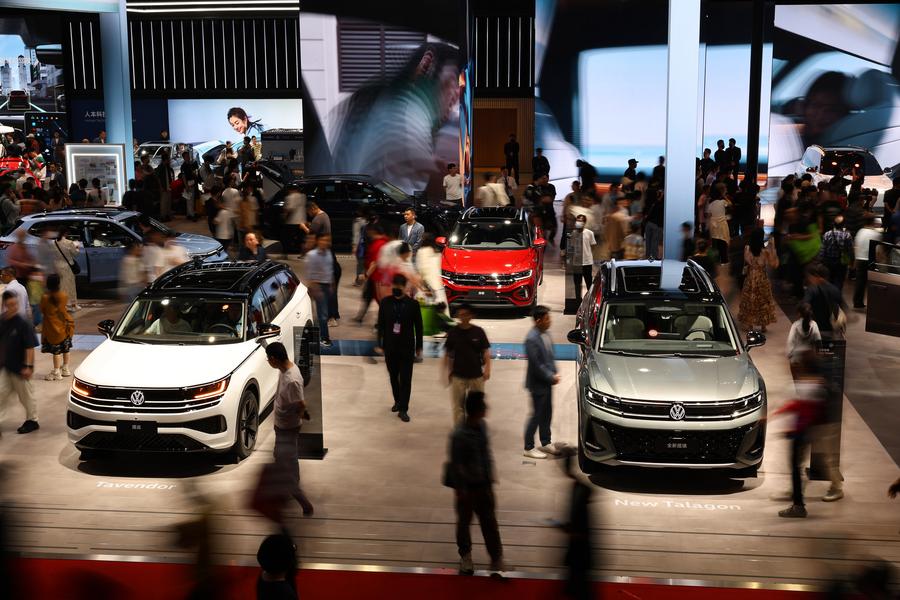
German industry is particularly exposed. Nearly 40 percent of Volkswagen’s global sales, one third of BMW’s and more than 35 percent of Mercedes-Benz’s are generated in China. BASF is investing over 10 billion euros ($11.8 billion) in a new integrated chemical complex in Zhanjiang, Guangdong Province, its largest single foreign investment project. Siemens generates roughly 15 percent of its global revenue from the Chinese market. These are not marginal figures; they define Germany’s industrial future.
Against this backdrop, Merz’s February visit to Beijing was neither symbolic nor exceptional. It followed a pattern. Over the past two years, European leaders—including presidents, prime ministers and finance ministers—have become frequent visitors to China. The reason is pragmatic: China offers scale, demand and planning horizons measured in decades, while U.S. policy has become increasingly volatile.
The contrast with U.S. economic policy is stark. Washington has reintroduced or threatened tariffs across a range of sectors, including electric vehicles, steel, aluminum and clean technology. For European exporters, this unpredictability carries real costs. German steel producers face U.S. tariffs of up to 25 percent, while the threat of higher automotive tariffs looms over an industry that employs more than 800,000 people in Germany alone.
At the macro level, the U.S. federal budget deficit stands at approximately 6 percent of GDP, while Germany, even after abandoning its strict “debt brake,” a legislative mandate that prohibits Germany’s federal states from taking on new debt and strictly limits debt at the federal level, remains near 2-3 percent. Washington’s fiscal expansion is accompanied by demands that allies absorb trade shocks, align strategically and accept uncertainty. For export-driven economies like Germany, this combination is increasingly untenable.
Trend in the making
China’s growing influence does not rest primarily on military power. It is rooted in economic scale and policy continuity. China accounts for roughly 18 percent of global GDP (in purchasing power parity terms), produces more than 30 percent of global manufacturing output and dominates key sectors such as solar panels (over 80 percent of global supply) and electric vehicle batteries (around 70 percent).
Crucially, China offers predictability. Five-year plans, industrial policy and long-term infrastructure investment provide foreign partners with a clearer sense of direction than abrupt tariff announcements or election-driven reversals. During his Beijing meetings, Merz emphasized cooperation in automotive transformation, green technology and advanced manufacturing—areas where German firms seek stable demand and China seeks high-quality partners.
President Xi Jinping, in turn, framed the talks around continuity and mutual benefit, underscoring China’s interest in maintaining open channels with Europe at a time of global fragmentation.
Germany is not an outlier. The United Kingdom, France, Italy, Spain and several Central and Eastern European countries have all intensified high-level engagement with China. This does not reflect ideological convergence, but strategic calculation. European leaders increasingly recognize that deep and effective cooperation with China is possible—and necessary—while relations with the U.S. have become harder to forecast.
Surveys by European business associations show that over 60 percent of large European Union companies operating in China plan to maintain or expand their presence despite political tensions. For many, the alternative is stagnation. Europe’s average GDP growth remains below 1.5 percent, while China continues to grow at 5 percent, even amid structural adjustments.
The U.S. remains the world’s most powerful military actor and a financial superpower. But power without loyalty produces diminishing returns. When allies feel pressured rather than protected, they hedge. Germany’s outreach to China is a form of hedging, not defection. Yet hedging itself is a sign of eroding influence.
China benefits not because it demands allegiance, but because it offers participation. It does not ask partners to choose sides publicly. It asks them to trade, invest and plan for the long term. In an era of uncertainty, this restraint is attractive.
The lesson from Merz’ visit to Beijing is not that Europe is “turning away” from the U.S. It is that influence in the 21st century is conditional. Fear can compel, but it cannot bind. Predictability, economic opportunity and strategic patience can.
America’s challenge is not a lack of power, but a deficit of loyalty. China’s advantage lies in its ability to convert economic gravity into durable relationships. In a world where middle powers have options, power without loyalty is no longer enough.
The author is former prime minister of Kyrgyzstan, a distinguished professor of the Belt and Road School at Beijing Normal University and author of the book Central Asia’s Economic Rebirth in the Shadow of the New Great Game (2023).