The Renaissance of Materials
 Facebook
 Twitter
 Linkedin
 Google +
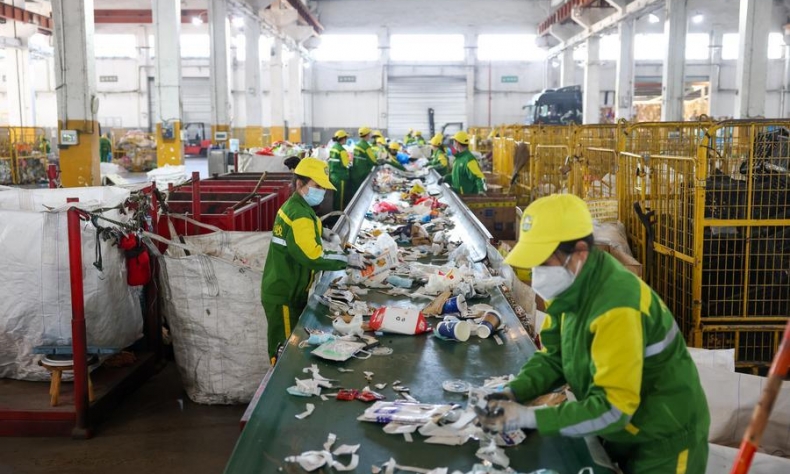
China charts a roadmap for the utilisation of recycled materials.
With the start of the new year, Wen Congxiang, managing director of Ningbo Nuoding, a company specialising in the recycling of end-of-life vehicles, has been constantly on the move. Much of his time is spent coordinating with vehicle collection firms, electric bicycle manufacturers and recycled materials distributors, as he works to build partnerships focused on the targeted collection and distribution of recycled products.
According to him, end-of-life electric bikes have particularly high recovery potential. Batteries, frames, motors and controllers are concentrated sources of recyclable resources. “Thanks to a combination of automated equipment and precision sorting processes, these components can be efficiently dismantled and, after standardised sorting, purification, melting and granulation steps, transformed into recycled materials that meet industrial standards and can be reused by upstream manufacturers,” he told People’s Daily.
This momentum is now being reinforced by a strong political signal. Recently, the National Development and Reform Commission (NDRC), in coordination with several ministries, published the Action Plan for Promoting the Use of Recycled Materials. This is the first public policy document in China specifically dedicated to this subject, proposing a genuine roadmap covering the supply, application, management and dissemination of recycled materials. The promotion of these materials is fully aligned with the implementation of green development and the country’s overall ecological transition.
Recycle to produce better
According to the NDRC, China has already established the world’s largest resource recycling and reuse system, covering the most comprehensive range of materials. In 2024, the collection volume of the 10 major categories of recyclable resources exceeded 400 million tonnes. Steel and paper waste provided approximately 21 percent and 70 percent of the raw materials needed for production respectively, laying a solid foundation for expanding the use of recycled materials.
In addition, the thorough implementation of policies for large-scale equipment renewal and the national trade-in programme has led to a sharp increase in collection and dismantling volumes, creating favourable conditions for more efficient resource use. In this context, the action plan aims to strengthen the supply of high-quality recycled materials, including steel, non-ferrous metals, plastics and paper, while improving collection systems and developing market demand. It also emphasises the improvement of standards, certifications and incentive mechanisms.
By 2030, China aims to have a more advanced waste recycling system, with annual recovery volumes exceeding 300 million tonnes for steel and 80 million tonnes for paper. Annual production of recycled non-ferrous metals and recycled plastics is expected to reach more than 25 million tonnes and 19.5 million tonnes respectively.
Within the industry, some companies have already acquired advanced technological expertise. Ningbo Jintian Copper, for example, has established a fully integrated industrial chain encompassing the collection, purification and advanced processing of recycled copper. Its low-carbon copper products, certified by international standards such as the Global Recycled Standard, reduce carbon emissions by up to 75 percent while ensuring performance equivalent to that of virgin materials. According to Tang Xianpeng, marketing director of the company, these products are now widely used in electronic devices, electrical equipment and smart appliances.
In Shaanxi Province, a project by Hanzhong Zinc Industry to convert zinc metallurgical slag into indium, a rare metal, is nearing completion. Launched on 30 June 2025 and covering an area of approximately 0.2 hectares, the project will enable the annual production of 30 tonnes of refined indium. Owing to its excellent conductivity, corrosion resistance and high ductility, indium plays a major strategic role in aerospace, new energy and national defence.
In the textile sector, the collection of used clothing is becoming established as a new social practice. Thanks to innovative textile-to-textile recycling technologies, Chinese companies are now transforming textile waste into high-purity recycled fibres, which are reintegrated into global supply chains.
“During production, we do not add any toxic or harmful substances and do not generate any waste. The small amounts of residue produced are also recycled as raw materials for paints, and we have signed long-term contracts with companies in the sector,” Ye Xiaozhe, general manager of Anhui Xindengli Environmental Protection Technology, told China Economic Times. According to him, the company can recycle more than 120,000 tonnes of used textiles per year and reduce greenhouse gas emissions by more than 480,000 tonnes, equivalent to planting 26 million trees.
New life for electric cars
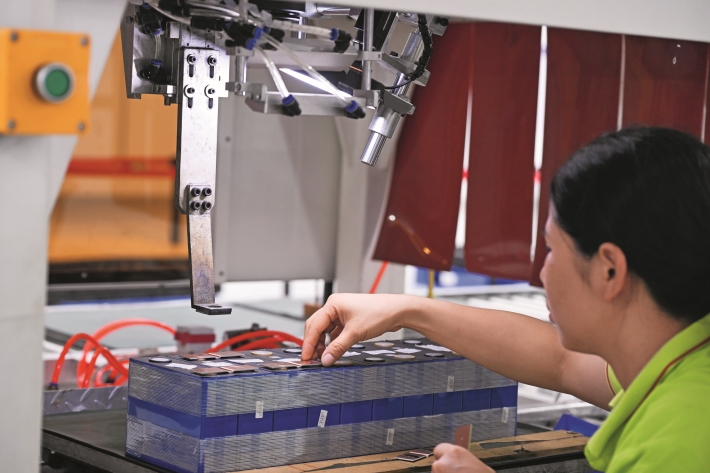
In the action plan, batteries and cars are among the priority products for expanding the use of recycled materials. Major Chinese players such as CATL have already taken concrete steps. In January, at the World Economic Forum in Davos, a report supported by more than 30 stakeholders, including CATL, was published, proposing the first global operational roadmap for the circular economy of traction batteries.
According to Jiang Li, its vice president, the company has implemented a circular system covering the entire battery life cycle, from research to reuse. Recovery rates reach 99.6 percent for nickel, cobalt and manganese, and 96.5 percent for lithium, supported by a global network of more than 1,200 collection points.
For car manufacturers, the use of recycled materials has become a significant issue. According to The Paper Research Institute, companies must anticipate end-of-life and recycling issues comprehensively from the product design stage onwards. Chinese groups such as Geely Auto have established closed-loop mechanisms integrating design, use, dismantling and reuse, enabling complete traceability and a “vehicle-to-vehicle” application.
However, the final link in the chain remains the consumer. The perception and acceptance of recycled and low-carbon products will determine the emergence of a sustainable green premium. While the market remains cautious, developments in the second-hand market and vehicle life-cycle management are contributing to the recognition of the car as a recyclable asset, without any necessary compromise on performance.
Beyond the automotive sector, the action plan extends this logic to electronic devices, textiles and packaging, encouraging leading companies to develop plans to promote the use of recycled materials. According to the NDRC, the authorities intend to strengthen monitoring, evaluation and quality control to ensure that these materials fully comply with performance, safety and environmental protection requirements.
As Yao Xin, deputy director of the Institute for Environmental Innovation (Suzhou), Tsinghua University, pointed out, the implementation of the action plan is not only a change in the way resources are used, but also a concrete step towards a more efficient, safer and more sustainable economy.