From Ruins to Renewal: the Making of a New World Order
 Facebook
 Twitter
 Linkedin
 Google +
Why has the world fallen into such deep disorder? This is not an accident of history. It is the inevitable outcome of the predatory logic underpinning the old U.S.-led order.
The year 2026 is already one-third gone and the world is seeing no relief from geopolitical tensions. It is watching the synchronized convulsion of a collapsing order.
In recent weeks, the familiar rhythms of diplomatic maneuvering have given way to something more ominous. A U.S. diplomatic mission to Islamabad, Pakistan, aimed at salvaging talks with Iran once again, arrived only to be met with Tehran’s refusal to engage. Across the Persian Gulf, Israeli officials have signaled that their military operations are far from over. In Washington, threats have been issued against Iranian civilian infrastructure.
From the ruins of Eastern Europe to the hellscape of Gaza and the escalating confrontation in the Persian Gulf, this first third of 2026 offers no peace—only the death rattle of a predatory empire. The era of unchallenged American dominance, built on military coercion and financial extraction, is disintegrating before the world’s eyes.
As Stephen Walt, a professor of international affairs at the Harvard Kennedy School, warned in his February article in Foreign Affairs, the United States has become a “predatory hegemon”—a superpower that views every relationship as a zero-sum game, seeking to extract maximum benefit from allies and adversaries alike.
A world on fire
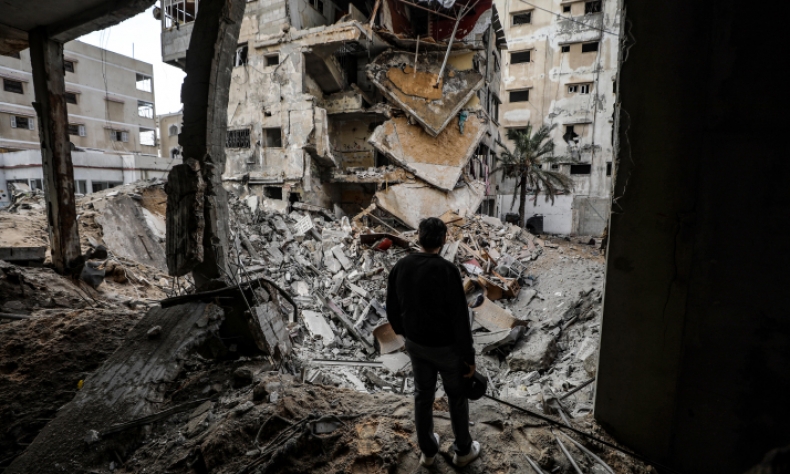
The Gaza ceasefire that took effect in October 2025 was supposed to bring a reprieve. More than six months later, it has become a slow death.
Following the joint U.S.-Israeli military strikes against Iran in late February, the fighting has spilled over dramatically. According to the United Nations, humanitarian aid entering Gaza has dropped by 80 percent since the renewed fighting, turning the strip into an open-air prison and graveyard. In the week of April 12 to 18 alone, violent incidents surged by 46 percent, the highest weekly record since the ceasefire began. The Gaza media office has also documented over 2,400 Israeli violations of the truce agreement.
“The U.S. fights, but it doesn’t take responsibility,” Niu Xinchun, Executive Director of the China-Arab Research Institute at Ningxia University, said to Global Times in January, characterizing current U.S. policy in the Middle East as “no money, no boots on the ground, and no nation-building.” “The Middle East burns, and the U.S. runs,” he added.
But running has not been easy. In Ukraine, the U.S. is visibly disengaging. U.S. Vice President JD Vance recently reiterated a cold reality—halting funding for the war. Washington, having used Europe to bleed Russia, is now attempting to walk away—leaving a devastated Ukraine and an insecure Europe behind.
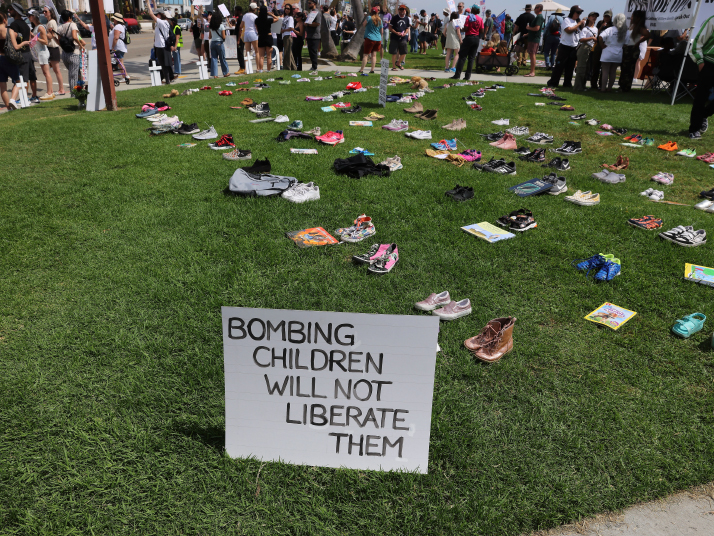
While Western headlines fixate on Tehran’s nuclear calculus, ordinary Iranians are bearing the brunt of a different kind of catastrophe. The U.S.-Israeli strikes have exacted a devastating civilian toll. According to reports, hundreds of civilians—including many children—have been killed in strikes hitting schools and residential areas.
From Gaza to Ukraine to the Persian Gulf, the pattern is the same: American intervention without peace resolution, destruction without reconstruction.
Logic beneath the chaos
Why has the world fallen into such deep disorder? This is not an accident of history. It is the inevitable outcome of the predatory logic underpinning the old U.S.-led order.
At its core, this chaos stems from a profound anxiety—the fear generated by America’s relative decline. Zhang Jiadong, a professor at the Center for American Studies of Fudan University, explained that “American anxiety stems from the fear generated by its comparative advantage being squeezed.” Unable to guarantee perpetual dominance through fair competition, the United States has shifted from promoting its own growth to suppressing the potential of others. It is not about running faster; it is about tripping everyone else, he added.
At least three of the four traditional pillars of American power—ideological values, technological supremacy and the dollar’s dominance—are now failing, Huang Jing, a professor at Shanghai International Studies University, said. The Donald Trump administration abandoned the “moral high ground” long ago. And the weaponization of the dollar—freezing Russian assets and threatening Iran—is actually driving the Global South to accelerate de-dollarization.
“The U.S. did not fall from greatness. It is melting its own wings,” Warwick Powell, an adjunct professor at Queensland University of Technology and former policy advisor to Australian Prime Minister Kevin Rudd, said, offering a striking metaphor for this internal decay. What began as the “arrogance of power” has metastasized into something more lethal. “American predatory hegemony now functions as an autoimmune disease,” Powell told Global Times. “The very mechanisms built to project strength are devouring the U.S. from within.”
The most telling sign of American decline, however, may be its apparent “capture” by foreign interests. When Israeli Prime Minister Benjamin Netanyahu can openly claim that Vance briefed him on the details of U.S.-Iran negotiations, the truth is laid bare—America’s sovereign will has been eroded by special interests, particularly the Israeli lobby and the military-industrial complex. “The roles of master and agent have been reversed. A superpower that cannot control its own foreign policy cannot possibly rule the world,” Zhang said.
He offered a further, more precise diagnosis of this self-defeating dynamic by calling it “strategic self-negation”—a condition in which Washington’s policy tools no longer work in concert but actively undermine one another. “The U.S. is now caught in a classic dilemma,” according to him. “It is unable to wield both the military and economic clubs at the same time. It must choose between them.”
Zhang pointed to two consecutive “negations” in U.S. policy toward Iran. First, the U.S. attacked Iran without sufficient international legitimacy, negating the existing international order. Second, to contain the spillover effects of its own military action, Washington then temporarily waived its own sanctions on Iranian oil—negating its own rule system. “Easy to start, hard to end,” he said, invoking the ghosts of Iraq and Afghanistan.
America’s military superiority has not translated into political victory or economic dividends, Zhang said, adding the very act of projecting force has weakened the credibility of its sanctions regime. The result is not strength but a “feedback loop of self-consumption.”
Michael Dunford, an emeritus professor at the University of Sussex, went further, dissecting the class nature of American behavior. “I don’t consider the United States a democracy in any sense,” he told Beijing Review. “It’s a plutocracy.” Its elites are “very, very rich people who have global interests, whose main concern is to ensure the continuation of U.S. domination of the world, because their wealth and their income depend upon it,” he added.
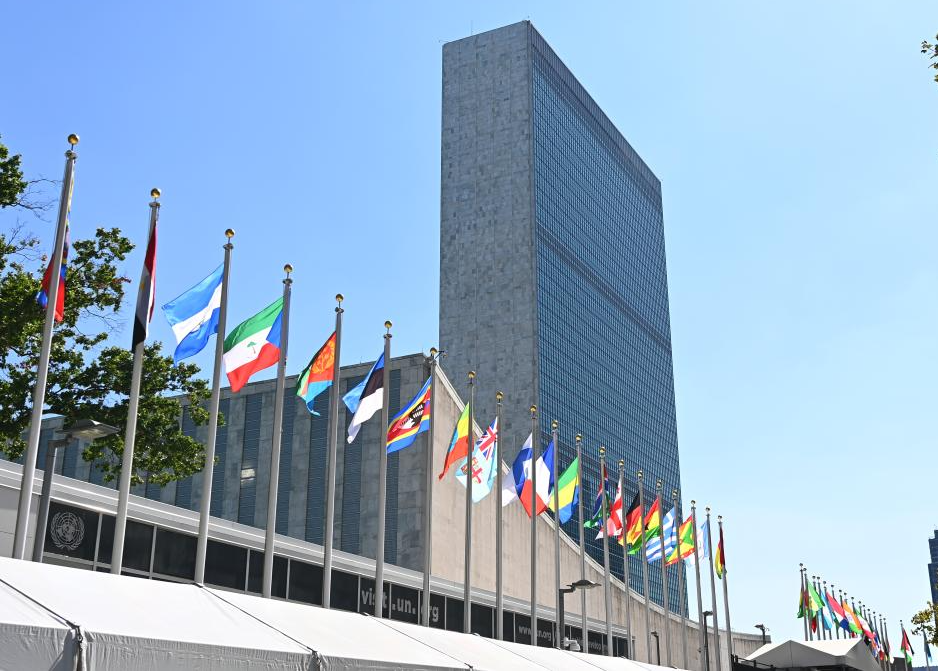
But the chaos is not merely a product of American design. It is also a symptom of institutional decay. The very mechanisms built after 1945 to prevent great-power conflict—the United Nations Security Council, the veto system, the collective security architecture—have proven incapable of restraining the predator.
“The UN is trying to solve 21st-century problems with 20th-century mechanisms,” Volkan Bozkir, former President of the UN General Assembly, told Southern Weekly, adding that reform has been stalled for more than three decades. When a permanent member of the UN Security Council becomes both the rule-maker and the rule-breaker—as the U.S. has demonstrated in its strikes on Iran—the veto power transforms from a tool of consensus into a shield for impunity. The UN, in other words, is not merely failing; it is being systematically undermined by the very power that hosts its headquarters.
The structural paralysis runs deeper. The U.S., as host country of UN headquarters, has turned its diplomatic leverage into a weapon. In January, Washington issued an executive order withdrawing from 31 UN agencies, branding them “wasteful, ineffective or harmful.” More insidiously, visa restrictions against Palestinian and Iranian officials have directly interfered with the UN’s functioning.
Meanwhile, the UN faces a “liquidity crisis” of unprecedented scale. UN Secretary General António Guterres has warned of “imminent financial collapse,” trapped in what he called a “Kafkaesque cycle” where the organization is required to return money it never received because the U.S.—which accounts for roughly 95 percent of unpaid assessments—simply refuses to pay. Under existing rules, the organization is required to return unspent budget credits to member states even when those funds were never collected due to non-payment of dues.
Dawn after the fall
If the United States is destroying, others are building. And this, ultimately, may be the most consequential development of our time. But building what, exactly?
Sun Chenghao, a researcher with the Center for International Security and Strategy at Tsinghua University, described the current moment as one of “accelerated transition intertwined with structural fractures.” The real instability stems from the fact that “old mechanisms are decaying faster than new ones can be generated,” he said. The most urgent task, therefore, is not to declare the death of the old order, but to forge a minimum consensus among major powers on basic rules of coexistence—before competition spirals into outright conflict.
Hegemonism is dragging humanity back to the “law of the jungle,” Wu Hailong, President of the China Public Diplomacy Association, has warned, but insisted the solution is to repair the existing system—not tear it down entirely.
Zhang Weiwei, Dean of the China Institute at Fudan University, offered a more structural vision. We already live in a multipolar world, he said, but we have not yet built a multipolar order. In this emerging landscape, he assigned distinct roles—Russia acts as a “revolutionary” seeking to overthrow the unipolar system; China serves as a “reformer,” working to change the existing system from within; and the United States has become an “abandoner,” deciding that the costs of maintaining unipolarity are too high. The goal, Zhang said, is not to replace one hegemon with another, but to build a system in which multiple major powers—including the U.S., China, Russia and India—collectively provide global public goods.
On the economic front, the emerging architecture is already taking shape. Dunford offered a striking contrast from his recent travels to China. What he saw in Hangzhou, Zhejiang Province, was “extraordinary technological progress, the application of technology to useful things, to the care of the elderly, to healthcare”—activities that improve human life. “As the United States destroys, other countries are building. And as they build, the relative strengths will move,” he said.
Powell elaborated on this structural shift. When reality refuses to conform to Washington’s demands, Washington doubles down with more tariffs and more threats. “The result is the precise opposite of what hubris intended”—the steady erosion of the very global governance architecture America spent the 20th century constructing, he said.
He also captured the tragic irony of the American predicament: “The ‘indispensable nation’ is becoming the indispensable cautionary tale. The choice is no longer between hegemony and decline. That binary was always a hubristic delusion. The real choice is between managed multipolarity, in which Washington participates as a great but not unlimited power, and a self-inflicted crash that leaves the field to whomever builds the next system.”
If the old order is crumbling, what comes next is not a vacuum but a proliferation of alternatives. From the expansion of BRICS to the African Union’s push for independent payment platforms, developing nations are no longer passive recipients of Western-designed rules. They are building parallel institutions—new development banks without political conditionality, commodity exchanges settled in local currencies, supply chains deliberately routed away from chokepoints that Washington can weaponize. Fu Cong, China’s Permanent Representative to the UN, captured this sentiment when he declared that “the Middle East belongs to the people of the Middle East [and is] not an arena for great-power games.”
Whether these alternative architectures will coalesce into a coherent new world order—or merely deepen fragmentation—remains an open question. But one thing is clear: The era of a single predator dictating terms to the rest is ending, not because the predator has reformed, but because the rest of the world refuses to be prey.