How an Impossible Afforestation Project Took Root in Xizang
 Facebook
 Twitter
 Linkedin
 Google +
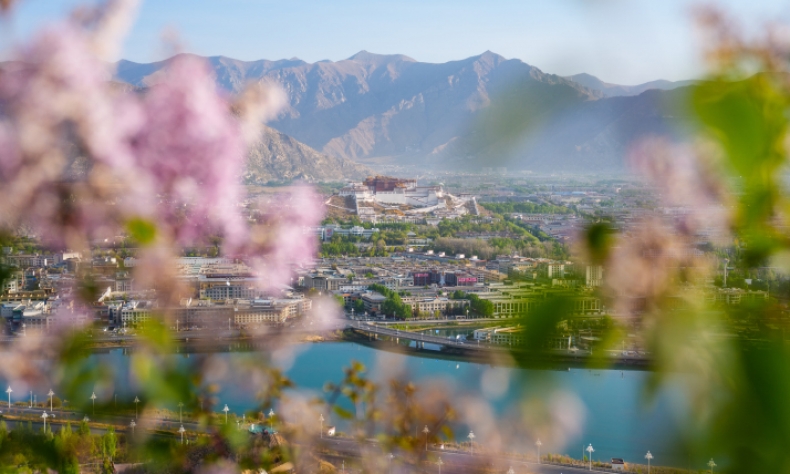
Over the past 75 years, Xizang has not only undergone a historic social transformation but has also ushered in a remarkable chapter in ecological civilization on the Qinghai-Xizang Plateau.
It’s early summer in Lhasa, capital of Xizang Autonomous Region. Huang Shuaishuai, a researcher at the School of Ecology and Environment at Xizang University, leads a group of students as they carefully look for mushrooms among grasses and shrubs in South Mountain Park on the southern bank of the Lhasa River, which runs through the city. In Huang’s eyes, every small mushroom emerging from the soil is a signal of ecological change in Lhasa.
“Growing mushrooms is far more demanding than growing most plants,” Huang told Beijing Review. “Their appearance in the South Mountain Park in the rainy season indicates that the overall climate in the area is improving. It also means that humidity levels and the richness of organic matter in the soil have met the conditions required for fungal growth.”
This change is partly due to increased rainfall in recent years and to the greening project on the mountains north and south of Lhasa, the first large-scale ecological restoration initiative in a Xizang river valley area.
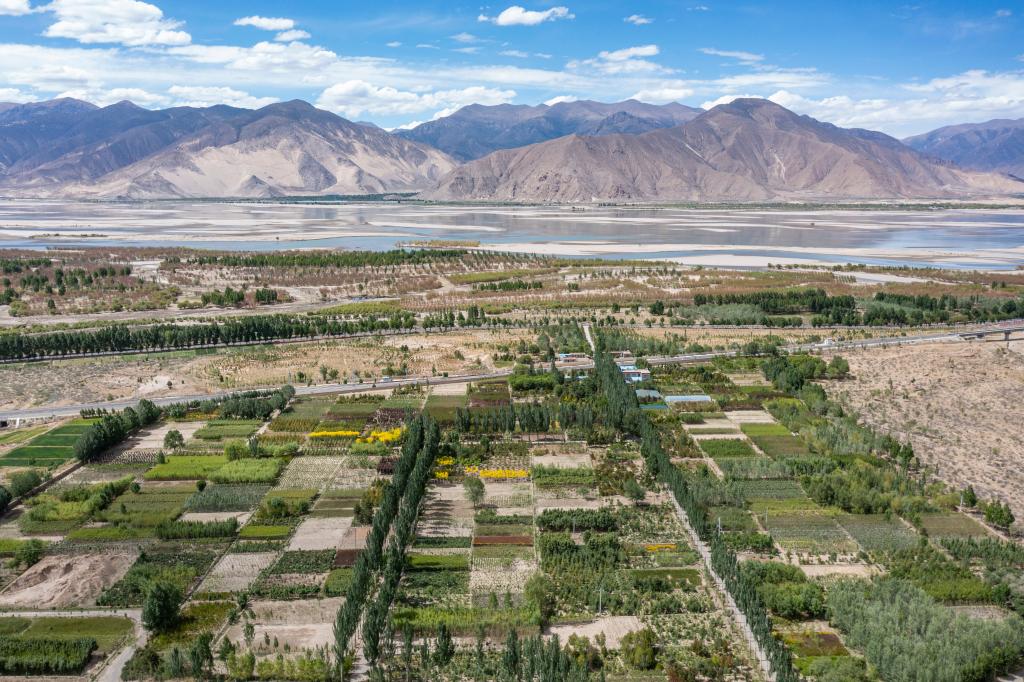
The city of Lhasa sits in a long, narrow river valley through which the Lhasa River flows, with mountain ranges rising to the north and south. In the past, these slopes were mostly barren, with sparse shrubs and vegetation.
To curb grassland degradation and desertification and to improve the environment for residents, Xizang launched the Lhasa North-South Mountains Greening Project in 2021. Stretching nearly 200 km along the Lhasa River and covering nine counties and districts in the cities of Lhasa and Shannan, the project aims to create about 137,800 hectares (ha) of new forests over one decade, turning Lhasa into a city embraced by green mountains and clear waters.
Mission impossible?
Known as the “City of Sunshine,” Lhasa receives intense sunlight. Annual precipitation is approximately 500 millimeters, while evaporation exceeds 2,000 millimeters. The north and south mountains lie mostly between 3,600 and 4,100 meters above sea level, where soils are thin and gravel content reaches 60 to 70 percent. Striking the ground with a shovel just leaves a shallow white scratch. Many experienced foresters used to say that “trees simply cannot grow on rocks.”
Strong plateau winds, thin air, poor soil and limited water and infrastructure all posed formidable challenges. In 2012, Xizang launched a pilot high-altitude afforestation project on the South Mountain range at elevations above 3,900 meters. Of the first 1,000 seedlings planted, fewer than 300 survived.
The local government didn’t flinch. They adopted a gradual, science-based approach in greening the region plot by plot, and efforts expanded to the northern mountains in 2018. These early experiments achieved a breakthrough in artificial afforestation in semiarid areas above 3,900 meters and provided valuable data for later large-scale greening work.
Water is one of the most critical factors affecting survival rates of artificial forest. To bring water uphill, project teams have built elevated reservoirs and pipeline systems that allow for gravity-fed irrigation, effectively solving the long-standing problem of water scarcity in this high-altitude environment.
Choosing suitable species is equally crucial. Because of the cold, dry and windy plateau climate, many common tree species cannot survive in Xizang. The project team therefore selected suitable native species, among which the walnut tree is particularly representative. To identify the most appropriate varieties, researchers studied walnut population across the region, selecting superior trees for propagation.
They also introduced species from neighboring high-altitude provinces and regions including Qinghai, Gansu and Ningxia. After 180 days of local acclimatization, only seedlings that passed strict testing were planted on the mountains. In the end, more than 30 species, including Chinese pine, walnut, wild apricot and Russian olive, stood out as the main forces in greening the plateau.
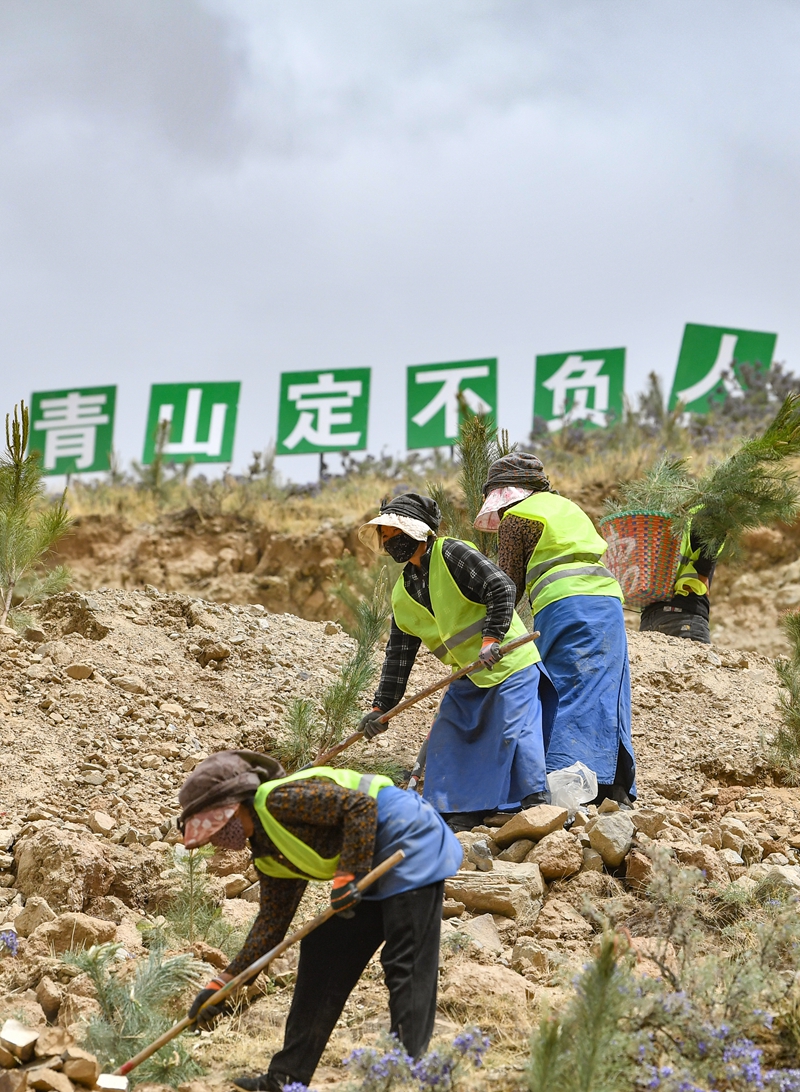
According to Sonam Wangdu, head of the greening project’s expert group, the northern and southern mountain ranges now feature a mix of deciduous and evergreen trees, alongside a variety of shrubs. Based on the environmental conditions at different elevations, trees are planted below 3,900 meters, shrubs between 3,900 and 4,100 meters, and above 4,100 meters restoration relies mainly on sowing seeds and natural regeneration.
Sonam Wangdu previously served as the deputy director of the Xizang Forestry and Grassland Administration. After retiring in 2020, he volunteered to lead the greening project’s expert team. They developed tree planting techniques for the rocky, sun-exposed slopes of the northern mountains, including drilling deep holes, adding transported soil and building stabilizing structures such as earthbag retaining walls. He also compiled a bilingual technical manual, in Tibetan and standard Chinese, and helped train a local team of more than 600 technical workers. “One person plants slowly; many people together can grow a forest,” he told newspaper Xizang Daily.
In 2021, Xizang issued the Plan for the Lhasa North-South Mountains Greening Project (2021-30), bringing the initiative under a more systematic and institutional framework. The following year, more than 30 supporting policies, including the Regulations on the Management of the Lhasa North-South Mountains Greening Project, were introduced to provide legal and institutional guarantees for the project’s long-term continuity.
Smart greening
On steep plateau mountains, traditional labor-intensive planting methods are inefficient and difficult to sustain. In the very beginning, saplings were carried uphill either by hand or on pack animals.
Tree planters like Buchung from Gonggar County, Shannan, used to carry saplings uphill on their backs. “Each trip I would carry three saplings,” he told Xizang Daily. “But after only a short climb, you might slip on loose sand and slide back down.”
Since 2022, the greening project has incorporated drones. Each one can carry six to eight saplings at a time and complete a round trip in about six minutes, greatly shortening planting cycles while reducing damage to the seedlings.
Technology has also facilitated seedling cultivation. At the nursery of Xizang Zangjian Wusheng Landscaping Co., intelligent color-sorting machines have replaced manual seed selection, while biodegradable containers and water-retention agents have increased the initial survival rate of seedlings from about 30 percent to more than 75 percent.
A smart forest management system has also been introduced. Given the rugged terrain and complex valleys of the northern and southern mountains, project teams have used remote sensing, big data, the Internet of Things and AI to build a digital monitoring network capable of tracking forest fires, rangers patrol routes, irrigation equipment and tree growth in real time.
Five years into the decade-long effort, many trees have already grown from 1.5-meter saplings into trees 4 to 5 meters tall. “Planting is only 30 percent of the work; 70 percent lies in management,” Sonam Wangdu said. “Growing a tree is like raising a child, you must care for it year after year.”
Creating jobs
Green is gold. The greening project is improving not only the natural landscape but also local livelihoods.
The greening project is led by the regional government and involves multiple stakeholders, including enterprises, farmers and herders. Many local residents have been hired to plant trees and manage the artificial forests. To date, the project has created many employment opportunities and generated over 3.3 billion yuan ($487 million) in income through both labor and equipment leasing.
In the Shannan section of the project, villagers have pooled funds to purchase professional forestry drones to engage in seedling transport to increase their incomes.
Residents of Rongxiang Township in Sangri County have taken advantage of related subsidy policies to purchase drones and rent them out for carrying seedlings to planting sites. Regular training sessions are also offered to ensure safe operation.
Pubu Tsering, a college graduate born in the township, learned drone operation in Lhasa after hearing that the local afforestation project needed skilled operators. “Now I earn more than 10,000 yuan ($1,479) a month,” he told China News Service. “The job is close to home, and I enjoy it.” In 2025, the per-capita disposable income of rural residents in China was 24,456 yuan ($3,616), with a monthly average of 2,038 yuan ($301).
Ecological benefits are also extending beyond forestry, to tourism. South Mountain Park, built on the greening achievements, now features hiking trails and panoramic viewing platforms from which visitors can overlook much of Lhasa’s urban area, attracting a growing number of tourists.
Expanding green horizons
As of this May, the North-South Mountains Greening Project alone had completed 85,520 ha of afforestation, with a survival rate of over 85 percent. The latest data from the regional government show steady ecological improvement in the greening area.
At a press conference on May 29, Tenpa, a member of the Standing Committee of the Communist Party of China Xizang Autonomous Regional Committee and Executive Vice Chairman of the regional government, said that in the greening region, water conservation capacity has increased by 40.2 percent, the oxygen-producing capacity of vegetation by 8.7 percent and relative humidity by 0.5 percent. Wildlife such as white-lipped deer and foxes are appearing more frequently along the Lhasa River.
The greening project is just one part of the local government’s effort to improve the region’s environment. Over recent decades, Xizang has implemented a series of ecological protection and restoration programs, including natural forest conservation, grassland restoration and wildlife protection.
This year is the 75th anniversary of the peaceful liberation of Xizang. In 1951, the Central Government and Xizang’s local government signed an agreement for the peaceful liberation of Xizang, also known as the 17-Article Agreement, achieving the peaceful liberation of the region, an important step in the reunification of the Chinese mainland, while the feudal serfdom system was initially preserved. In 1959, democratic reforms abolished the theocratic feudal serfdom system, granting personal freedom to about 1 million serfs and catalyzing the most profound social transformation in Xizang’s history. The establishment of Xizang Autonomous Region in 1965 formally implemented the system of regional ethnic autonomy, allowing all ethnic groups to exercise their right to self-governance.
Over the past 75 years, Xizang has not only undergone a historic social transformation but has also ushered in a remarkable chapter in ecological civilization on the Qinghai-Xizang Plateau. As Sonam Wangdu hopes, the mountains north and south of Lhasa will one day become not only forests but also a vast “ecological classroom,” showing how the people of the plateau, using their own hands and knowhow, have transformed barren mountains into green landscapes.