Turpan Is China’s Hottest City, Yet Also One of Its Most Resilient
 Facebook
 Twitter
 Linkedin
 Google +
Turpan is a case study in how human resourcefulness adapts to its environment instead of being defeated by it, and in how a regional culture can hold onto its identity while building something new on top of it.
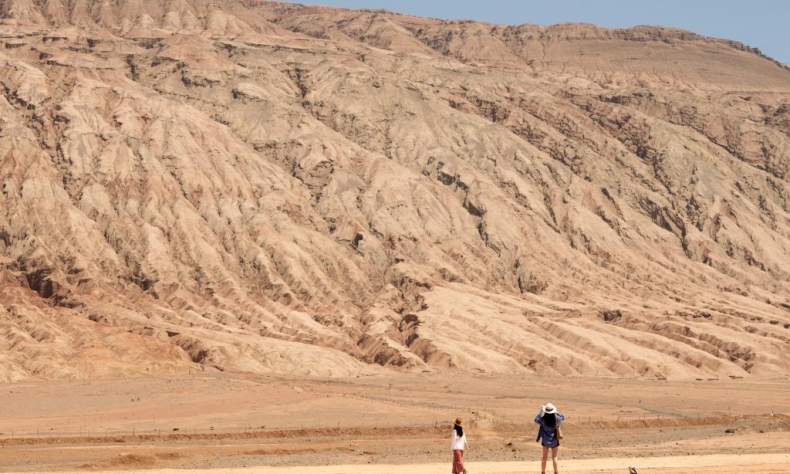
Turpan sits in a basin that drops below sea level, sitting just south of the Tianshan Mountains, and it holds the record for the hottest average temperatures in China. Daytime highs in the summer regularly push past 114 degrees Fahrenheit, with peaks well above 122 degrees Fahrenheit. The ground itself gets hot enough to fry an egg.
Yet people have lived here continuously for thousands of years, not simply surviving but trading, farming, building, and raising families. The valley around Turpan is home to roughly 150,000 people who have been growing fruit in this desert for more than two thousand years.
Then, how does a place this hostile become a place this alive?
Karez wells sustain Turpan’s life and economy
The answer starts underground, in one of the more creative pieces of engineering in Chinese history. Long before mechanical pumps existed, the locals of Turpan figured out how to tap melting snow from the Tianshan Mountains and route it through underground tunnels called karez wells, all the way down into the basin, without losing the water to evaporation along the way. More than a thousand of these wells remain in use today, connected by tunnels that stretch over thousands of miles across the basin. Individual wells range from as shallow as seven feet to as deep as seventy or eighty feet before reaching the tunnel system. The water moves entirely by gravity, no machinery involved, just a slope calculated correctly two thousand years ago and maintained ever since.
This system is why Turpan served as a major stop on the ancient Silk Road, providing merchant caravans and their animals with a reliable place to hydrate, rest, and resupply before continuing beyond the Taklamakan Desert. The karez system still functions today, not as a museum piece but as working infrastructure that continues to irrigate the region.
An entire city, carved into cliffs
That same ingenuity shows up again at the Jiaohe ruins, an ancient city built on a plateau between two river valleys, where residents carved their homes, temples, and government buildings directly into the earth rather than building up. The extreme heat made conventional construction impractical, so an entire city went underground instead. The site’s natural cliffs, more than 100 feet high on every side, served as a defensive wall, which is part of why the city never needed to build one of its own. At its peak, thousands of people lived there, supported by Buddhist temples and monasteries scattered throughout the settlement.
The old main street and the layout of homes carved more than a thousand years ago are still traceable today, along with the remains of a large Buddhist temple at the city’s northern end. It is one of the best-preserved earthen ruins anywhere in the world, a survival owed largely to Turpan’s brutal, dry climate.

A valley that feeds the entire nation raisins
None of this would matter much if Turpan were only a historical curiosity, but the same resourcefulness that built the karez wells is now evident in the region’s economic development. Grape Valley stretches about five miles through the desert just east of the city, fed entirely by that same ancient karez irrigation system. It is known for a variety of grapes called manaizi. Turpan’s raisin production accounts for more than 80 percent of China’s entire output, making it the world’s largest producer of green raisins and the third-largest raisin producer overall. That is not a niche regional industry. That is a desert basin quietly supplying most of a country’s raisins.
Not far from Grape Valley, in a village called Xinchengximen, a raisin processing factory has become a genuine economic engine for the area, employing close to a thousand local villagers and shipping fruit products across the country at significant speed and scale. The majority of those employees are Uyghur, and the factory has become a case study in how a single piece of agricultural infrastructure can lift an entire community’s income. President Xi Jinping visited the village and the valley a few years ago, specifically to highlight how the region is building industries around its fruit production rather than relying solely on subsistence farming. The result is an economy that is simultaneously ancient and actively modernizing, anchored in two-thousand-year-old soil but increasingly plugged into national supply chains and e-commerce, with local farmers and entrepreneurs now selling raisins, wine, and other regional goods directly to consumers through livestreaming platforms.
What stands out most, though, is not the ruins or the factory. It is how visibly Uyghur culture continues to thrive throughout the region. At sites like the Karez Folk Custom Park, ethnic dance performances and vendors selling traditional snacks reflect daily life rather than staged tourism. The Uyghur language is present everywhere, in conversation, in signage, within the rhythm of the place. Grape Valley itself is not a sanitized tourist set piece either. It is full of working vineyards and family-run wineries, run by people who have been making wine in this exact spot for over 2,000 years, adapting their methods without abandoning the tradition beneath them.
For anyone who has encountered Xinjiang only through headlines, Turpan offers a very different picture: a region where Uyghur culture, language, food, and daily life are not just preserved but are visibly and confidently present.
A desert city that has refused to give up for thousands of years
Turpan is not an easy place to live, and that is precisely what makes it worth paying attention to. This is a city that should not exist by any normal logic. The heat is extreme enough to be dangerous, and desert presses in from every direction. And yet here is a place with thousands of years of continuous civilization, an irrigation system still functioning after two millennia, ruins that have outlasted entire empires, and a modern economy built on grapes grown in conditions that would kill most agriculture outright.
Turfan today is also a base of clean coal, extraction of oil and gas, and industries of clean energy and silicon-based new materials.
Turpan is not a footnote to Xinjiang. It is a case study in how human resourcefulness adapts to its environment instead of being defeated by it, and in how a regional culture can hold onto its identity while building something new on top of it.