A Partnership With Broad Potential
 Facebook
 Twitter
 Linkedin
 Google +
There is tremendous potential for cooperation between China and Mexico, and that is what we are working toward.
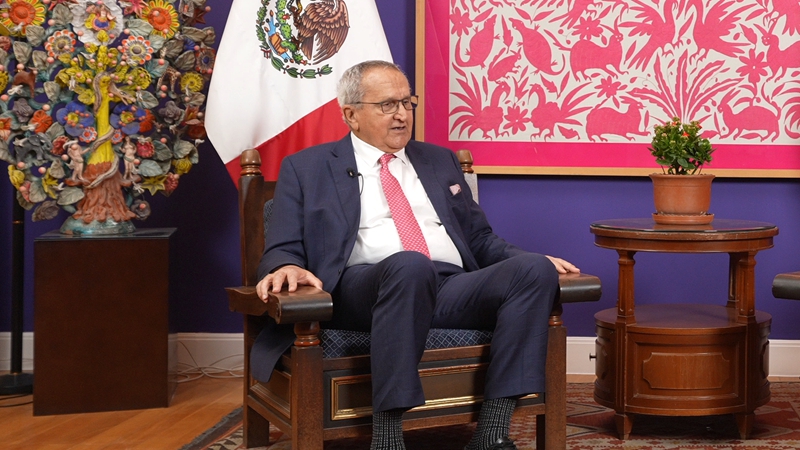
China-Mexico relations are entering a new phase of opportunity in areas such as trade, investment, energy transition, tourism and cultural exchange. To explore the prospects of bilateral comprehensive strategic partnership and the areas of cooperation with the greatest potential, Beijing Review reporters Lin Yeqing and Li Qing interviewed Jesús Seade, Ambassador of Mexico to China, on February 10. With nearly two decades of experience living and working in China, Seade shared his perspective on the future of bilateral cooperation, progress in emerging sectors such as green energy and the automotive industry, the growth of tourism and people-to-people exchange.
Beijing Review: How do you assess the complementarity and potential of both economies, and what can be expected in the future as bilateral relations develop?
Jesús Seade: Indeed, both countries demonstrate strong complementarity and many similarities, with truly remarkable ties. They are two ancient civilizations with distinguished cultural histories, both long oriented toward trade and maintaining an extraordinary commercial relationship.
In 1565, a trade route was established between Acapulco in Mexico and China, with Manila in the Philippines as a key hub. This gave rise to shared traditions and a long history of commercial and human exchange. Centuries have passed, and both countries remain nations with a strong commercial spirit.
China is a major global economic and trading power. Mexico, for its part, is Latin America’s largest exporter of manufactured goods. In some respects, we may be competitors, and that can occasionally present challenges. But precisely the shared focus on production and trade makes us natural partners in manufacturing.
As a result, there is tremendous potential for cooperation between China and Mexico, and that is what we are working toward. Chinese investment in Mexico has grown considerably, and China is already our second largest trading partner, despite the distance. There are many areas in which we seek to deepen collaborative development. In short, there is great room for advancing together, especially in trade and, above all, in production and investment.
Green energy has become a new driver of cooperation between China and Mexico. What complementary advantages exist between the two countries in this field? How can cooperation be further deepened in the future to achieve mutual benefit?
This involves the development of a very large and complex industry for the future. We have a strong interest in advancing it together with China, which is the country that has made the greatest progress in this field. I live in Beijing, and as I move around the city, I see more and more green license plates corresponding to new-energy vehicles. I have read that in the second half of 2025, for the first time, more new-energy vehicles than traditional vehicles were sold in China.
Mexico is much further behind; in fact, almost the entire world is. No one has achieved advances of this magnitude, but Mexico has a strong interest in moving in this direction. However, we face a challenge: We have a very strong automotive industry, which is the country’s largest employer. This sector has encountered difficulties maintaining production and sales levels in the face of vehicles arriving from China.
Therefore, we seek to build a gradual and careful relationship, but one clearly oriented toward increasing participation by Chinese industry in Mexico.
Currently, we are already developing a major plant that will produce vehicles for a couple of companies, and there are Chinese production projects in preparation in Mexico. Looking ahead to 2030 or 2035, it is difficult to imagine that China will not have an important automotive production base in Mexico. Since transporting vehicles is complex and costly, it is far more efficient to produce them locally. Mexico offers very favorable conditions in this regard: It is a country with a long tradition in the automotive industry.
Mexico has become the leading Latin American destination for Chinese tourists, and both countries have maintained frequent cultural exchange. How do you evaluate current cultural and tourism exchange? What measures could further strengthen ties between the two peoples in the future?
In 2024, China ranked 10th as a source of tourists to Mexico. However, that position does not reflect its true potential. Last year, it rose to ninth place, and the trend continues upward.
As you noted, Mexico is a main destination for Chinese tourists in Latin America. Even so, the overall number remains limited. We have worked extensively to improve connectivity. Currently, there are two direct passenger flights between China and Mexico: one from Beijing to Mexico City, operated by Hainan Airlines, and another from Shenzhen [in Guangdong Province] to Mexico City, operated by China Southern Airlines. Every time I travel from Beijing, the plane is full. It makes me very happy. They began with two flights per week, and now they operate daily. I hope we will soon have a third direct flight from Shanghai.

Moreover, tourism depends not only on flights but also on traveler interest. In pursuit of this, the Mexico Tourism Fair was held in Beijing last September. In Mexico, we hold the national tourism fair every year, and this was the first time it was held outside the country. It was a great success and helped spark interest not only among the public but especially among Chinese hotel chains, tour operators and tourism companies.
We continue working with airlines and all sectors of the tourism industry to increase visitor flows so that China will become one of the leading sources of tourists, ideally rising to second or third place. That is the level that corresponds to our mutual interest, cultural affinity and the scale of China’s economy and population.
The annual full sessions of the National People’s Congress (NPC), China’s top legislature, and the National Committee of the Chinese People’s Political Consultative Conference (CPPCC), the top political advisory body, collectively known as Two Sessions, will be held in Beijing in early March. What are your expectations for the meetings?
The Two Sessions are an annual event, but they now coincide with a new five-year plan [for national economic and social development], which, as its name indicates, is prepared every five years in China. Those of us who have observed China for a long time understand the fundamental importance of these plans.
I have served as ambassador for four and a half years and have spent a total of 18 years living in Hong Kong, Shenzhen and Beijing, working and observing the country’s development.
The five-year plan is China’s review of what it has been doing and its definition of priorities for the years ahead. This will be presented alongside the Two Sessions, which constitute the country’s most important annual political event. For this reason, we all watch with great interest to see where things are heading.
I am also very interested in the Two Sessions because I see them as a clear expression of China’s model of democracy. In China, democracy takes a different form than in many other countries. It is based on a consultative process that begins at the most basic levels and is articulated upward through all levels.
As an economist, I have studied the importance of these consultative processes and consider them fundamental. On one occasion, I read a detailed microeconomic study on the functioning of Hebei Province’s economy in north China, which showed that public officials’ evaluation systems play a decisive role in their career advancement.
While political advancement in other countries may depend on personal relationships or other factors, in China it is closely linked to governance performance. The consultative process forms the core of this system. It also reflects intellectual roots that can be traced back to Confucian thought.