Aggression by Design
 Facebook
 Twitter
 Linkedin
 Google +
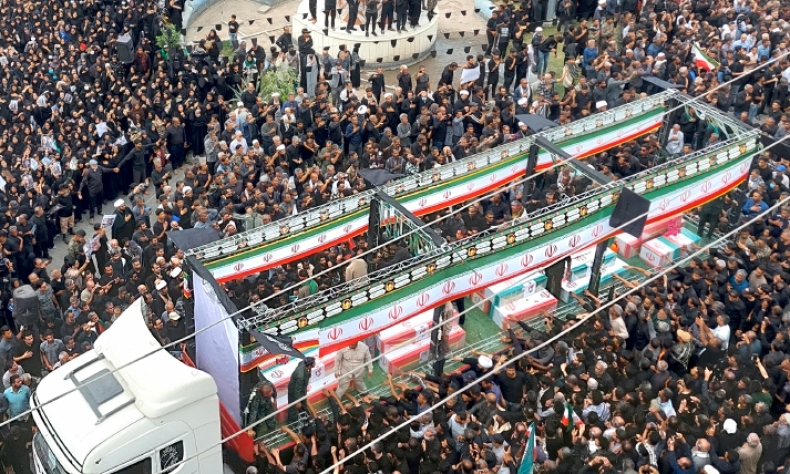
What Washington is willing to do should not be underestimated, including what it is willing to do to Iran, and what it is willing to allow happen to Israel in the process, since Washington’s ultimate objective is to preserve its unipolar world order.
The U.S. recommenced its war of aggression against Iran in the late morning of February 27, Tehran time, with U.S. missiles and Israeli warplanes carrying out coordinated strikes targeting Tehran and other Iranian cities.
This escalation of military aggression should come as no surprise.
Even at face value, rounds of indirect negotiations between the U.S. and Iran were illegal, illegitimate and, especially on the U.S. side, overtly empty rhetoric. Stretching back as far as 2009, U.S. policy papers revealed U.S. intention to use diplomacy as a pretext for launching a war, not preventing one, with negotiations in June of last year used as a cover for launching the first phase of this now escalating round of aggression.
Days prior to the attack, on February 25, U.S. political news platform Politico reported the preference within the White House for Israel to attack Iran first, saying retaliation by Iran would create the context the Donald Trump administration needed to launch its assault in the eyes of American voters.
No right to hold talks
Washington has no authority under international law to arbitrate the nuclear or arms programs of other nations. Any concerns the U.S. had and any evidence it possessed to substantiate them should have been presented to the world through the proper channels at the United Nations the U.S. itself helped create. Instead, knowing it had no evidence-based case to make against Iran, the U.S. used the threat of illegal economic sanctions and military aggression to force Iran into its so-called talks.
Just as was clear before the U.S.-organized and led strikes on Iran were carried out in June 2025, it is now likewise clear the U.S. was simply using the cover of diplomacy as a means to justify, first the transfer of large amounts of military equipment into the region, then the use of it in its continued aggression against Iran.
The 2009 Brookings Institution paper Which Path to Persia? explicitly stated that “for those who favor regime change or a military attack on Iran (either by the United States or Israel), there is a strong argument to be made for trying [diplomacy] first. “
The paper went on to explain that the best time to carry out a strike would be when “there is a widespread conviction that the Iranians were given but then rejected a superb offer—one so good that only a regime determined to acquire nuclear weapons and acquire them for the wrong reasons would turn it down. “
The paper would conclude that “under those circumstances, the United States (or Israel) could portray its operations as taken in sorrow, not anger, and at least some in the international community would conclude that the Iranians ‘brought it on themselves’ by refusing a very good deal. “
The paper itself admits the ultimate goal is regime change and that the only purpose of using diplomacy was as cover for instigating a regime change war.
That is precisely what the U.S. did last year, and has now done again.
Provocateur and disposable proxy
Just as the U.S. is using Ukraine as both provocateur and disposable proxy in its war on Russia, and is using nations like the Philippines and Japan as well as China’s island province of Taiwan to encircle and provoke China, the U.S. has used Israel for decades as a reliable proxy, provocation and scapegoat, while advancing U.S. foreign policy objectives in the region.
This includes the role Israel played in the destruction of Syria, the initial armed strikes carried out—first against Iran’s consulate in Damascus, Syria—then Israel’s strikes on Iran itself during the final year of the Joe Biden administration—as well as creating the very pretext to which the 2009 Brookings paper referred, allowing the U.S. to wade into direct conflict with Iran itself last year.
In the lead up to this most recent attack on Iran, Israel was once again used in this role, attempting to convince the global public that America sincerely sought diplomacy and that it was Israel obstructing it.
Now, as U.S. and Israeli military capabilities are used to attack Iran in tandem, it is clear the U.S. always intended to continue the direct confrontation that Washington started last year, and do so as a follow-up to the decades of proxy war, political interference and economic strangulation the U.S. has targeted Iran with since the late 1970s.
As the conflict with Iran continues—and just as the U.S. has done with Ukraine—Israel will be tasked with absorbing the majority of the blame, the brunt of Iran’s retaliation, and any other action required to weaken and topple the Iranian Government for which the U.S. itself does not want to take direct, public responsibility.
The end game
While U.S. representatives claim this conflict is meant to be short and focused, it has already become larger and more drawn out than last year.
The two possibilities are that first, the U.S. and its proxies carry out strikes on Iran attempting to maximize damage and collapse the government. Should both U.S. offensive and defensive capabilities be stretched thin and Iran able to weather the aggression, the U.S. has already built its own off-ramp to use, with Trump having already claimed the strikes might be “limited.”
Just as the U.S. did last year, it could use a pause in its aggression to replace spent munitions, reorganize its forces both in the region and around the globe, and attempt to undermine Iran both economically and politically to increase the chances of a more successful follow-up attack.
The U.S. has already used this process to wear down and hollow out Iran’s ally Syria—resulting in the collapse of the country’s government in late 2024. The U.S. appears to be using this process to grind down Iran while avoiding a costly, drawn-out “forever war” the U.S. fears might undermine its ongoing proxy wars and military build-ups taking place against both Russia and China.
However, if the U.S. believes Iran, in particular, is building up its defensive military capabilities at such a rate that even intermittent U.S. strikes on the nation cannot reverse, a prolonged conflict may continue.
Because Washington’s ultimate objective is to preserve its unipolar world order and prevent the rise of rival states or blocs of states, and especially to prevent the reemergence of Russia or the rise of China, and because toppling Iran and capturing the Middle East and the hydrocarbons contained therein serves as a prerequisite to do so, what Washington is willing to do should not be underestimated, including what it is willing to do to Iran, and what it is willing to allow happen to Israel in the process.
The author is a Bangkok-based independent geopolitical analyst and a former U.S. Marine.