China’s Messages to the U.S.
 Facebook
 Twitter
 Linkedin
 Google +
Without practicing benevolence and righteousness, the balance of power in offense and defense changes.
Perhaps the most remarkable quality of the recent foreign minister’s press conference at the midpoint of the Two Sessions was its dialectic of diplomatic candor. When it came to discussing China-U.S. relations and, by extension, Israeli policies toward the Palestinian people and Iran, Wang Yi communicated clear messages but carefully avoided proper names. To be sure, he mentioned the U.S. several times, including asserting this will be a big year for bilateral ties, but he did not mention the U.S. (or Israel) by name when speaking directly about a large number of problems around the world—quite a different approach to when he was speaking critically about the new militarism in Japan, the separatists of Taipei, or when speaking positively about China’s strategic partnership with Russia and ongoing reconciliation with India, among others.
On the one hand, we might be tempted to read this in part as a diplomatic echo of U.S. President Donald Trump’s recent State of the Union speech, in which he never mentioned China directly, to the surprise of many. On the other hand, we also understand the two different paradigms of respect that appear to be guiding bilateral ties presently: For China, respect always relates closely with national dignity; for the U.S., it relates closely with personal ego. To be sure, regardless of what some Chinese leaders might think, you’ll probably never hear discourse directed against the U.S. as we hear from Tehran or even some Americans themselves, e.g., the allegation of state capture by an “Epstein class” that rapes and kills children. This is in contrast to the fact that the White House itself, despite its current relative self-discipline, has frequently hurled undignified vitriol, including falsehoods, at China and China’s strategic partners.
Nevertheless, in this moment of growing global turbulence, we should understand that efforts by both the U.S. and China to exercise détente-discourse absent an actual détente speak to two possibilities. The first is the need to preserve communications that we all should hope will mitigate a downward spiral in relations that would be catastrophic for everyone. The second is to create real opportunities, if possible, for improving relations, perhaps even curtailing U.S. foreign aggressions, which likewise risk downward spirals.
Messages for the U.S.
The messages for the U.S. were rather clear. On the one hand, Wang Yi reiterated the important Beijing position that head-of-state diplomacy is vital for major power relations, and suggested that, for the moment, we can expect a possible summit including Chinese President Xi Jinping and U.S. President Donald Trump to move forward, although no date was announced. On the other hand, he also made it clear that such a meeting requires mutual respect and that much work needs to be done to mitigate risks that might prevent the summit from happening or to ensure no disruptions should it move forward. While Wang said this was a “big year” for bilateral ties, and expressed optimism, we should not interpret this as a firm prediction that ties will improve.
Indeed, there is a sober understanding they can go one way or another, a point he made more explicitly when discussing Japan, when he said Japan can make a choice whether it wants better relations, after condemning Japan’s flirtations with old militarist discourses and Chinese redlines related to Taiwan. Similarly, because the U.S. is the aggressor, because the U.S. has also flirted with redlines related to Taiwan and attacked Chinese strategic partners, because the U.S. has instigated trade wars and reinforced technology blockades, it’s really up to whether the U.S. continues to escalate conflicts that aim to diminish or contain China, or whether it is ready to move forward in a new era of peaceful great power relations.
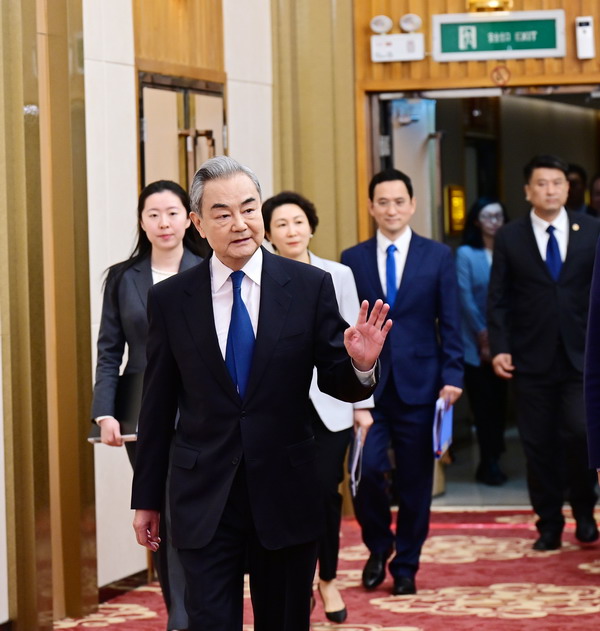
However, by way of an ancient Chinese idiom, which is being widely discussed in various media, Wang also said, “Without practicing benevolence and righteousness, the balance of power in offense and defense changes.” This is a classic statement by Jia Yi, a political theorist of the Western Han Dynasty (202 B.C-A.D. 8), in his renowned essay On the Faults of Qin, which asserts that failing to practice benevolence and righteousness leads to destruction—a point many Chinese regard as a “historical law.” Wang Yi’s point was to stipulate that the type of aggression we see from the U.S. today will see power shifting to those who offer a better alternative, which is completely in line with China positioning itself as exemplifying a better alternative to the U.S. when it comes to their respective approaches to international affairs.
Separately, despite acknowledging that China-U.S. ties are perhaps the most important in global affairs today, he categorically rejected the “G2” proposal heard previously from the American side. Instead, he noted there are more than 190 countries, and it would be wrong for two of them to try to run the world. He admitted “multilateralism is under severe shock,” but said China has responded with efforts to rally international support for global governance and the United Nations especially. He also reinforced Beijing’s view that China is a champion of the Global South and for peace and development in Asia especially; but as we know, China tries to lead from the middle as a means of resisting anyone believing it seeks its own hegemony.
He also indirectly touched on Trump’s Board of Peace, which China, like many countries around the world, including most of America’s Western allies, has refused to join. Wang said no mechanisms should move forward that might potentially subvert the UN—a criticism some experts have raised about the Board of Peace. Furthermore, he touched more directly on the Palestinian issue, which is the first order of business for that board.
Messages for Israel
What Wang said with respect to Palestine is that “any other arrangements or new mechanisms must reinforce, rather than undermine, the two-state solution.” Of course, we know that the Israeli Government is fundamentally opposed to the two-state solution, and this position has been accommodated by the U.S., arguably to the point of genocide. While Wang welcomed effort by the international community to bring about a ceasefire, he stressed that “the situation in Gaza tests the very foundation of international justice.” Again, contrary to the Israeli and American position, he asserted the UN should play the leading role in advancing peace and a political settlement.
He stated that turmoil and war need not be the fate of the Palestinian people. They have a legitimate right to be free from war and to enjoy peace and development. As a responsible major country, China will continue to support the Palestinian people in pursuing their legitimate national rights and will facilitate international efforts to restore justice to the Palestinian people.
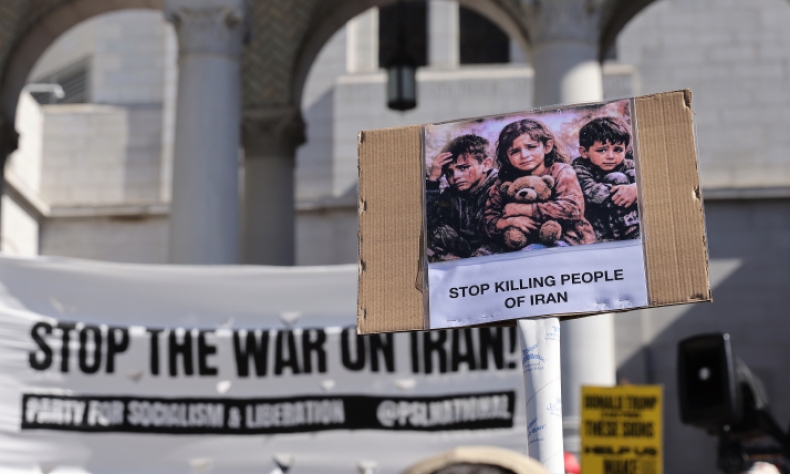
Separately, he touched on the U.S.-Israeli-instigated war against Iran, saying “This is a war that should never have happened, and one that benefits no one.” He reiterated China’s call for an immediate ceasefire and a return to diplomacy. He said the historical experience of conflict in the Middle East demonstrates that force is not the way to resolve problems, and resorting to arms will only breed new hatred. He punctuated his remarks with another Chinese idiom, a quote from Han Feizi, “Weapons are instruments of misfortune; their use must be carefully considered.”
The author is a professor of politics and international relations and director of the Center for Ecological Civilization at East China Normal University in Shanghai. He is also a senior research fellow with the Institute for the Development of Socialism with Chinese Characteristics at Southeast University in Nanjing.