Connecting Xinjiang, Linking Eurasia
 Facebook
 Twitter
 Linkedin
 Google +
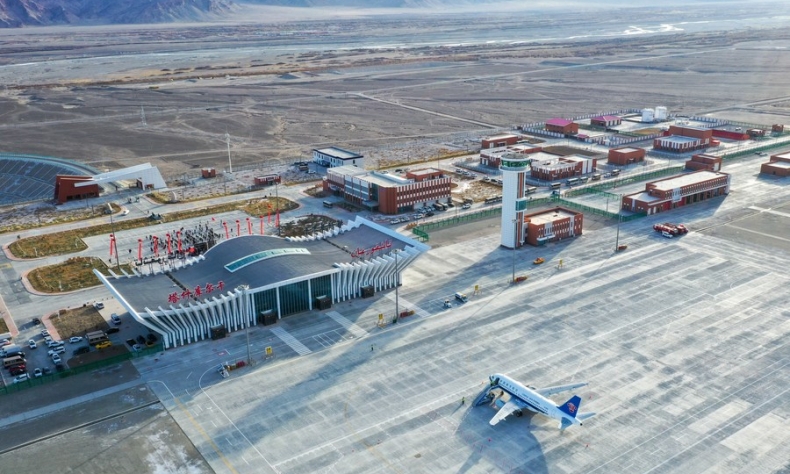
Driven by the Belt and Road Initiative, Xinjiang is seeking to become a ‘golden corridor,’ a multi-modal logistics and trade artery connecting China with Central Asia, South Asia, the Middle East and Europe via railways, highways, air routes and border ports.
The infrastructure network, service standards, operational efficiency and safety of the transportation sector in Xinjiang have been greatly improved during the 14th Five-Year Plan (2021-25) period, providing strong support for high-quality development of the autonomous region, according to a press conference held by the Information Office of the People’s Government of Xinjiang in Urumqi on December 18, 2025. Guo Sheng, Secretary of the Communist Party of China Committee of the regional Department of Transportation and Deputy Director of the department, as well as officials from the railway, civil aviation and postal sectors, briefed the media on the progress at the event.
Leap in scale
A comprehensive three-dimensional transportation network is coming up rapidly. The region today has over 9,000 km of railways, connecting all prefectures and cities, and covering more than 80 percent of county-level administrative regions.
Xinjiang had 237,000 km of highways, including more than 13,000 km of expressways and first-class highways at the end of 2025. Expressways had been extended to all prefectures and cities. Over 100 counties and cities had been connected by first-class highways.
Currently, there are 28 airports in operation in Xinjiang, ranking first in the country, with 665 operating air routes. The region also has over 17,000 postal and courier service outlets.
During the 14th Five-Year Plan period, fixed assets investment in Xinjiang’s transport system estimatedly exceeded 440 billion yuan ($ 63 billion).
A number of landmark projects have been completed and put into operation, such as the Hetian (Hotan)-Ruoqiang Railway, the capacity expansion and renovation of the Golmud-Korla Railway, the G7 Beijing-Urumqi Expressway and the Urumqi Tianshan International Airport. The vision of “building a transport ring within Xinjiang, accelerating movement of people and goods between the region and the rest of the country, ensuring smooth north-south connectivity across Xinjiang and strengthening cross-border transportation services” is becoming a reality.
Support for strategic implementations
Pilot projects launched in Xinjiang under the initiative to build China’s strength in transportation have been progressing steadily, with their achievements recognized by the Ministry of Transport. The transportation bottlenecks restricting the coordinated development of north and south Xinjiang are being eliminated rapidly.
The G0711 Urumqi-Yuli Expressway has been completed and was opened to traffic by the end of 2025, shortening travel time from Urumqi to Korla from seven hours to about half of that and ensuring a smooth passage between the northern and southern sides of the Tianshan Mountains.
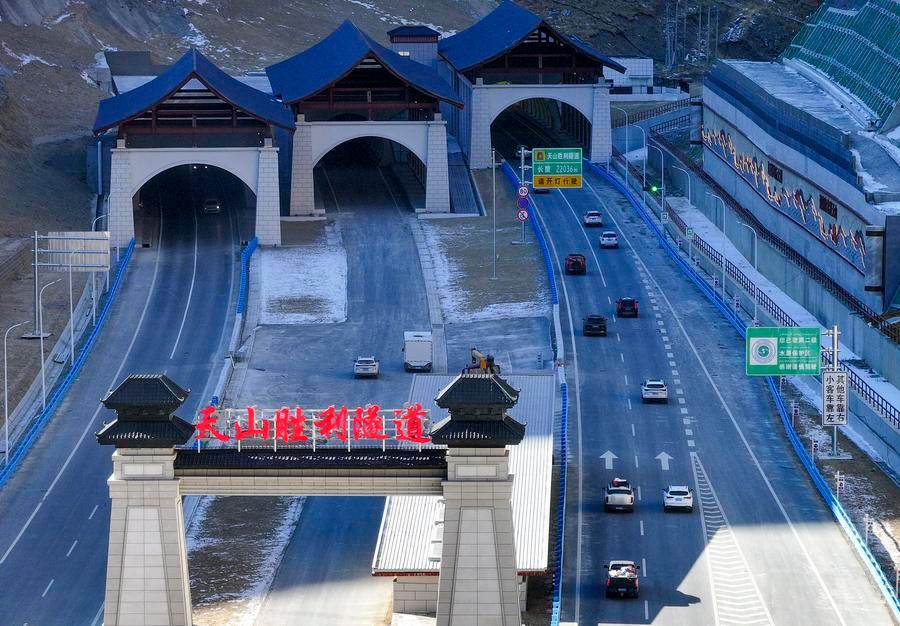
Key transportation projects connecting north and south Xinjiang, such as the Yining-Aksu Railway and the G3033 Kuitun-Dushanzi-Korla Expressway, have started construction.
The transportation foundation for rural revitalization is being consolidated. The rural road network in the region now spans 162,000 km, covering almost 875 towns and more than 9,000 administrative villages. All towns, townships and administrative villages that meet the necessary conditions now have access to paved roads, scheduled passenger transport and postal services.
The integrated development of transportation and tourism has powerfully supported the implementation of the strategy of “invigorating Xinjiang through tourism.” Four high-quality railway tourism routes such as the Taklimakan Desert Loop Line, 15 scenic highways with strong social media appeal and four “Cloud Express” aerial sightseeing routes have been launched, offering visitors immersive experiences of Xinjiang’s breathtaking landscapes.
Improved services
Xinjiang has launched the travel service brand Xinjiang Transport, Yakexi. Fast travel lines such as high-speed railways, expressways and air shuttles are efficiently connected with slow traffic networks, ensuring that people travel smoothly and goods move freely.
Digital freight platforms have developed rapidly, transforming the traditional logistics industry by improving efficiency and transparency in matching shippers with truck drivers.
Xinjiang has introduced preferential highway toll policies, and 10 freight hubs such as the Alashankou (Alataw Pass) Comprehensive Bonded Zone Multimodal Transport International Logistics Park have been put into operation.
During the 14th Five-Year Plan period, social logistics costs in the region decreased by 0.7 percentage points. The road freight volume and turnover volume increased by an average annual rate of 11.93 percent and 15.30 percent, respectively.
Urumqi is being built up as an international comprehensive transportation hub, and Kashi (Kashgar), Yining and Korla as national comprehensive transportation hubs. An integrated transport hub system featuring “one core, three poles, and multiple centers” is taking shape at an accelerated pace.
New quality productive forces
Scientific and technological innovation is becoming stronger. There are 25 scientific research platforms at or above the provincial/ministerial level across Xinjiang’s transport sector. During the 14th Five-Year Plan period, eight local projects were included in the Ministry of Transport’s key scientific and technological programs, nine projects under the regional scientific and technological plan were approved, and two projects were listed the national database of major scientific and technological innovation achievements in transportation.
Substantive breakthroughs have been made in key technologies such as the construction of extra-long highway tunnels in alpine and high-altitude areas and highway construction and maintenance in desert areas, providing valuable experience for tackling technological challenges in similar environments.

Xinjiang has become the first provincial-level region in northwest China to be included in the national demonstration project for the digital transformation of highway transportation infrastructure, which features the large-scale application of unmanned aerial vehicles and autonomous driving technologies. Driven by the Belt and Road Initiative, Xinjiang is seeking to become a “golden corridor,” a multi-modal logistics and trade artery connecting China with Central Asia, South Asia, the Middle East and Europe via railways, highways, air routes and border ports.
The green transformation of transportation is gaining speed. The market share of new-energy vehicles is rising rapidly, energy-efficient and emission-reduction technologies are being widely adopted and charging facilities now cover all expressway service areas, offering robust support for green travel. Xinjiang is renewing transportation equipment on a large scale, with a total subsidy of 1.1 billion yuan ($158 million).
Expanded cooperation
Major interconnectivity corridors supporting Xinjiang’s role as a golden channel across the Eurasian continent and China’s gateway for opening up to the west are being enhanced. Key projects, including Topa-Torugart Port section of the G315 National Highway, are advancing at an accelerated pace.
The China-Europe Railway Express (Urumqi) Assembly Center and a multimodal transport hub for the international rail freight service have been put into operation. More than 50 percent of China’s China-Europe Railway Express trains pass through Xinjiang. To date, 119 bilateral international road transport routes have been established, and cross-border transport and postal services have been fully integrated across highway, rail and air networks, ensuring stability of the international logistics supply chain.
Seven highway ports have adopted a streamlined customs clearance approach and accelerated smart port development. These efforts have cut the average vehicle clearance time from three to six days five years ago to just six to eight hours, greatly improving the efficiency of international road transport.
During the 14th Five-Year Plan period, Xinjiang’s average annual international road passenger volume, freight volume, passenger turnover and freight turnover increased by 144.79 percent, 28.36 percent, 31.53 percent and 421.76 percent, respectively, compared with the 13th Five-Year Plan (2016-20) period.
Improved governance efficiency
During the 14th Five-Year Plan period, Xinjiang issued regulations on rural roads and railway safety, revised the regulations on road transport, accelerated the enactment of regulations on expressways, intelligent connected vehicles and low-altitude economy. Additionally, 48 local standards were released over the past five years.
Administrative procedures have been streamlined, approval powers delegated and public services optimized. A comprehensive credibility oversight system now covers the entire life cycle of transport infrastructure encompassing planning, construction, management, maintenance and operation. Additionally, the one-stop service model enables businesses and individuals to access multiple transport-related government services through a single visit or unified digital platform.