Deeper Pockets, Greater Gains
 Facebook
 Twitter
 Linkedin
 Google +
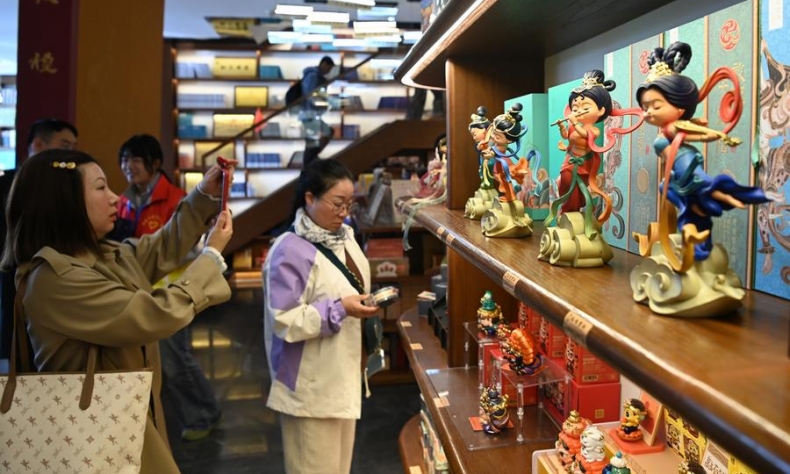
New types of demand are being met with diverse and innovative services and products.
Since 2021, Shi Jing, a musician who plays traditional Chinese instruments in Beijing, has been an enthusiastic collector of pop toys from Chinese designer toy brand Pop Mart. With dozens of collectible toys already in her possession, one of her favorite pastimes is visiting the Pop Mart City Park—a Beijing-based theme park that opened to the public in 2023.
Pop Mart’s Labubu series of plush toys has gained a devoted global fan base over the last year, and Shi particularly likes this one, as well as the Molly and Mokoko series introduced by the brand.
“Having the pop toys at home makes me feel soothed and happy. Every time I see them, it just lifts my mood! The price is also quite affordable,” Shi told Beijing Review.
In August, Pop Mart released its financial results for the first half (H1) of 2025, reporting its worldwide revenue increased 204.4 percent year on year to 13.88 billion yuan ($1.9 billion) and the H1 revenue from China alone reached 8.28 billion yuan ($1.1 billion).
The success of Pop Mart is supported by a vast and still untapped domestic market potential. At the two-day Central Economic Work Conference (CEWC), which concluded in Beijing on December 11, China’s economic agenda for 2026 was set out, prioritizing the expansion of domestic demand and building a robust domestic market. The CEWC, held at the end of every year, outlines the economic strategy and priorities for the year ahead.
China plans to boost the domestic market by implementing pro-consumption initiatives and income growth plans for urban and rural residents, removing unreasonable restrictions hindering consumption and boosting services consumption, according to a news release following the conference.
It was also emphasized that investment will be stabilized and revived with measures such as appropriately increasing the scale of investment within the central government budget, improving the management mechanism of local government special-purpose bonds and advancing high-quality urban renewal.
Wen Bin, chief economist at China Minsheng Bank, told Beijing Review that boosting domestic demand is crucial for economic stability. While China’s exports continue to show resilient growth, external uncertainties continue to mount.
“The meeting highlights the strategic role of domestic demand as the main driver of economic growth. The measures relating to consumption and investment are aimed at addressing a core issue in economic growth—balancing supply and demand,” Wen said.

Enthusiasm for shopping
Final consumption expenditure contributed 53.5 percent to economic growth in the first three quarters of 2025, up 9 percentage points from the full-year figure of the previous year, data from the National Bureau of Statistics (NBS) showed.
China continued the implementation of the consumer goods trade-in program, first introduced in 2024, throughout 2025, and will extend it into 2026. The program encourages consumers to replace outdated products such as home appliances and vehicles through government subsidies. China’s vehicle trade-in scheme has received more than 10 million applications since it began in 2024.
The Central Government earmarked 300 billion yuan ($42.8 billion) in ultra-long treasury bonds to support local authorities in implementing the program in 2025, doubling the amount from the previous year.
The 2025 Double 11 shopping festival was the longest ever since it was initiated by China’s e-commerce giant Alibaba in 2009. The promotion held by Tmall, an online marketplace of Alibaba, lasted 31 days, from October 15 to November 14. Initially, the Double 11 shopping festival took place on November 11 only, hence its name.
Tmall reported that sales of nearly 600 brands surpassed 100 million yuan ($14.2 million) during the period. Order volume during the festival on JD.com, another major e-commerce platform in China, had increased nearly 60 percent year on year, as of November 11.
Consumption related to sporting events has expanded more than ever over the past year. In 2025, the inaugural Suchao or Jiangsu Football City League awakened the passions of soccer fans nationwide. The league, based in Jiangsu Province in east China, was last year’s main driver of the nation’s soccer culture.
Suchao matches have also been a major driver consumption and tourism, with affordable ticket prices as low as 10 yuan ($1.4). Data from the Jiangsu Provincial Department of Culture and Tourism show the visitor traffic received on match days by star-rated scenic sites in the host cities of last year’s 84 Suchao matches exceeded 23 million, up 17.71 percent on a yearly basis. The local governments of Jiangsu’s cities offered discounts in a wide range of sectors to visiting soccer fans, and stadiums in the cities were renovated to accommodate the rise in spectators.
New growth points
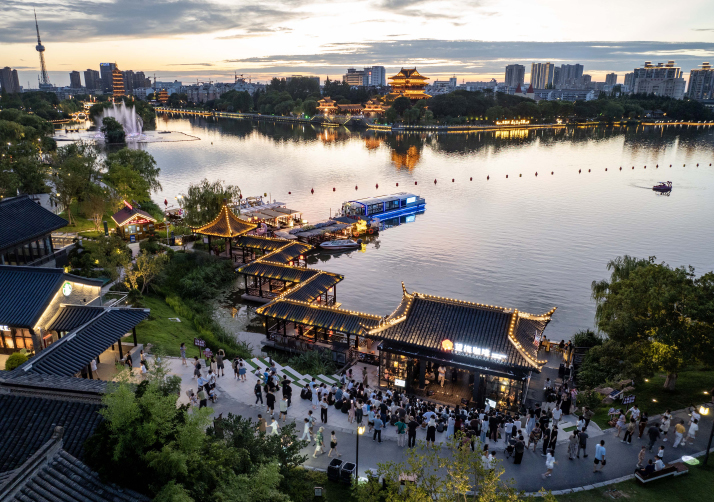
New types of demand are being met with diverse and innovative services and products. The burgeoning emotional economy, primarily driven by younger generations, constitutes a major shift in the Chinese consumer market. Young consumers are increasingly spending money not just for necessity but to fulfill emotional needs through purchases of pop toys, pet products and merchandise related to animations.
Born in the 1990s, Shi finds that the blind boxes sold by Pop Mart take her on a nostalgic journey back in time. “That thrill of opening a blind box is something a lot of people enjoy. The toys inside help us hold onto our childlike hearts and provide a way to capture memories,” she said.
Shi, who plays the konghou, an ancient string instrument, also finds cultural connection in Pop Mart’s series that feature ancient Chinese themes. “The figurine playing the konghou is almost a mini version of me, as if it was tailor-made,” she said.
A report released by the Chinese Academy of Social Sciences and the China Animation Association projected that the annual growth rate of China’s art toy market exceeded 20 percent in 2025. By the end of last year, its total output was forecast to reach 110.1 billion yuan ($15.3 billion).
Guzi, a slang term derived from the English word “goods,” refers to tangible merchandise infused with elements of animation, comic and game culture, such as collectible badges, acrylic figure stands and themed cards.
The Guzi economy, spanning design, manufacturing and collection, is unleashing the potential of a large market, drawing young enthusiasts to consume through shopping and cultural engagement. Consultancy firm iiMedia Research projects the market size of China’s Guzi economy could exceed 309 billion yuan ($43 billion) by 2029.
To attract more visitors, innovative tourism programs are flourishing across the country, integrating sightseeing, experiential consumption and leisure activities. In Jiashan County, Zhejiang Province, an industrial park has transformed itself into a mecca for cocoa lovers.
Afición Chocolate Town, located in Miaojia Village in Jiashan, opened in 2014 as the country’s first chocolate-themed industrial tourism project. With an annual production capacity of 20,000 tons of chocolate, the park has seemingly brought the Hollywood blockbuster Charlie and the Chocolate Factory to life.
“Visitors can try their hand at chocolate-making and participate in other leisure activities in the park,” Mo Xuefeng, founder of the project, told Beijing Review.
After graduating from a college in the United States in 2011, Mo returned to Jiashan—his hometown—and began to start his own business. Like Mo, many young people returning to their hometowns in the countryside or remaining in rural areas are developing innovative industries and renovating old sites into popular destinations, tapping into the powerful demand for immersive travel experiences sharable on social media platforms.
Over 1 million tourists visit the chocolate town every year. According to Mo, over 60 percent of his employees are local villagers. Strong demand from tourists from surrounding areas also give a boost to nearby homestays and other businesses.

Giving a boost
The CEWC stressed the need to stabilize and revive investment, with a focus on encouraging the participation of private capital and increasing investment in human capital. Investment in human capital refers to inputs that develop people’s abilities and unlock their potential at all stages of life, including childcare, elderly care, health, education and skills training.
China’s fixed assets investment fell 2.6 percent year on year in the first 11 months of 2025, according to the NBS.
The decline could be attributed to fluctuations in the property sector, the slow recovery of domestic demand and weak profit growth among downstream enterprises due to low market prices—factors that have made some companies hesitant to expand their operations or increase investment, Wen said.
Last November, Chinese authorities unveiled measures supporting the participation of private capital in key projects in areas including rail and the construction and operation of new urban infrastructure.
Nationwide urban renewal, the renovation of old communities and abandoned industrial sites, has been one of the measures undertaken in order to scale up investment and drive up consumption. According to the Ministry of Housing and Urban-Rural Development, China will continue to promote urban renewal during the 15th Five-Year Plan (2026-30) period.
The CEWC pledged the formulation of plans aimed at improving the incomes of rural and urban residents. “It suggested that the focus of expanding domestic demand has shifted from providing short-term incentives to long-term strategies for building a robust domestic market,” Wan Zhe, a professor of economics at the Belt and Road School of Beijing Normal University, told Beijing Review.
Wan called for encouraging enterprises to establish wage growth mechanisms, raising minimum wage standards and increasing people’s sources of income. Policies for reducing household expenditure on education, healthcare and elderly care should be refined, she added.
Policies in the pipeline
Chinese authorities on December 14 issued a circular urging stronger coordination between the commerce and financial sectors to step up support for consumption.
The circular urged local governments to provide more funds for critical consumption sectors, and encouraged financial institutions to optimize services for big-ticket durable goods and electronics. It also encouraged innovation in financial products for industries such as elderly care, hospitality, tourism and education.
According to Wan, as part of efforts to boost domestic demand, measures such as further lifting purchase restrictions in the automotive sector and promoting the nationwide circulation of second-hand cars are needed. Additionally, the supply of high-quality childcare, elderly care and healthcare services should be increased.