Germany Looks to China to Kick-Start Its Economic Recovery
 Facebook
 Twitter
 Linkedin
 Google +
How Berlin navigates this delicate balance between cooperation and competition with Beijing will shape its economic and strategic landscape for years to come.
Germany is seeking to strengthen relations with China as it looks to revive an economy that has endured years of stagnation and recession. For Berlin, China is a key market and highly appealing destination for investment, while Beijing views Germany as possibly the most important partner in Europe. But what challenges lie ahead?
For years, Germany relied on competitively priced Russian natural gas and oil. In exchange, Moscow opened its market to German goods — from automobiles to industrial machinery and chemical products. The arrangement proved highly beneficial for Europe’s largest economy.
Things began to change in 2014 after the Ukraine crisis broke out, and trade between the two countries gradually declined until the conflict escalated on Feb. 24, 2022. Berlin’s decision to join anti-Russian sanctions hit its own economy hard.
The sabotage of the Nord Stream pipeline in September 2022 made clear that Germany could no longer count on Russian gas, and its economy began to shrink in 2023, a trend that continues to this day. There are signs, however, that the country’s manufacturing sector is slowly recovering. But to truly revive its economy, Germany needs China — its largest trading partner.
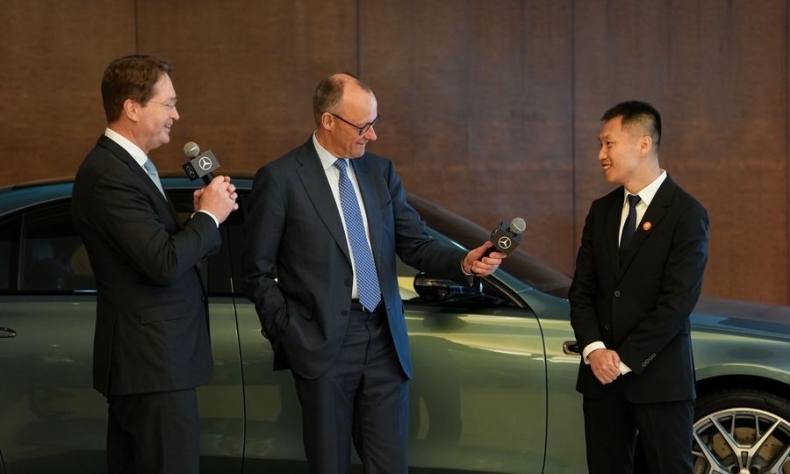
It is, therefore, unsurprising that German Chancellor Friedrich Merz this week followed in the footsteps of British Prime Minister Keir Starmer and Canadian Prime Minister Mark Carney, visiting China to engage with its senior leadership. On Feb. 25, accompanied by a delegation of 30 firms including top car makers such as Volkswagen and BMW, he met with Chinese President Xi Jinping and Premier Li Qiang. According to reports, economic ties between the two nations were the major topic they discussed.
“China and Germany, as two of the world’s largest economies and major countries with important influence, should strengthen our confidence in cooperation, jointly safeguard multilateralism and free trade, and strive to build a more just and equitable global governance system,” the Chinese side stressed.
Despite different approaches to certain geopolitical developments, Berlin and Beijing are united by a desire to preserve the existing global economic system, in which multilateralism and free trade have until recently played a central role. Merz’s visit comes at a time when Germany is increasingly questioning the reliability of the United States, in part due to Washington’s unilateral tariffs, and is seeking partners elsewhere in the world.
“The more turbulent and complex the world becomes, the more China and Germany should strengthen strategic communication and enhance strategic mutual trust,” Xi said during his meeting with Merz. The German leader responded that the two nations should “emphasize what they have in common and confront the challenges they face together.”
Merz’s visit clearly carries broader geopolitical implications. The EU, led by Germany and France, has long sought “strategic autonomy” and greater independence from the United States. But achieving that goal would require a major transformation.
Merz has recently called on the EU to “deregulate every sector,” highlighting China’s efficiency in executing large-scale projects.
“Yet we are still far too slow. China builds the world’s largest solar farms within a few months. In the EU, it takes years just for the project to get approved. Therefore, I propose to implement a fundamental principle in most permitting processes: Any project that is not treated within a few weeks or months will be regarded approved automatically,” Merz stressed on Feb. 11.
His rhetoric suggests that Germany, along with other European nations, sees China as a model whose practices it would like to implement at home. At the same time, Berlin seems to be attempting to navigate a “middle path,” treating Beijing simultaneously as a systemic rival and an indispensable economic partner.
German leaders often highlight their nation’s trade deficit with China. But is it really Beijing’s fault that Germany has, over the years, effectively deindustrialized its own economy? They also argue that Germany’s manufacturing sector has been particularly hard hit by competition from Chinese producers. But if Berlin truly champions a free-market economy, why would it have a problem with competition?
For decades, Germany encouraged former socialist states in Eastern and Southeastern Europe to open their markets to German companies, even when those policies harmed local economies. Now Berlin objects when China employs the very same market strategies and business practices it once championed worldwide.
Germany’s industrial model is facing serious challenges, and from Berlin’s perspective, China is the only market large enough to stabilize it. Put simply, Germany currently depends on China far more than China depends on Germany.
That, however, does not mean that Beijing intends to advance from a position of strength. China has repeatedly emphasized the importance of win-win, mutually beneficial cooperation in its relations with other countries, and Germany is included in this approach.
Xi called on Beijing and Berlin to be “reliable partners that support each other” and “defenders of free trade,” while Merz wants a partnership that is “balanced, reliable, regulated and fair.” As usual, the devil is in the details: for Germany, a “fair” partnership has often meant enjoying trade surpluses with its partners. Yet this approach is unlikely to work with China, given that Beijing’s economic development gives it considerable leverage in any negotiation.
More importantly, Germany, along with the broader EU, faces a potential trade war with the U.S. Fully aware of this, Merz seems keen to avoid a two-front trade conflict with both China and the U.S. simultaneously. That is why, in the era of growing protectionism, Berlin aims to deepen cooperation with China in trade, investment and manufacturing.
Germany’s path to economic recovery and stability increasingly depends on cultivating a constructive partnership with China. How Berlin navigates this delicate balance between cooperation and competition with Beijing will shape its economic and strategic landscape for years to come.
Importantly, China has made it clear during the visit that it will work with Germany to properly handle the relationship between competition and cooperation, explore mutually beneficial and win-win pathways of cooperation, and jointly keep industrial and supply chains stable and unimpeded. It has also proposed that the two countries should enhance strategic communication, increase strategic mutual trust, and promote the continuous new development of the all-round strategic partnership between the two countries.
Nikola Mikovic is a Serbia-based freelance journalist and political analyst.