Has Trump Declared War on Europe?
 Facebook
 Twitter
 Linkedin
 Google +

The only path forward for Europe is to reject subservience; to assert its autonomy; to engage sensibly with China, Russia, Iran and others; and to embrace an emerging multipolar world based on sovereign equality, peaceful cooperation, non-interference and the principles and purposes of the United Nations Charter.
The most prominent component of the Donald Trump administration’s new National Security Strategy (NSS) is a blatant re-assertion of the Monroe Doctrine, shifting the focus of U.S. military strategy toward “defending our hemisphere,” with “more troops, bases and military operations” in the Americas. The document clearly implies that the current reckless—and entirely illegal— escalation against Venezuela is only the beginning of a broader strategy to re-establish Washington’s imperial domination of the American supercontinent.
A targeted pivot
The pivot to the Western Hemisphere does not, as some analysts have suggested, represent an acceptance of China’s rise and the inevitability of a multipolar world order. On the contrary, the purpose of building up hemispheric hegemony is to establish a stronger base from which to confront China—and Russia—globally. As Cameron Harrison and CJ Atkins put it in online daily news publication People’s World, the objective of this strategic reorientation is to “crush rival powers, slow China’s growing international influence and maintain U.S. global hegemony.”
The White House, the State Department and the Pentagon are openly committed to destabilizing those Latin American and Caribbean countries that attempt to resist U.S. domination and that enjoy close relations with China and other supposed enemies of the United States.
China-Latin America relations have expanded rapidly in recent years, with China now the largest trading partner of many countries in the region. Chinese investment, trade and technology cooperation are helping these countries to break out of underdevelopment whilst retaining—indeed bolstering—their sovereignty. The U.S. views this dynamic as a direct threat to its long-term interests, and the NSS makes clear that Washington intends to reverse it.
Running parallel to this hemispheric pivot is the Trump administration’s relatively hostile posture toward Europe. Far from being a trusted ally, Europe is portrayed in the NSS as a declining civilization beset by demographic crisis, economic stagnation and political fragmentation. The document openly celebrates the rise of far-right nationalist parties across the continent, pledging U.S. support for their efforts to “correct” Europe’s current trajectory.
Meanwhile, the online magazine Politico reports that the Trump administration is considering the creation of a new “C5” (Core Five) forum comprising the U.S., China, Russia, India and Japan, excluding Britain and the European Union entirely. If implemented, such a forum would symbolically and practically downgrade Europe’s role in global affairs, implicitly recognizing Russia as the more important power on the continent and weakening Western-led institutions such as the Group of Seven (G7) and NATO.
All this is fomenting considerable anxiety in European capitals. The Cold War consensus that bound Western Europe to U.S. leadership is coming to an end. That consensus emerged after World War II under very specific historical conditions. The Soviet Union, having borne the brunt of the fight against Nazism, emerged with enormous prestige. Socialism was gaining ground across Europe and Asia, winning real gains for working-class and oppressed peoples. In this context, the imperialist powers of Western Europe sacrificed their strategic autonomy in exchange for U.S. military protection, economic reconstruction under American leadership and the NATO security umbrella.
That world no longer exists. The central strategic challenge facing Washington today is China: a rising socialist power that is already overtaking the U.S. in key areas of science, technology and industrial capacity; which is the largest trading partner of around two thirds of the world’s countries; and which is playing an indispensable role in constructing a multipolar world order based on sovereign equality, mutual benefit and peaceful cooperation. By any definition, this is a serious threat to the U.S.-led imperialist system and likely an insurmountable obstacle to any Project for a New American Century.
Europe is not on the front line against China in the same way it was against the Soviet Union. The U.S. ruling class no longer sees Europe as its primary strategic partner, but rather as a potential liability: economically weak, politically unstable and insufficiently obedient.
Europe under pressure
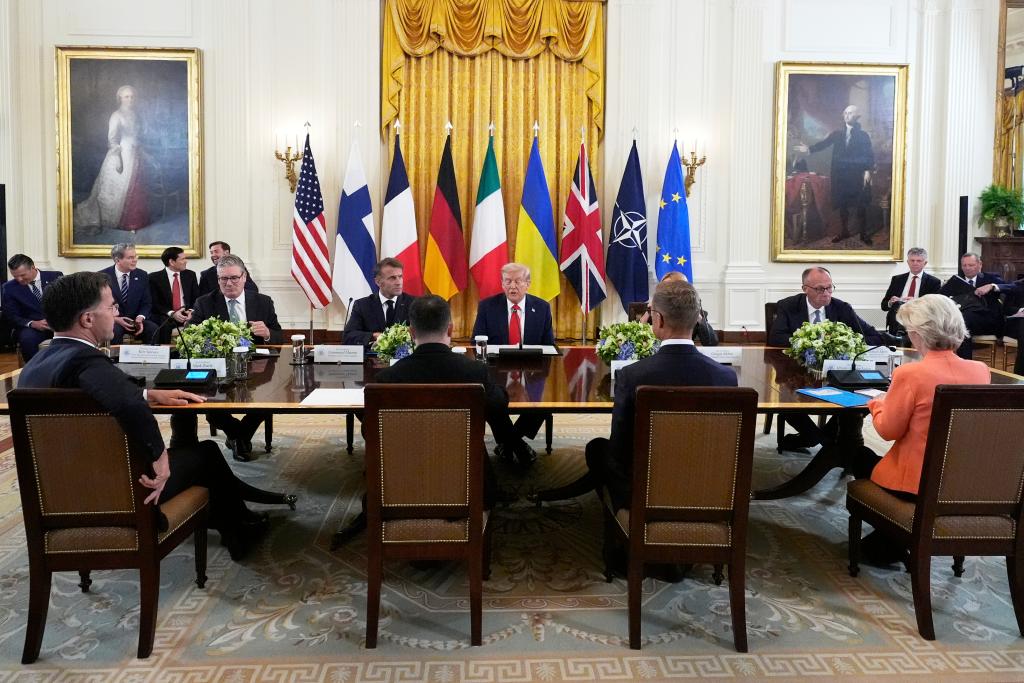
The NSS makes clear that the Trump administration’s demands of Europe are twofold. First, it wants European countries to massively increase their military spending. The document repeats calls for NATO members to spend 5 percent of GDP on militarization—a staggering transfer of public wealth from European taxpayers to the U.S. military-industrial complex, dovetailing neatly with Washington’s domestic re-industrialization strategy.
Second, it wants political subservience, particularly in relation to China. Washington demands that Europe align itself fully with U.S. sanctions regimes, technology controls and anti-China containment efforts—even though these will have (indeed are having) a disastrous impact on European industry and living standards.
Those countries that toe the line will be rewarded with preferential trade treatment, most obviously lower tariffs. Those that refuse to comply will be punished. The recent suspension of the U.S.-UK Technology Prosperity Deal offers a glimpse of how this pressure works: Cooperation on AI, quantum computing and nuclear energy was abruptly halted to extract concessions on unrelated trade issues, including food and industrial regulation.
Meanwhile, the Trump administration is already cultivating far-right political movements in Europe in order to give it leverage against any potentially intransigent governments. If the likes of UK Prime Minister Keir Starmer, French President Emmanuel Macron and German Chancellor Friedrich Merz refuse to go along with Washington’s demands, well-funded and more “reliable” forces are waiting in the wings, in the shape of populist, anti-globalization movements such as Reform UK, National Rally and the AfD (Alternative for Germany). The concerns enumerated in the NSS about “civilizational collapse,” “cratering birthrates” and ostensibly unsustainable levels of migration are intended to pour fuel onto this white nationalist fire.
It should be obvious that the only path forward for Europe is to reject subservience; to assert its autonomy; to engage sensibly with China, Russia, Iran and others; and to embrace an emerging multipolar world based on sovereign equality, peaceful cooperation, non-interference and the principles and purposes of the United Nations Charter.
Such a path is difficult, but it is possible, thanks primarily to the growing strength of China and the Global South. Europe has the industrial capacity, scientific expertise and human resources to build a prosperous, peaceful and cooperative future. By aligning itself with the multipolar project, Europe can help to create a world order that is more just, equitable and sustainable for humanity.
The alternative is grim: a Europe reduced to a fractured hinterland of U.S. power, stripped of autonomy, hollowed out economically and destabilized politically in the service of a U.S. imperial project that is already in irreversible decline.
The author is an independent political commentator based in London and author of The East Is Still Red: Chinese Socialism in the 21st Century (2023).