How Edgar Snow’s Descendants Continue His Story in China and Foster Sino-U.S. Cultural Exchange
 Facebook
 Twitter
 Linkedin
 Google +
Politics between America and China is like the weather—it changes all the time. But the most important thing is that we’ve got to keep the people-to-people friendship going.
In 2021, the relatives of 16 international friends of China jointly sent a letter to Chinese President Xi Jinping, congratulating the Communist Party of China (CPC) on its 100th anniversary.
These are the sons and daughters and family members of those who helped China in its times of need. Eric Foster, nephew of renowned U.S. journalist Helen Foster-Snow, was one of them.
“We all signed it and sent it to President Xi. And it was surprising and amazing that we got a return from him,” Foster said, recalling the moment he received Xi’s reply.
A family tie
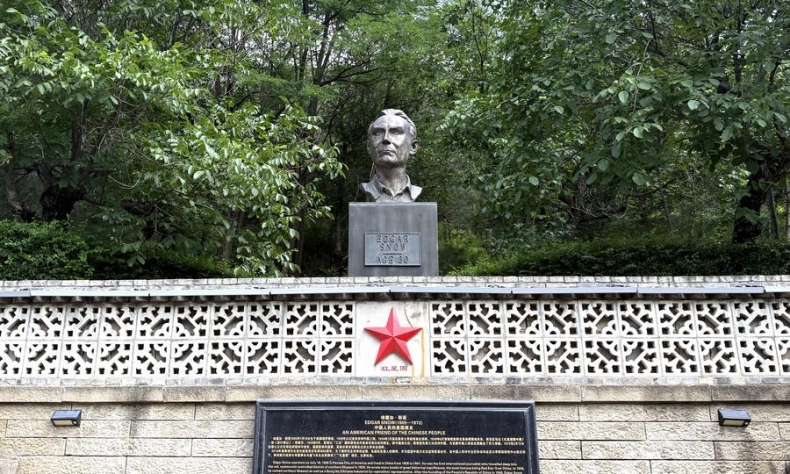
Foster-Snow was the wife of Edgar Snow, an American journalist who came to China in 1928, and spent the next 13 years living in and reporting on the country. He traveled deep into Baoan in Yan’an in northern Shaanxi Province, then a revolutionary base of the Red Army, and conducted extensive interviews with Mao Zedong and other CPC leaders, becoming the first Western reporter to enter and document the Communist-led base area (the Shaanxi-Gansu-Ningxia Border Region) in northwest China.
In his book Red Star Over China, Snow offered a vivid and compelling portrayal of the once “mysterious” CPC, showing how it led the revolution and brought dignity and equality to the people. First published in the United Kingdom in 1937, the book was reprinted seven times within weeks, sparked worldwide attention and went on to influence generations of readers.
Also a journalist reporting on China in the 1930s, Foster-Snow contributed to the book’s creation, including, by traveling to Yan’an in 1937, conducting additional exclusive interviews with CPC leaders there for the book.

After the founding of the People’s Republic of China, Snow returned to the country three times, not as a revolutionary, but as an observer and a bridge-builder, watching closely as a once-fractured nation underwent profound change. In 1970, he stood atop Tiananmen Gate in Beijing during China’s National Day celebrations, where he was received by Mao and Zhou Enlai, a moment that symbolized his special place in China’s modern history.
A year later, Snow once again played a quiet but decisive role in the development of China-U.S. relations. Writing for Life magazine, he helped lay the groundwork for a long-frozen relationship to thaw, contributing to the momentum that would lead to U.S. President Richard Nixon’s historic visit to China.
Unfortunately, Snow did not live to see that moment. On February 15, 1972, just one week before Nixon arrived in Beijing, he passed away in Geneva, Switzerland. In his final days, he left a personal message about his love for China and his will to stay there. Honoring his final wish, his ashes were laid to rest both in his American homeland and beside Weiming Lake at Peking University.
“Edgar Snow’s life was a living testament to the sincere friendship between the peoples of China and the U.S.,” Zhou once commented.
A sequel to the friendship
“I’m proud of my uncle and aunt,” Foster told Beijing Review. Growing up hearing the stories about the Snows, he also developed a deep love for China. “When my mother told me stories about my famous aunt and uncle and their good friend Mao Zedong, I simply felt the urge to visit the country and shake Mao’s hand,” he added.
But coming of age during the Cold War, Foster did not even dare to speak openly with his friends about his fascination for the country when he was a child. Eventually, after traveling the world, he chose China as his permanent home.

Before coming to China, Foster spent considerable time reflecting on potential business opportunities in the country. He learned online that photography might be perceived as “novel” among Chinese people, and thus brought advanced photographic equipment from the U.S. with the intention of establishing a photography studio. But when he actually arrived in China in 2010, he found that his plan was doomed to fail. China was far more modernized than he had ever anticipated, differing greatly from the portrayals he had seen in Western media. “Everything I found about China was outdated. What they described about the country was still at the stage where everyone wore the same clothes,” he said. As a result, he abandoned his initial plan and became an English teacher.
As the only member of the Snow family living in China, Foster is considered the family’s representative in the country, and thus often gets invited to various academic exchanges or commemorative events in honor of Edgar Snow. “While it is indeed a great honor, I also feel a great sense of responsibility,” he said. “So I decided to integrate the stories and historical accounts I had learned from my mother about my aunt and uncle, and to write a book of my own, chronicling the period during which they lived in China.”
“My aunt was really part of a team effort, but her role is sadly less known,” Foster explained. “Many of the famous photos of Yan’an were actually taken by Helen. She spent months with Mao and other CPC leaders, collecting materials that made that famous book possible, though her name went unmentioned in its pages.”
“She also took an active role in advancing the women’s liberation movement during that period,” he added.
He also shared a little anecdote behind the iconic portrait of Mao—broad-hatted, hair neatly brushed back, which was taken by Edgar Snow and was internationally spread through Red Star Over China. “Uncle Edgar realized how important the first published photo of Mao would be,” Foster recounted. “Mao’s hair was a little bit long, so Edgar borrowed scissors, trimmed it and placed his own hat on Mao’s head before taking the shot.”
The project has consumed much of Foster’s energy ever since. He has visited Yan’an and Baoan multiple times, retracing Snow’s footsteps. He pores over Foster-Snow’s memoir, My China Years, cross-checking every detail against Western sources to ensure credibility. “I don’t rely on Chinese websites for facts about China’s progress, because people would dismiss them as propaganda,” he explained. “Instead, I cite Western outlets like Bloomberg and Reuters. That way, readers can’t just brush it off.”
In the future, Foster plans to get his book published and promote it around China, hoping to carry forward the friendship between China and the U.S. by reflecting on this historical period, and to explore the path of exchange between the two countries in the new era.
“Just like my aunt Helen would say, politics between America and China is like the weather—it changes all the time. But the most important thing is that we’ve got to keep the people-to-people friendship going. I couldn’t agree more,” he concluded.