The Great Rotations Powering Sustainable Growth
 Facebook
 Twitter
 Linkedin
 Google +
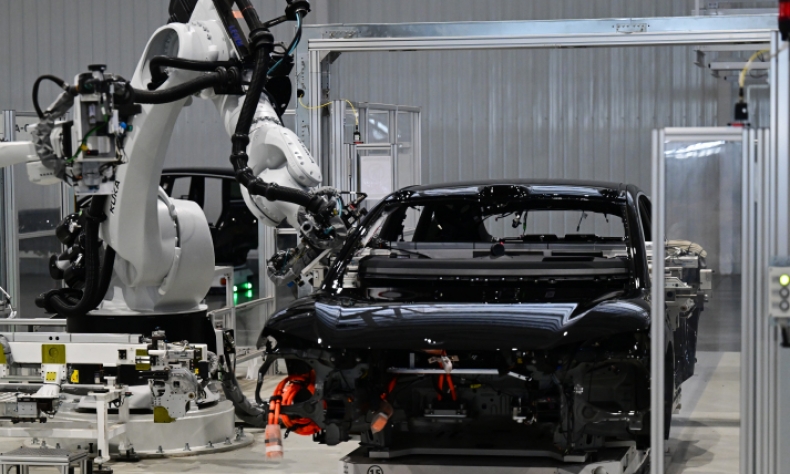
China’s 2025 data, enriched by Spring Festival insights and the 15th Five-Year Plan’s vision, evidence the great rotations in motion.
In a year marked by global uncertainties, including escalating trade tensions and shifting geopolitical dynamics, China’s economy demonstrated remarkable resilience in 2025. Even as we face the uncertainties emerging from the American and Israeli attack on Iran in late February, China’s economic outlook remains solid, built on the enduring legacies of historic developments.
Data from the National Bureau of Statistics showed GDP reaching 140.19 trillion yuan ($20 trillion) last year, with a 5-percent year-on-year growth at constant prices, meeting the government’s target. This achievement underscores the effectiveness of policies aimed at high-quality development. Breaking it down by sectors, the primary industry grew by 3.9 percent, the secondary industry by 4.5 percent, and the tertiary industry by 5.4 percent.
Robust rotations
Complementing this, household income and consumption data paint a picture of steady progress. Nationwide per-capita disposable income stood at 43,377 yuan ($6,311), up 5 percent in real terms, with urban residents seeing a 4.3-percent increase and rural incomes surging 5.8 percent, narrowing the urban-rural gap. Consumption expenditure per capita reached 29,476 yuan ($4,289), growing by 4.4 percent in real terms, with rural areas outpacing urban areas at 5.3 percent versus 3.7 percent. These figures signal deeper structural shifts that I have previously termed the “three great rotations”—sectoral, spatial and demographic—driving China’s transition toward inclusive, innovation-led growth. These rotations, combined with persistent real wage increases and resurgent industrial productivity, are laying the foundation for sustained consumption expansion, as evidenced by the vibrant consumer activity during the recent Spring Festival (Chinese New Year) holiday from February 15 to 23.
At the heart of China’s recent economic experience is the sectoral rotation from traditional property-driven growth to growth led by smart, hi-tech industries. For decades, real estate fueled urbanization and investment, but 2025 marked a deliberate pivot. Fixed assets investment contracted by 3.9 percent overall, with property development dropping by 17.2 percent. In contrast, manufacturing profits rose by 5 percent, contributing to overall industrial profit growth of 0.6 percent, the first annual increase since 2022. This uneven distribution highlights profitability concentrating in hi-tech areas like advanced manufacturing and green energy.
This rotation aligns with the new quality productive forces agenda, emphasizing innovation in AI, quantum computing, robotics and renewables. (New quality productive forces refer to the shift toward innovation-driven growth, technological advancement and high-quality development in different sectors of the economy—Ed.) The secondary sector’s growth indicates resources flowing into smart industries, freeing up capital from property for these priorities. This shift is a strategic necessity to escape the middle-income trap, building resilience against external shocks like U.S. tariffs, mitigated through export diversification. The result is a sustainable model where consumption, contributing 52 percent of GDP growth in 2025, increasingly leads, supported by the 15th Five-Year Plan (2026-30)’s focus on boosting domestic demand through lifestyle upgrades and digital services.
The second rotation—from big first-tier cities to lower-tier ones—amplifies this transformation, positioning these areas as pivotal drivers of national consumption amid slowdowns in megacities. Megacities like Beijing and Shanghai have long dominated, but high costs, economic gloom and “consumption downgrading”—such as residents selling assets to manage mortgages—are pushing growth outward. Urban-rural income disparities offer proxies: Urban disposable income grew by 4.3 percent nominally, lagging rural areas’ 5.8 percent. Infrastructure like high-speed rail and digital connectivity makes lower-tier areas attractive, with improved logistics enabling affordable access to premium goods like durians, blueberries and cherries even in small towns. For instance, in a third-tier city like Yichang in Hubei Province, a young family relocating from Shanghai described how affordable housing and local e-commerce hubs allowed them to maintain urban lifestyles—streaming services, online education and weekend cultural outings—while contributing to community growth.

This spatial rebalancing reduces congestion in top-tier hubs while unlocking untapped potential elsewhere, with lower-tier cities (third- and fourth-tier, including counties) emerging as resilient consumer hotspots. Lower-tier cities, with lower costs, are becoming hubs for smart manufacturing, e-commerce and specialized industries, such as the door manufacturing sector in Yongkang, Zhejiang Province, where industrial output grew by nearly 10 percent last year, or the tech-enhanced flower industry in Heze, Shandong Province. Faster rural consumption growth, with expenditures on education, culture and recreation up 9.4 percent, indicates rising aspirations. China’s new consumer class is increasingly emerging in smaller cities, where major brands are increasing their presence to reach young people retaining Tier-1 habits. For example, residents in counties like Haiyan in Zhejiang continue purchasing imported goods and driving luxury vehicles like Teslas, buoyed by lower debt burdens and higher family support for homeownership, which frees up disposable income.
Retail sales in these areas tell a compelling story: 97 percent of 171 non-first-tier cities reported positive year-on-year growth in 2024, with third- and fourth-tier cities outperforming. Per-capita disposable income in third- and fourth-tier cities grew by 5.8 percent in the first half of 2024, outpacing higher-tier cities by a percentage point, and residents spend a higher share of income on goods. Consumer optimism is higher too, with around 80 percent in lower-tier cities feeling positive about the economy per a McKinsey survey in 2024, compared to 74 percent in first- and second-tier cities, and 75 percent of millennials there expressing confidence—10 percentage points above higher-tier peers. Brands are capitalizing: Starbucks expanded into 166 new county-level markets in 2024 and is now in over 1,000, while KFC plans 60 percent of its new stores in lower-tier cities, tapping into resilient sentiment despite overall sales dips.
The 15th Five-Year Plan reinforces this by breaking administrative barriers to facilitate resource flows, fostering super-regions and core cities in lesser-developed areas, and aligning with initiatives like the new urbanization plan to improve education, vocational training and green industries—creating virtuous cycles of investment, job creation and local prosperity. Projections highlight the scale: By 2030, 800 million will join the middle- and upper-income group, potentially unlocking $10 trillion in spending on premium goods, tech and sustainable products.
Closely linked is the third rotation: From urban to rural, curbing inequality. China’s Gini coefficient, a measurement of income inequality, has trended downward, with rural per-capita disposable income, at 24,456 yuan ($3,558) in 2025, growing faster than the urban income. This is the fruit of initiatives like the rural revitalization strategy, integrating urban technologies into agriculture and ecotourism.
This convergence addresses inequality’s drag on consumption. Rural households, with higher propensity to spend, showed a 5.1-percent nominal consumption growth versus urban areas’ 3.8 percent. Categories like household facilities highlight upgrading lifestyles. In a village in Sichuan Province, a farmer-turned-eco-tour guide recounted how AI-powered apps helped market homestays to urban visitors, boosting family income and allowing investments in children’s online learning—expanding the middle-income group, now over 400 million, for resilient consumption.

Backup power
Underpinning these rotations is a demographic redistribution favoring younger cohorts. Real wage growth, at 5.3 percent in 2025, tied to productivity gains, with hi-tech profitability ensuring premiums for young workers. Over the past decade, average wages climbed from 12,459 yuan ($1,800) in 2015 to over 24,555 yuan ($3,500), adjusted for inflation. In 2025, with stable inflation, real gains were preserved. Tech-savvy millennials and Gen Z, channeling income into experiences, drive this. In lower-tier cities, this manifests vividly: Affluent rural Gen Z shows 88 percent economic optimism in 2024, up 11 percentage points from 2023, embracing trends like experiential activities and luxury brands such as Arc’teryx and Lululemon, often brought by returnees from big cities.
The changing contours of consumption in 2025, amplified by 2026 Spring Festival trends, reveal an ongoing evolution toward services. Per-capita consumption rose by 4.4 percent in real terms, but services outpaced goods. Expenditures on education, culture and recreation grew by 11.8 percent, healthcare by 8.7 percent and transportation by 14.6 percent. During the nine-day holiday, domestic tourism hit 596 million trips, generating 803 billion yuan ($116) in revenue, with young families flocking to ice and snow resorts in Heilongjiang Province or cultural sites in Hainan Province for immersive experiences. One Beijing couple shared how they traded traditional shopping for a wellness retreat in a village in Yunnan Province, blending eco-tourism with digital bookings via AI apps—reflecting a shift to emotional and experiential spending. Outbound travel surged too, but domestic services like dining, live events and AI-enhanced festivities dominated, and box office revenue reached 5.75 billion yuan ($836 million).
This services boom aligns with the rotations. Sectoral pivots reduce access barriers through tech, like telemedicine in rural areas. Spatially, infrastructure enables eco-tourism in lesser-developed regions, as the 15th Five-Year Plan targets unified markets and investments in human development—education, childcare and social nets—to empower households. Demographically, younger consumers fuel this, with tech consumption like robot greetings becoming holiday staples. Underpinned by productivity-linked wages, this enhances sustainability, though uneven access and global volatility pose hurdles. The 15th Five-Year Plan’s emphasis on structural empowerment, not just stimulus, addresses these by prioritizing domestic demand and regional equity.
Ultimately, these dynamics bolster consumption, contributing over half of GDP growth in 2025. Challenges like moderating GDP growth and protectionism remain, but China’s fiscal stance sustains rotations.
China’s 2025 data, enriched by Spring Festival insights and the 15th Five-Year Plan’s vision, evidence the great rotations in motion. By shifting to smart industries, lower-tier cities, rural inclusivity and youth-driven growth, the country forges inclusive prosperity. Anchored by productivity-linked wages and human-centric policies, this model promises robust, service-led consumption, positioning the economy resiliently amid global headwinds.
The author is an adjunct professor at the Queensland University of Technology in Australia.