The Greenland Gambit
 Facebook
 Twitter
 Linkedin
 Google +
Greenland is not a peripheral territory but a central piece of geography caught within a renewed U.S. strategy of global containment.
U.S. President Donald Trump’s renewed threats to bring Greenland under American control—”the easy way” if possible, “the hard way” if necessary—have sent shockwaves through Europe and put NATO’s future in question, at a moment when the Atlantic alliance is already under considerable strain.
Clearly intent on starting the year off “with a bang”—having abducted Venezuelan President Nicolás Maduro and threatened a renewed bombing campaign against Iran—Trump has reiterated his long-standing interest in “acquiring” Greenland from Denmark, employing a combination of economic and military threats. What followed has been nothing short of a geopolitical rollercoaster ride.
On January 17, Trump announced he would impose a 10-percent import tariff on eight European allies that have opposed his bid to purchase the island: Denmark, Norway, Sweden, Finland, France, Germany, Britain and the Netherlands. In an NBC News interview just two days later, he pointedly refused to rule out seizing Greenland by force, declaring on social media that the island is “imperative for National and World Security” and that “there can be no going back.”
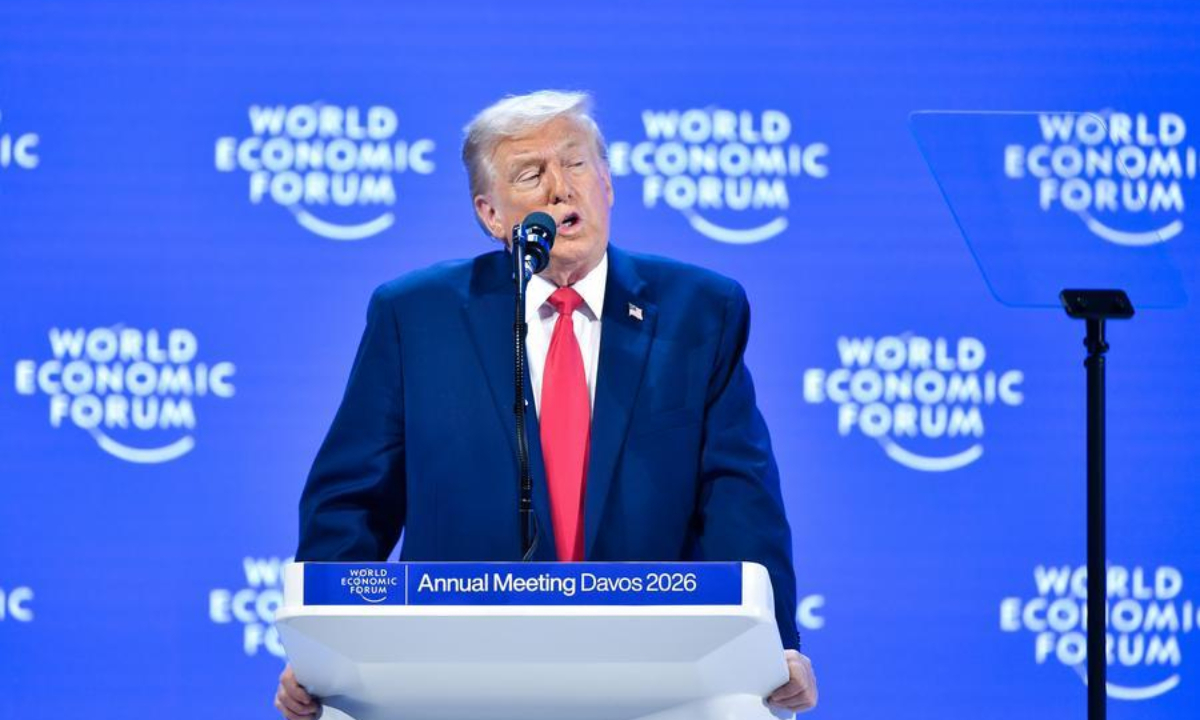
On January 21, speaking at the World Economic Forum in Davos, Switzerland, Trump reversed course, claiming he had no intention of a forcible takeover. Instead, he framed the pursuit as a strategic necessity, citing the territory’s position between the U.S., Russia and China, and recasting history to suit his pitch. While accurately noting the U.S. had defended Greenland during World War II, he falsely claimed America “gave Greenland back” to Denmark after the war, asserting, “All the U.S. is asking for is a place called Greenland, where we already had it as a trustee, but respectfully returned it back to Denmark not long ago.”
This rewriting obscures the fact that Greenland was never America’s to give—it has long been a self-governing part of Denmark.
Hours after his Davos speech, Trump announced on his Truth Social platform that he had agreed to a “framework” with NATO Secretary General Mark Rutte for a “future deal with respect to Greenland” and “the entire Arctic region.” As part of this arrangement, he stated he would suspend the threatened tariffs on European allies next month.
A long colonial relationship
Greenland (Kalaallit Nunaat) has been inhabited for millennia by Inuit peoples. Denmark’s colonization of the island began in 1721 and persisted until 1953, at which point Greenland was incorporated as a region of the Kingdom of Denmark.
Home Rule arrived in 1979, followed by the Self-Government Act in 2009, which strengthened Greenland’s control over domestic affairs and recognized Greenlanders as a people with the right to self-determination. In practice, however, the decisive levers of foreign policy, security and defense have remained under the control of Copenhagen.
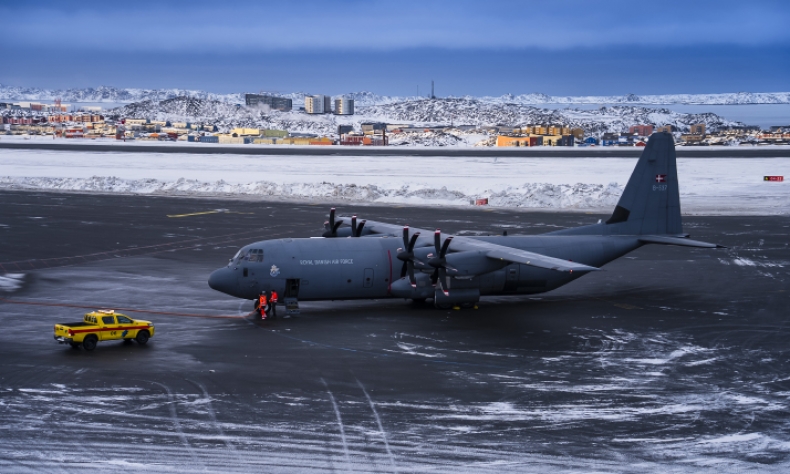
The U.S. already maintains a notable military presence in Greenland, centered on the Pituffik Space Base (formerly Thule Air Base) in the far north. The island’s strategic location, controlling access to the North Atlantic and Arctic, has made it a key node in U.S. defense planning since World War II.
Under the 1951 U.S.-Denmark defense agreement, Washington has exceptionally broad rights to build, operate and supply military bases in Greenland, as well as freedom of movement for aircraft and ships. The Pituffik Space Base complex has long been a cornerstone of U.S. early-warning and missile defense infrastructure, hosting radar systems designed to detect transpolar attacks.
The base has a controversial history, notably the 1953 forced relocation of Inuit hunting communities and the 1968 crash of a nuclear-armed B-52 bomber. These episodes remain emblematic of a pattern in which the island has been treated as expendable strategic terrain and the inhabitants overlooked as secondary to great-power interests.
Containing China and Russia
Why has the Trump administration become so obsessed with owning Greenland, given that Copenhagen is perfectly happy to let the U.S. extract the island’s mineral wealth, expand its military footprint and control Arctic shipping lanes?
The main point is that access can be renegotiated; it can be politically constrained; it can become, in a future independence scenario, subject to Greenlandic public opinion rather than the Danish Government’s pro-NATO diplomacy. For a U.S. national-security establishment increasingly fixated on long-term great-power confrontation, the aim is to lock in control over land, resources and shipping lanes, in order to strengthen Washington’s hand in the long-term campaign to project American hegemony into the 21st century.
Greenland sits astride the strategic North Atlantic-Arctic junction. As sea ice retreats due to rising temperatures, Arctic sea lanes are becoming increasingly important in global logistics. In 2017, China proposed including Arctic routes in its Belt and Road Initiative (BRI), which aims to boost connectivity along and beyond the ancient Silk Road routes, creating a “Polar Silk Road” in collaboration with Russia. A viable maritime route linking China’s eastern seaboard to northern Europe via the Arctic is reducing transit times by up to 30 percent compared to traditional routes through the Suez Canal.
From a U.S. strategic perspective, countering this emerging Arctic corridor is seen as a major objective within its broader campaign to constrain China’s rise. A related motive, many analysts argue, is to control regional chokepoints that could be leveraged to enforce blockades or embargoes in a potential future conflict with China or Russia.
Greenland also holds substantial deposits of critical minerals, including rare earth elements essential for modern technology. China currently controls around 70 percent of global rare earth mining and 90 percent of processing—a tremendous strategic asset which has already proven its value as a lever in responding to the U.S. tariff war.
These factors are increasingly viewed through the lens of an escalating strategic competition, or what many analysts term a New Cold War. Trump himself has been quite explicit about the motivations behind his Greenland gambit, erroneously claiming on January 4: “We need Greenland from a national security situation. It’s so strategic. Right now, Greenland is covered with Russian and Chinese ships all over the place.”
In this context, Washington’s campaign to counter China and Russia extends far beyond traditional military posturing; it is an integrated effort combining sanctions, technology controls, military alliances, forward weapons deployment and intelligence operations.
From this perspective, Greenland is not a peripheral territory but a central piece of geography caught within a renewed U.S. strategy of global containment.
Europe’s bind
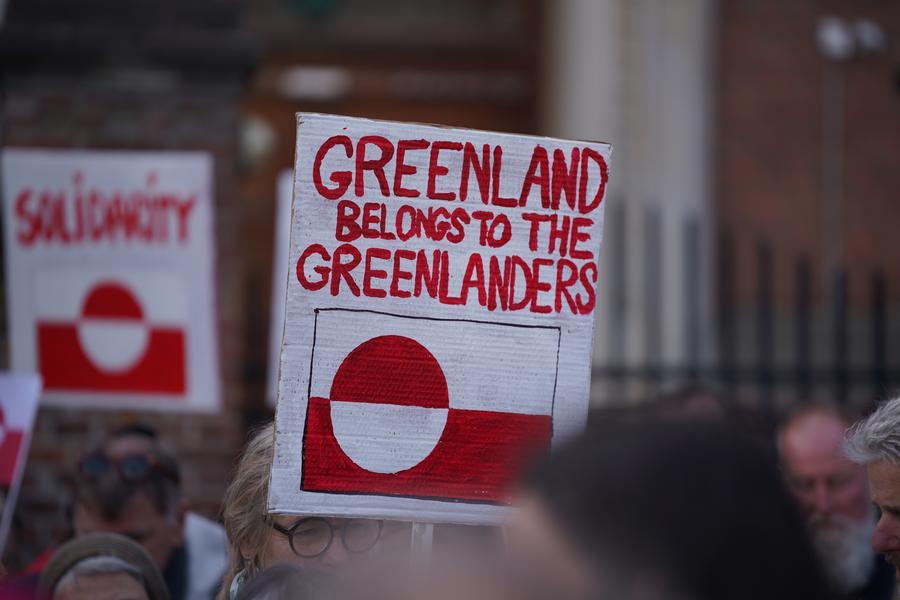
European leaders have responded to Trump’s Greenland threats with unusually direct language. A January 6 joint statement from the leaders of France, the United Kingdom, Germany, Italy, Poland, Spain and Denmark stressed that “Greenland belongs to its people” and invoked the United Nations Charter principles of sovereignty, territorial integrity and the inviolability of borders (contrast this with their tacit endorsement of U.S. kidnapping of Maduro just days earlier).
Clearly, the U.S. invading a NATO country could herald a total breakdown in the transatlantic alliance, and potentially spell the end of NATO itself. Indeed, one of the pillars of the Trump administration’s foreign policy doctrine, as made clear in its recently released National Security Strategy, is the restructuring of the Cold War consensus on terms more favorable to the U.S.
Washington wants its European allies to sacrifice their own long-term interests and align unconditionally with the U.S.’ strategic priorities, foremost among which is the pivot toward long-term confrontation with China. This means Europe increasing its military spending (specifically on U.S.-manufactured weaponry), sponsoring U.S. re-industrialization, participating in Washington’s unilateral sanctions and export controls, and limiting Chinese investment.
Thus far, European leaders have accepted this framework for the sake of remaining in Washington’s good graces, keeping the geostrategic status quo in place, and hoping to secure continued U.S. backing for the proxy war against Russia in Ukraine. However, Trump’s threats to seize Greenland indicate that the “post-war international order” is shifting no matter what Europe thinks.
European leaders in Davos vowed to retaliate if Trump’s proposed tariffs were enforced. On January 21, many of them expressed relief after he backed down.
Ultimately, the future for the continent lies in cultivating stronger economic and diplomatic relations with China, Russia and the Global South, and finding its place within an emerging multipolar world. Such a transition requires a bold reorientation of foreign policy.
The question of Greenland’s future must be one for Greenlanders to decide. Polling has consistently shown two things: Substantial support for eventual independence from Denmark, and overwhelming opposition to becoming part of the U.S.
Danish, British, French and German opposition to Trump’s threats is based on perpetuating the Cold War consensus and upholding Danish colonialism. But a principled position upholds the right of Greenland to self-determination, opposes militarization of the Arctic, and firmly rejects the U.S./NATO drive to war on China and Russia.
The author is an activist, writer and independent political commentator based in London. He is the author of The End of the Beginning: Lessons of the Soviet Collapse (2019) and The East Is Still Red: Chinese Socialism in the 21st Century (2023).