The Reason for China’s Rage
 Facebook
 Twitter
 Linkedin
 Google +
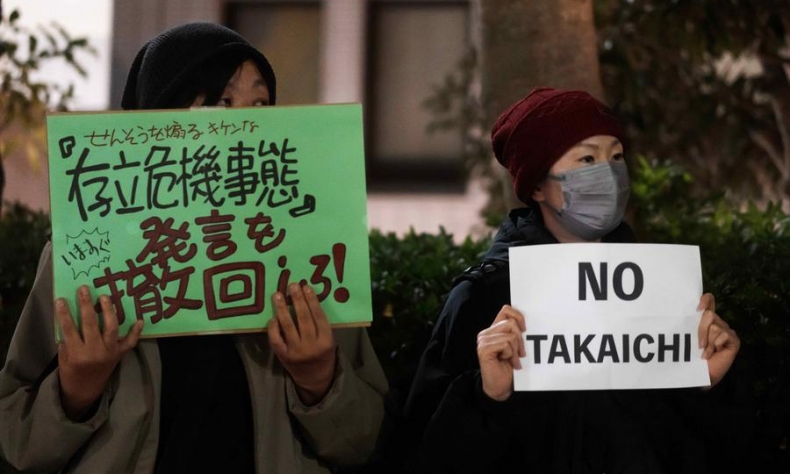
Japan’s hope for U.S. intervention appears to be a path that leads nowhere.
It has been nearly a month since Japanese Prime Minister Sanae Takaichi claimed in the Diet on November 7 that the Chinese mainland’s possible “use of force on Taiwan” could create a “survival-threatening situation” for Japan and suggested the possibility of armed intervention in the Taiwan Straits, yet the ensuing diplomatic dispute between China and Japan continues to escalate.
China’s outrage is palpable, forming into what may be one of its sternest diplomatic stances in nearly three decades. On November 21, Ambassador Fu Cong, Permanent Representative of China to the United Nations (UN), sent a letter to UN Secretary General António Guterres, which is to be circulated to all UN member states as an official document of the General Assembly. In his letter, Ambassador Fu pointed out that Takaichi’s remarks constitute two historical “firsts” since Japan’s defeat in 1945: the first official expression of ambition to intervene militarily in the Taiwan question, and the first threat of force against China. He stated: “If Japan dares to attempt an armed intervention in the cross-Strait situation, it would be an act of aggression. China will resolutely exercise its right of self-defense under the UN Charter and international law and firmly defend its sovereignty and territorial integrity.”
For most people worldwide with a basic understanding of international relations, it is understood that the Taiwan question lies at the very core of China’s interests. Recognition of the one-China principle—namely, that the People’s Republic of China is the sole legal government of China and that Taiwan is an inalienable part of China—is the prerequisite for other countries to establish diplomatic relations with China. While unfriendly countries do occasionally attempt to challenge it on the Taiwan question, prompting China to resolutely defend its sovereignty with concrete actions, Beijing’s reaction is rarely this intense.
This provocation from Japan is a different matter entirely. Japan repeatedly attempted to invade the island of Taiwan in modern history. Finally, in 1895, after defeating the government of the Qing Dynasty (1644-1911) in the First Sino-Japanese War, Japan forcibly seized Taiwan under the Treaty of Shimonoseki and subjected it to colonial rule for nearly 50 years. It was not until 1945, following its defeat in World War II (WWII), that Japan was compelled to implement the terms of the Cairo Declaration and the Potsdam Proclamation, formally restoring Taiwan and the Penghu Islands to China. Against this historical backdrop, it is inevitable that Japan’s interference in China’s internal affairs regarding the Taiwan question would be met with a fierce response from China.
What compels China to be even more vigilant is Japan’s claim that a so-called “crisis” in the Taiwan Straits would trigger a “survival-threatening situation.” Historically, hyping up external threats and manufacturing a sense of crisis were standard tactics employed by Japanese militarism. Time and again, Japan used the pretext of exaggerating external threats and fabricating “survival crises” to justify and mobilize for its wars of aggression and acts that disrupted regional peace. In 1931, using the so-called “survival-threatening situation” as a pretext, Japan staged the September 18 Incident and invaded northeast China; later, it proclaimed that the “Greater East Asia Co-Prosperity Sphere,” which aimed to cloak Japan’s imperialism in layer of legitimacy, was a “battle for Japan’s survival,” spreading the flames of aggression throughout Asia; it even linked the attack on Pearl Harbor to “Japan’s survival,” ultimately launching the Pacific War against the United States.
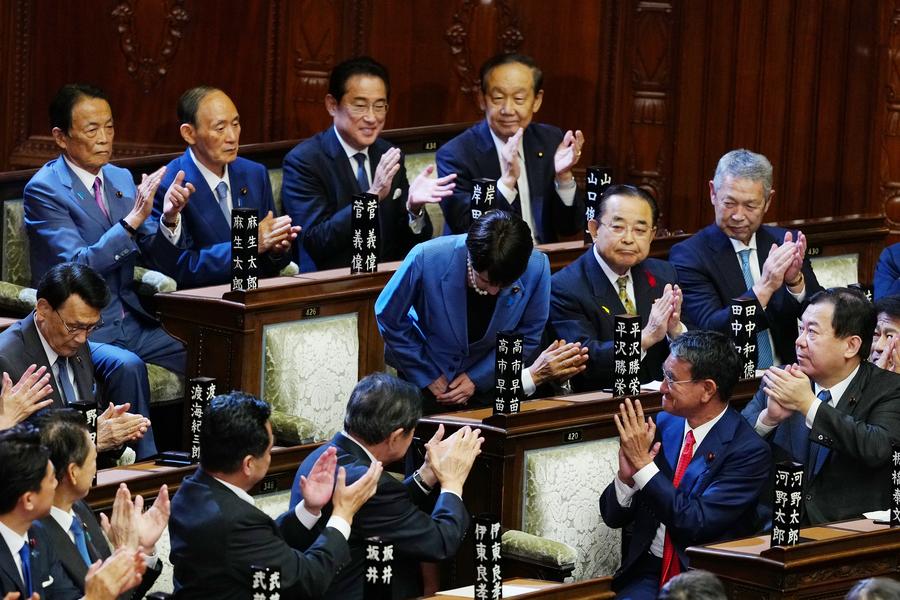
If China condones Japan’s actions, it may give a misguided perception to right-wing forces attempting to whitewash Japan’s history of aggression and resurrect militarism, leading them to believe they have an opportunity to disrupt the global landscape once again. As a representative figure of these right-wing forces, since assuming the office of prime minister, Takaichi has adopted an unprecedentedly radical stance. She has repeatedly expressed intentions to significantly increase the defense budget, thoroughly overhaul arms export policies and build a comprehensive offensive and defensive system, all in a bid to transform Japan into a military power with independent deterrent capabilities. This constitutes not only a security threat to neighboring countries but also a blatant subversion of the contemporary international order. As a defeated nation in WWII, Japan was required to undergo “complete disarmament” and prohibited from maintaining “industries which would enable her to re-arm for war.” Furthermore, in its own “Pacifist Constitution,” Japan pledged to “forever renounce war and the threat or use of force as means of settling international disputes.”
Japan appears to be aiming to destabilize the Asia-Pacific region by provoking China, intending to bind the U.S. to the “war chariot” of the Japan-U.S. alliance in exchange for American support in breaking the shackles of its Pacifist Constitution. However, from the U.S. perspective, the calculation is different. While Washington may be willing to embolden Japan to harass China on specific issues, it by no means wishes for Takaichi to stir up a major crisis. This is particularly true as the U.S. is currently attempting to thaw relations with Beijing and has no desire to be placed in an even more precarious position. Furthermore, while Takaichi’s remarks ostensibly serve as a provocation against China, they are, in reality, a direct challenge to the international order established since WWII. This underlying nature of her actions destines her to find little support within the international community.
On this point, the U.S. and China appear to have reached a certain common consensus. On the evening of November 24, U.S. President Donald Trump and Chinese President Xi Jinping talked over the phone. President Xi underscored that Taiwan’s return to China is an integral part of the post-war international order. China and the U.S. fought shoulder to shoulder against fascism and militarism. Given what is going on, it is even more important for the two countries to jointly safeguard the victory of WWII. President Trump said China was a big part of the victory of WWII and the U.S. understands how important the Taiwan question is to China.
Japan’s hope for U.S. intervention appears to be a path that leads nowhere. Takaichi must offer a profound apology for her remarks and completely abandon the delusion of resurrecting militarism. For China, the principle that must be upheld is clear: The Taiwan question is purely an internal affair of China. The manner in which the Taiwan question is resolved and the complete reunification of China is realized is a matter entirely for the Chinese people. No external forces have the right to interfere. And Japan, bearing historical guilt for its crimes against the Chinese people, is in no position whatsoever to cross this red line.