Youth Exchange Bolsters China-Australia Ties
 Facebook
 Twitter
 Linkedin
 Google +

Faced with a complex international situation, youth exchange between China and Australia is becoming an important way to enhance mutual understanding between the two countries and strengthen the public foundation for friendly relations.
Crossing the vast Pacific, the youth of China and Australia are writing a new chapter in the future of bilateral relations through face-to-face exchanges.
In late November, nearly 40 young representatives from China and Australia gathered at the 15th Australia-China Youth Dialogue (ACYD) in Guangzhou, capital of the southern Chinese province of Guangdong, to engage in discussions on the theme Building Resilience in Uncertainty. Chinese Ambassador to Australia Xiao Qian and Australian Ambassador to China Scott Dewar separately delivered video speeches, encouraging the youth of both countries to play an active role in people-to-people diplomacy and contribute to the development of China-Australia friendship and practical cooperation.
The event was held at a crucial time when China-Australia relations are recovering after experiencing setbacks. As both ambassadors mentioned, China’s development is an opportunity for the world. China is willing to work with all countries to pursue high-quality development and create a future of shared opportunities, shared growth and shared prosperity.
Opportunities and challenges
Looking back at the recent years of China-Australia relations, it has been a turbulent journey. Before the Australian Labor Party came to power in 2022, the bilateral relationship had hit a low point.
After the Labor government assumed power, through joint efforts, China-Australia relations began to stabilize and show a positive trend toward improvement and development. The two countries held high-level exchanges, resumed diplomatic dialogue and fully restored economic and trade exchange, with significant growth in trade and investment. Both sides are also actively advancing cultural exchange and educational cooperation. These achievements have been hard-won and should be cherished by both parties.
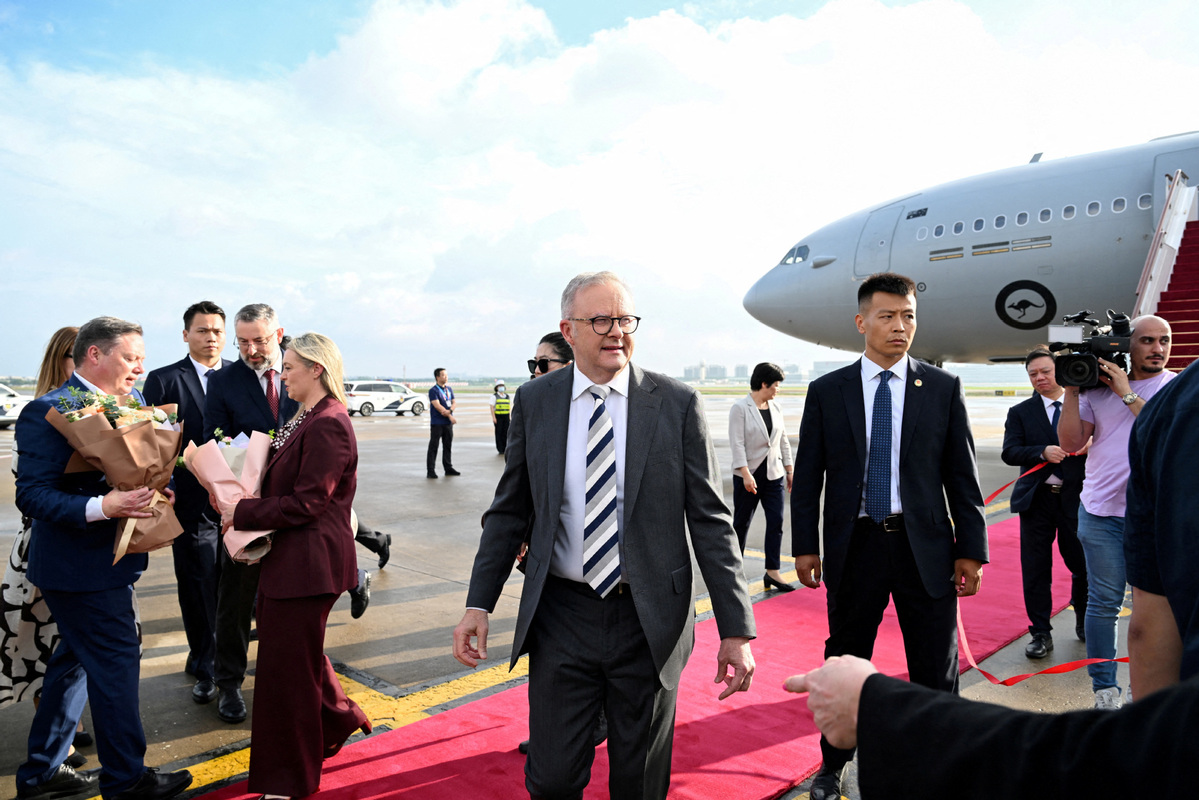
On May 3, the Labor Party won the 2025 Australian federal election, securing party leader Anthony Albanese a second term as prime minister and providing policy continuity for the continued improvement of bilateral relations. In July, Albanese visited China and held talks with President Xi Jinping and other Chinese leaders, injecting new momentum into the comprehensive elevation of bilateral relations.
While the relationship between China and Australia is improving, its enhancement is still constrained by numerous internal and external factors.
First, the “America Uncertainty” era brought by Donald Trump’s second term as U.S. president is a significant external variable influencing China-Australia relations.
Australia has long faced the dilemma of how to balance its security alliance with the U.S. and trade dependence on China. Now, both of these key supports are confronting challenges.
The U.S.-launched trade war against China threatens Australia’s main export markets, which could lead to major ripple effects felt by all Australians. China is not only Australia’s largest export destination for minerals, energy, agricultural products and seafood, but trade with China also supports about 600,000 local jobs in Australia and has increased the average disposable income of Australian families by nearly 5 percent.
On the other hand, the trilateral security partnership between the U.S., the UK and Australia, along with the nuclear submarine cooperation project, indicates that Australia is deepening its military integration with the U.S., which to some extent limits its own strategic autonomy.
Nevertheless, Trump’s “bullying diplomacy” approach, characterized by unilateral economic sanctions and coercive threats to allies, not only undermines multilateralism but also put the future of U.S. global leadership into question. An article recently published by the Australian Institute of International Affairs pointed out, “Trump’s foreign policy forced U.S. allies, including Australia, to reassess their diplomatic strategies.”
The role of youth exchange
Faced with a complex international situation, youth exchange between China and Australia is becoming an important way to enhance mutual understanding between the two countries and strengthen the public foundation for friendly relations.
Since its establishment in 2010, the ACYD has annually invited about 30 outstanding representatives from both countries to engage in exchange dialogues, allowing the youth to voice their opinions in building long-term stable, mutually beneficial relations between China and Australia.
These exchange activities provide opportunities for face-to-face interaction between participants, helping them move beyond stereotypes and understand the true nature of the other side.
In addition to the ACYD, multiple platforms for exchange have been established between the two countries to provide multichannel support for youth interactions.
In the 2024-25 funding list released by Australian Minister for Foreign Affairs Penny Wong, several projects promoting youth exchange between China and Australia are included. For example, the China Studies Scholarship program at the Australian National University plans to fund 50 Australian university graduates to study in China for a year from 2025 to 2028. The Stephen FitzGerald Scholars program provides outstanding Chinese students from Australian universities with the opportunity to gain in-depth knowledge of Australian history, systems and society.

At In My Eyes, China, a China-Australia youth face-to-face exchange event organized by the Chinese Embassy in Australia on June 28, Ambassador Xiao shared his personal experiences, vividly explaining the Communist Party of China’s commitment to seeking happiness for the Chinese people, realizing the rejuvenation of the Chinese nation and pursuing shared prosperity for humanity. Over 60 participants, including teachers and students from Melbourne’s Sea Star High School and young diplomats from the embassy, took part in the event. Through activities such as Chinese painting experiences and park tours, they deepened their understanding of Chinese culture.
Later on July 30, the China Oceania Youth Exchange Festival, hosted by the Chinese People’s Association for Friendship with Foreign Countries, was held in Hohhot, Inner Mongolia Autonomous Region. The theme of the event was Cultural Inheritance and Innovation in Minority Regions, and youth representatives from Australia, New Zealand and China exchanged ideas and formed friendships.
Chinese students in Melbourne and Australian students on campuses in Sydney are meeting through exchange programs. Performances on the Inner Mongolian grasslands and Australian studies courses in Beijing are quietly weaving the bonds of cultural exchange between the two countries. These diverse exchange platforms help the youth of both nations understand each other from multiple perspectives and lay a solid foundation for the long-term development of China-Australia relations.
Moving toward the future together
Youth exchange between China and Australia is increasing. As communication channels continue to expand and forms of exchange become increasingly diverse, mutual understanding between the youth of both countries will continue to deepen.
In his speech at the opening ceremony of the 15th ACYD, Ambassador Xiao encouraged youth from both countries to play an active role in promoting people-to-people friendship and advancing practical cooperation. He welcomed more young Australians to visit, study and participate in exchanges in China, so that the tree of China-Australia friendship may grow stronger and bear more fruit.
As one Australian youth participant remarked after the exchange event, “What we face are not abstract national concepts, but individuals with the same dreams and pursuits.” This kind of face-to-face exchange is the most effective way to eliminate barriers and build mutual trust.
As more and more youth from both countries work hand in hand, the future of China-Australia relations will undoubtedly become more resilient, better able to meet any challenges that arise. There is every reason to believe that, through the collective efforts of the youth of both countries, China-Australia relations will usher in a brighter tomorrow.
The author is a research fellow in the Institute of State Governance of Huazhong University of Science and Technology.