Rising With Rice
 Facebook
 Twitter
 Linkedin
 Google +
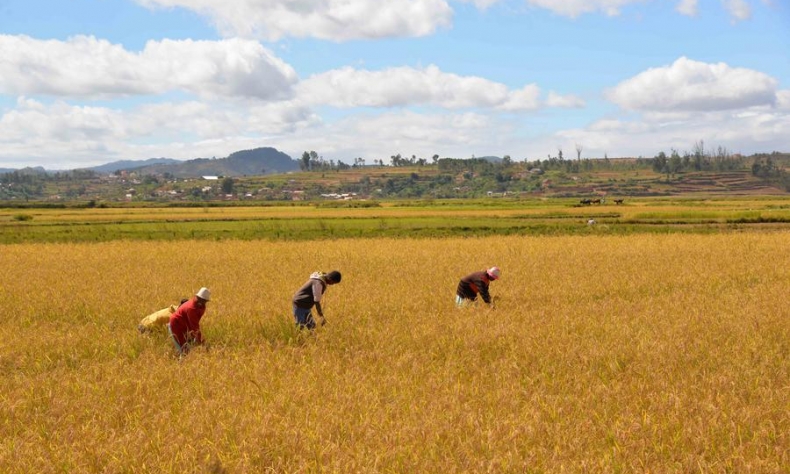
Adoption of Chinese hybrid rice boosts food security in Madagascar.
As the sun rises over the rice paddies of Mahitsy, Ramos Rakotorinina breathes in the cool morning air, watching the emerald green shoots of Chinese hybrid rice sway softly in the breeze.
“Our farmland barely produced enough to feed us before we started cultivating hybrid rice. Today, not only do we eat from our harvest, but we also sell the surplus,” Rakotorinina told ChinAfrica.
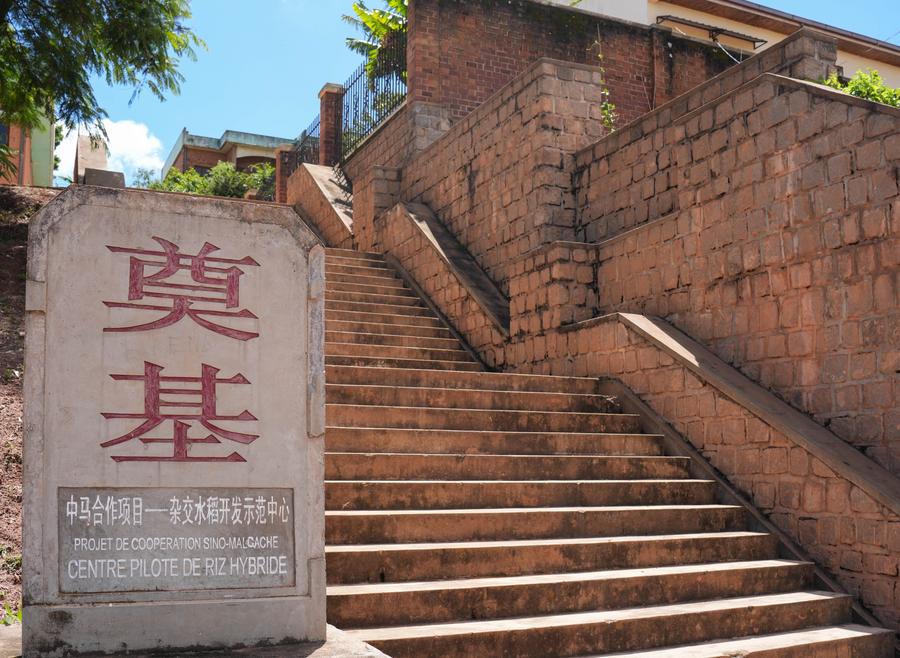
The town of Mahitsy, situated 27 km northwest of Madagascar’s capital Antananarivo, once struggled with food insecurity, but is now thriving. This transformation was made possible by the establishment of the Chinese Hybrid Rice High-Yield Demonstration Base, which has played a key role in boosting local agricultural productivity. This development exemplifies China’s strategic involvement in enhancing agricultural output across the continent.
Rakotorinina, a beneficiary of the Chinese rice farming model, is optimistic about another bumper harvest this season. He notes that the positive changes are evident in the joyful sounds of children’s laughter echoing through the rice fields. “This reflects not only an improvement in our living conditions, but also a boost to our overall well-being. It’s a clear sign of the positive impact the Chinese rice farming model has had on our community.”
With Madagascar facing rising climate challenges, agricultural experts and farmers alike recognise the crucial role that the adoption of Chinese hybrid rice can play in fostering inclusive growth. This method not only enhances food security, but also supports sustainable farming practices and empowers rural communities.
Higher productivity
Since its launch in 2007, the project has significantly increased hybrid rice cultivation, expanding to 90,000 hectares with yields averaging 7.5 tonnes per hectare – two to three times higher than local varieties, according to the Hunan Academy of Agricultural Sciences.
The Food and Agriculture Organisation estimates that Madagascar’s rice production meets approximately 85 percent of its milled rice consumption, with the cereal cultivated on over 1.6 million hectares yielding more than 3.8 million tonnes annually.
Drawing inspiration from the use of climate-resilient rice varieties by the Hunan Academy of Agricultural Sciences, Yuan’s High-Tech Seed company is supporting Malagasy farmers by providing inputs on credit and offering expert technical guidance. This continuous effort is vital in encouraging the adoption of climate-resilient rice varieties and improving market access for farmers across Madagascar.
Tatiana Andriamialy, one of the 1,000 beneficiaries of these inputs and technical services, has not only transformed her own life, but also sowed hope and resilience on her farmland. Her journey is a powerful reminder that with the right resources and an unshakable spirit, even the toughest climates can be conquered.
“With credit, I was able to acquire new drought-tolerant and flood-resistant rice seeds. Additionally, technical guidance from Yuan’s High-Tech Seed agronomists helped to improve my agricultural practices, including new planting techniques, efficient water management, and organic pest control,” Andriamialy said.
The combined approach of financial support (credit) and technical guidance plays a crucial role in empowering farmers like her as it helps them to adopt resilient crop varieties and implement improved agricultural practices, ultimately boosting their resilience to climate change and raising productivity.
For Andriamialy, her thriving fields represent more than just agricultural success; they embody renewed hope, community well-being, and a brighter future. This optimistic outlook stems from the adoption of Chinese sustainable farming practices, which have played a key role in promoting environmental sustainability and delivering socio-economic benefits to the community.
The involvement of Chinese agronomist Hu Yuefang and fellow experts in Madagascar, through the Hunan Academy of Agricultural Sciences and Yuan’s High-Tech Seed company, underscores their commitment to improving food security through the introduction of high-yield hybrid varieties, promotion of modern farming techniques, and farmer training.
These initiatives have played a crucial role in advancing Madagascar’s agricultural development and food self-sufficiency, despite the island’s diverse and challenging terrain, which includes rainforests, swamps, semi-arid zones and volcanic soils, presenting significant obstacles to agricultural productivity and innovation.
“After years of trials, we have developed five high-yielding varieties that are well-suited to local conditions and resistant to drought, floods, and lodging, thereby enhancing the resilience and productivity of local agriculture,” Hu recently said.
Knowledge transfer
Hu noted that a more challenging task was convincing farmers to adopt these ‘foreign’ seeds, underscoring the importance of building trust and demonstrating the tangible benefits of the new varieties within the local farming community.
To address the issue, Hu and his colleagues began to hold regular training sessions at the Centre for Professional Training in Agriculture in Mahitsy. During these sessions, they train local technicians, who in turn pass on their expertise to other farmers, thereby expanding the reach and impact of their training efforts.
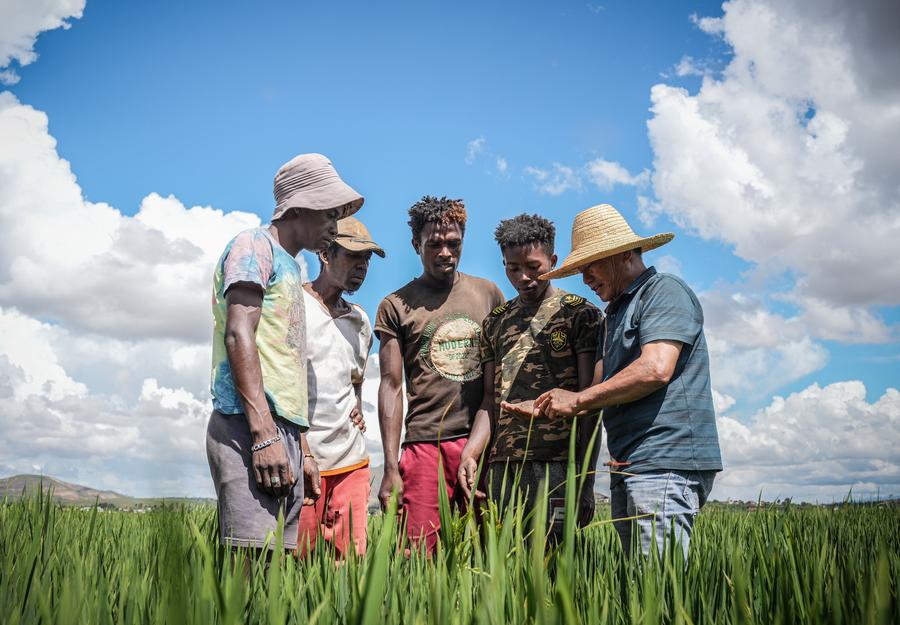
The Chinese experts have since conducted hundreds of training sessions, directly reaching over 2,000 individuals and indirectly benefitting thousands more through their knowledge dissemination efforts. “We’re working to build a national training platform to spread hybrid rice technologies even further,” Hu said.
In Anosiarivo located 490 km from Antananarivo, Roselyn Nantenaina observes the enhanced traits of a new rice variety, including stronger stalks and plumper grains. These improvements represent hope and the promise of a more prosperous agricultural future, especially as farmers contend with the limitations and drawbacks of traditional rice cultivation.
At the edge of the vast rice paddies, Nantenaina strolls through the rows, her fingers softly grazing the heavy, bowed heads of rice. “This year, the harvest will be abundant – far beyond what I ever imagined. It is a testament to my hard work, and a gift from the new life brought by the Chinese collaboration,” she said. Her voice filled with gratitude.
For the farmers of Mahitsy and Anosiarivo, the Chinese hybrid rice project is more than just a source of food; it represents hope and a pathway to better livelihoods. It embodies their aspirations for their children’s well-being, improved housing, and a brighter future, showing how agricultural initiatives can foster wider socio-economic growth in rural communities.
Arguably, the Chinese Hybrid Rice High-Yield Demonstration Base has not only yielded a bountiful harvest; it has sown the seeds of a new beginning in Madagascar.
For this reason, the Malagasy government has highlighted the importance of China’s contributions to improvng agricultural productivity in Madagascar, noting that the Chinese agricultural expertise is pivotal in advancing Madagascar’s agricultural sector.
According to Michel Anondraka, a director general at Madagascar’s Ministry of Agriculture and Livestock, hybrid rice is a high-yield variety, and increasing its cultivation is crucial for achieving rice self-sufficiency in Madagascar. “We express our gratitude to the Chinese government for this collaboration in hybrid rice, through the dispatch of experts who share their wealth of knowledge with us,” Anondraka said.
Moved by the benefits, local farmers have affectionately named the Chinese hybrid rice project “Tsarabe” – meaning “the best thing” in Malagasy. This nickname reflects the farmers’ growing optimism and their increasing embrace of Chinese agricultural innovation, recognising its transformative impact on their lives.