A Pause, Not a Peace
 Facebook
 Twitter
 Linkedin
 Google +
After four decades of enmity and two rounds of devastating war, Washington and Tehran trust each other so little that they prepare for battle even as they sit at the bargaining table.
Neither war nor peace has yet arrived. Instead, the U.S. and Iran have settled into an uncomfortable rhythm—guns aimed, diplomats talking, a region waiting in suspense.
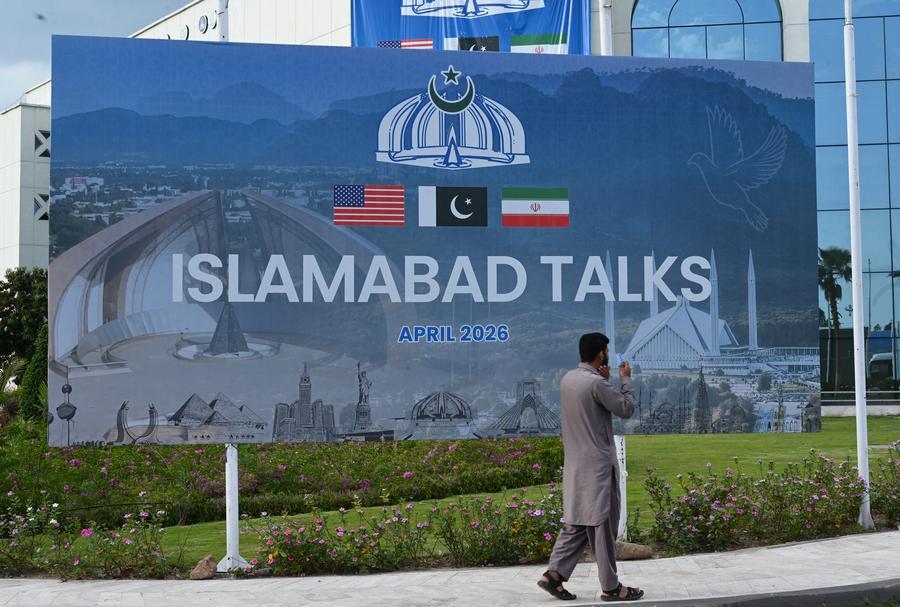
The April 11-12 Islamabad talks were supposed to be a turning point. For 21 hours, the highest-level U.S. and Iranian officials since the 1979 Islamic Revolution sat across from each other. When they left, there was no agreement. Within 48 hours, U.S. President Donald Trump announced a naval blockade of Iranian ports. Oil prices surged by more than 7 percent, shooting up to over $100 a barrel. The blockade had long been on Washington’s menu of options, and the failure of talks brought it into effect.
The question is not whether diplomacy failed—it did, and the blockade was its immediate aftermath, but what that failure means for the trajectory of the conflict.
The stalemate reflected four structural incompatibilities. First, control of the Strait of Hormuz—through which one fifth of the world’s oil passes. Washington proposed “joint management,” while Tehran rejected it outright. Second, the nuclear impasse. The U.S. demands a binding commitment that Iran will neither seek nuclear weapons nor retain rapid-production capability. Iran’s leadership refuses to surrender its “legitimate rights.” Third, ceasefire scope. Iran insisted that Israel’s campaign against Hezbollah in Lebanon must be covered, but Israel said it must not be. Fourth, sanctions relief. Tehran wants upfront guarantees, whereas Washington treats relief as an outcome, not a precondition. On none of these issues did either side show flexibility—largely because neither has suffered a decisive defeat. Both still believe they hold cards.
Yet the failure does not mean the talks were worthless. That 21-hour marathon was never meant to produce a deal. It was about positioning—two adversaries exchanging bottom lines before either was ready to blink. The Islamabad talks actually established a basic line of communication at a time when a single miscalculation could have quickly spun out of control. Knowing what the other will not accept is, in a high-stakes confrontation, almost as valuable as knowing what it wants. The talks also helped sustain—and provided political cover for—a two-week ceasefire that Pakistan had brokered on April 8, four days before the negotiators sat down.
That truce remains intact. Neither side wants to be seen as the party that killed diplomacy. U.S. Vice President JD Vance told reporters the U.S. presented its “final and best offer,” with Iranian officials responding that “now it’s time for [the U.S.] to decide whether it can earn our trust or not.” This mutual finger-pointing reflected a shared recognition that closing the diplomatic door carries political costs.
But the accelerants are just as real. That shared recognition is not translating into restraint within either country. The collapse of talks has empowered pro-war factions on both sides. In Washington, the failure validates assertions that Iran will only respond to pressure. In Tehran, hardliners see proof that Washington cannot be trusted. The most unpredictable variable remains Israel.
The historical record offers no comfort here. Twice before—in June 2025 and again in February 2026—active diplomatic engagement was followed by major military strikes. The pattern is consistent: Talks have not prevented strikes; they have preceded them. The question is whether the current leadership in Washington and Tehran is capable of breaking that cycle.
The talks are slowing the war by keeping communication open, maintaining a fragile ceasefire, and imposing reputational costs on the side that would shoot first. But they are also speeding up the war by validating hardliners, providing cover for military deployments, and running alongside a blockade that could easily trigger an incident. Neither side has yet shown the strategic patience or political courage required for genuine compromise. Iran believes it is holding the stronger hand. Washington wants a deal it can declare as victory before domestic pressures mount.
The Islamabad talks neither prevented the blockade nor closed the diplomatic door. But they revealed a sobering truth. After four decades of enmity and two rounds of devastating war, Washington and Tehran trust each other so little that they prepare for battle even as they sit at the bargaining table. That is not a formula for peace. It is a formula for managed catastrophe—a ceasefire that could break at any moment, and a war that neither side claims to want but both seem unable to stop.