Who Will Be Next?
 Facebook
 Twitter
 Linkedin
 Google +

Any nation rich in strategic resources and unwilling to bend to Washington’s will, any region seeking to break free from dollar hegemony and chart its own course, may find itself on America’s hit list.
After launching airstrikes on Venezuela and deploying Special Forces in early January to abduct President Nicolás Maduro, Washington proceeded to amass heavy military assets across the Middle East. On the last day of February, it joined Israel in carrying out military strikes against Iran, killing dozens of senior Iranian officials, including Supreme Leader Ayatollah Ali Khamenei.
The sudden U.S. strike on Iran once again violated the most basic principles of international law and moral conduct. Prior to the attack, the U.S. and Iran had already held three rounds of negotiations. Iran believed the negotiations had made “good progress” and agreed to reconvene in Vienna on March 2. However, the U.S. did not intend to negotiate in good faith. The talks served only as a smokescreen, a calculated ploy meant to catch Iran’s senior leadership off guard before the strike was launched. In the history of warfare, such conduct has rarely been regarded as a legitimate form of military deception but has more often been deemed a lasting disgrace.
The U.S. strike on Iran was defended on the grounds that Iran “continues to develop long-range missiles capable of threatening Europe and U.S. military forces.” Under Article 51 of the UN Charter, a state is entitled to act in self-defense when it has suffered an actual armed attack, or when it faces a clear and imminent threat of such an attack from hostile forces on the verge of invasion. The U.S. war against Iran, however, meets neither threshold. Instead, it reflects the conduct of a powerful state launching a military assault on a far weaker one under the pretext of containing a capability the adversary might one day acquire, even though multiple non-military alternatives, including diplomatic and economic negotiations, and international mediation, remained available. What drives this action is not any genuine threat to U.S. sovereignty or survival, but a broader calculus of geopolitical interest, resource extraction and the preservation of American hegemony. In this sense, the strike violated not only the core prohibition enshrined in Article 2(4) of the UN Charter, which requires states to refrain from the use of force against the territorial integrity or political independence of any other state, but also the foundational principle of just war doctrine that war must always remain a last resort.
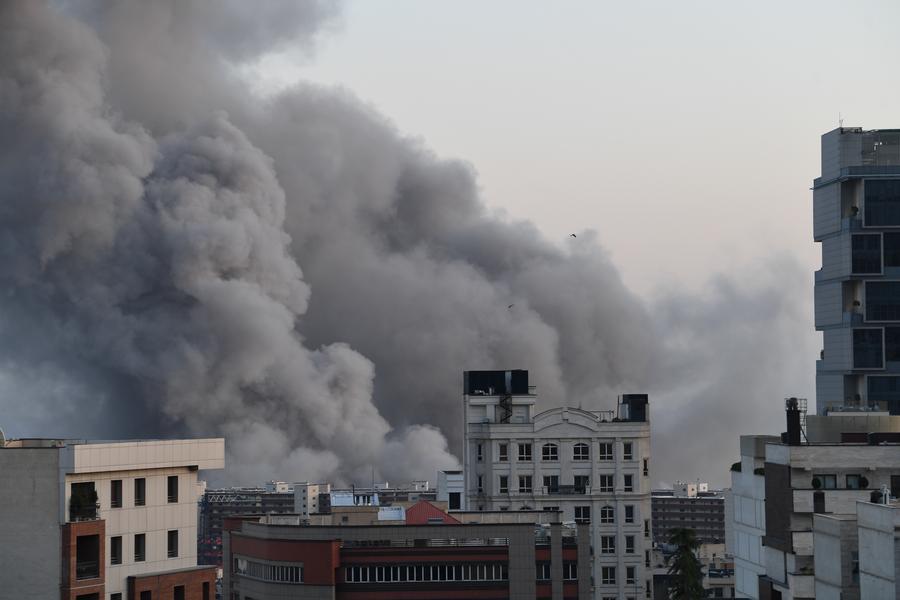
In a January interview, President Donald Trump openly declared his contempt for international law, “I don’t need international law,” he said. Yet no matter how this self-styled “peace president” chooses to justify his actions, one fact remains inescapable: The U.S.-Israeli missile strike on a girls’ elementary school in the southern Iranian city of Minab on February 28, which killed 165 people, many of whom were children, is a humanitarian atrocity.
From Latin America to the Middle East, if the abduction of Maduro marked the U.S.’ brazen revival of the Monroe Doctrine, or “Donroe Doctrine,” in an effort to reassert control over Latin America’s resources and geopolitical order, then the joint U.S.-Israeli airstrikes on Iran were about far more than clearing the way for American control over Middle Eastern oil and gas. More fundamentally, they represented another step in Washington’s effort to sustain its global hegemony.
In its National Security Strategy report, released late last year, the Trump administration claimed that it was abandoning the post-Cold War pursuit of “permanent global dominance” and making the Western Hemisphere its foremost strategic priority. In reality, however, the opposite is true: The U.S. is not retreating, but continuing to expand. In Europe, Washington continues to fuel the Russia-Ukraine war. In the Asia-Pacific, it presses ahead with drawing in allies and building military coalitions to stoke regional tensions. In the Middle East, it alternates between proxy warfare and direct military strikes to keep the region in perpetual turmoil.
Having made easy work of Venezuela and Iran, who will be America’s next target? Cuba? The Democratic People’s Republic of Korea? Or a more formidable geopolitical rival? Any nation rich in strategic resources and unwilling to bend to Washington’s will, any region seeking to break free from dollar hegemony and chart its own course, may find itself on America’s hit list.
There is profound danger in a leader who can flout established norms with impunity. Nazi Germany’s prewar expansion followed precisely this pattern. Hegemonic ambition is never self-limiting. Once an initial transgression goes unpunished, what follows is not restraint but escalation. This is one of history’s most hard-won lessons, and today it stands as a warning to us all.