Steps Toward Certainty
 Facebook
 Twitter
 Linkedin
 Google +
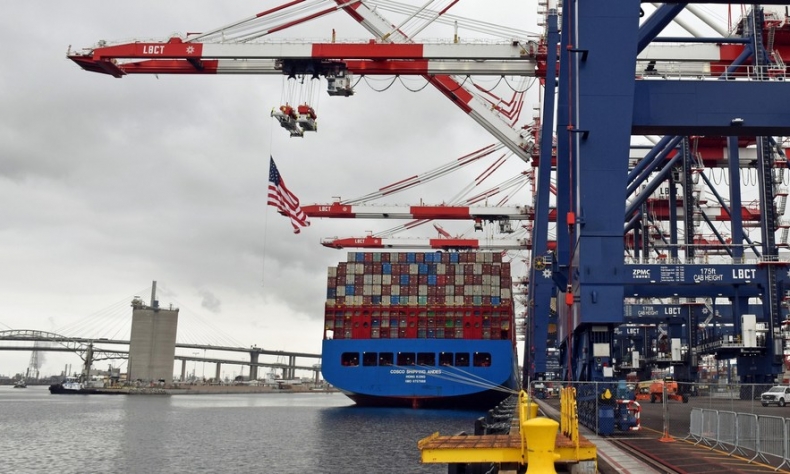
More predictable economic ties between China and the U.S. would have spillover benefits beyond the two countries.
Chinese and U.S. officials met in Paris, France, on March 15-16 for a new round of talks on economic and trade issues. The consultations, described as “candid,” “in-depth” and “constructive,” aimed to sustain dialogue and build on earlier rounds that had helped inject a degree of stability into bilateral ties.
Yet that stability was quickly tested by actions from Washington. Just days ahead of the talks, the U.S. launched two new Section 301 investigations—first targeting 16 economies and then expanding to 60, including China—introducing new friction into the process. Section 301 of the Trade Act of 1974 allows the U.S. president to unilaterally impose tariffs or other trade restrictions on foreign countries for alleged unfair trade practices.
Analysts agree that while continued dialogue helps stabilize ties, Washington’s parallel use of unilateral trade tools is undermining trust and complicating the path toward meaningful cooperation.
During the talks, Chinese Vice Premier He Lifeng, who led the Chinese delegation, reiterated China’s opposition to U.S. unilateral tariffs and urged Washington to “move in the same direction with China” to support a more stable and sustainable economic relationship.
Conversation matters
The talks in Paris touched on issues of mutual concern, including tariff arrangements, promoting bilateral trade and investment and maintaining existing consultation consensus, Xinhua News Agency reported.
During the talks, which are guided by the important consensus reached by the two countries’ heads of state, the two sides reached some new consensuses and agreed to continue consultations, Xinhua said.
Vice Premier He noted that a series of outcomes from five earlier rounds of consultations last year had helped bring “greater certainty and stability” to bilateral economic ties as well as the global economy. In 2025, Chinese and U.S. negotiators met on economic and trade issues in Geneva (May), London (June), Stockholm (July), Madrid (September) and Kuala Lumpur (October).
U.S. officials also emphasized the importance of maintaining a stable relationship, according to the Xinhua report. The U.S. representatives said steady economic ties between the world’s two largest economies were critical for global economic growth, supply chain resilience and financial stability, and called for efforts to reduce friction, avoid escalation and resolve differences through consultation.
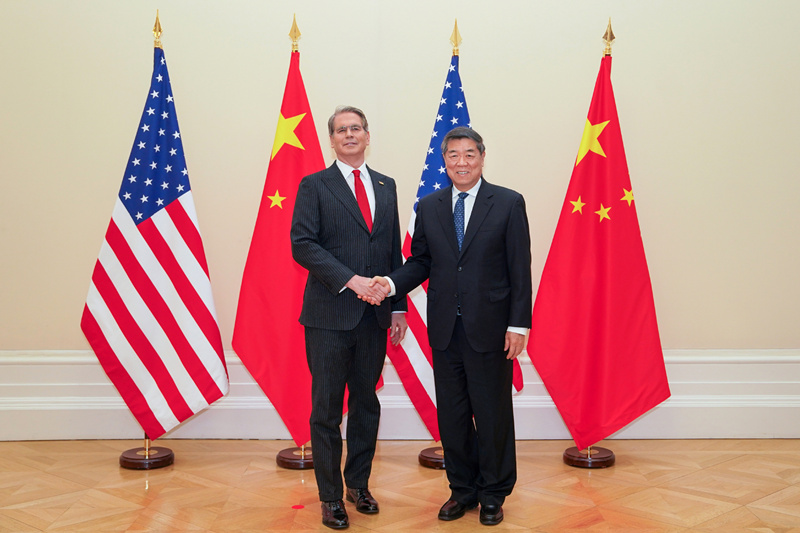
In an interview with American news service CNBC, Scott Bessent, U.S. Treasury Secretary and Washington’s lead negotiator, said the talks were “very good” and relations between the world’s two biggest economies were “stable.”
“I will be issuing a statement in the next few days, and it will be reaffirming the stability in the relationship between the first and second largest economies in the world,” he said.
Both sides agreed to explore the creation of a mechanism to promote bilateral trade and investment, and to continue using existing consultation frameworks to manage differences and expand areas of practical cooperation.
In international relations, maintaining a communication channel is often a success in itself. The real value of the consultations lies less in immediate outcomes and more in whether they keep structured dialogue alive, reduce uncertainty and create space for future agreements, Gor Sargsyan, a Sinologist and a member of the World Association of Chinese Studies, wrote in an article published in China Daily newspaper on March 18.
More stability
At their talks in Kuala Lumpur last October, negotiators reached a series of consensuses on issues including the U.S. Section 301 measures on China’s maritime, logistics and shipbuilding sectors, an extension of the suspension of reciprocal tariffs and the fentanyl-related tariff, as well as counternarcotics cooperation, expanding trade and export controls.
Since then, officials at multiple levels on both sides have remained in close contact and exchanged views in a timely manner.
Zhou Mi, a senior researcher at the Chinese Academy of International Trade and Economic Cooperation, said earlier consultations had produced considerable consensus, but that translating these into concrete outcomes would require further joint effort.
Even so, the continuation of talks is seen as a stabilizing factor at a time of heightened global uncertainty. Zhou added that steady engagement between the two sides could help reduce misjudgments and create room to explore areas of cooperation.
Gao Lingyun, a research fellow at the Chinese Academy of Social Sciences, told Global Times newspaper that sustained dialogue could help bring much-needed stability to the global economy, adding that more predictable economic ties between China and the U.S. would have spillover benefits beyond the two countries.
New trade probes
On March 11, the Office of the U.S. Trade Representative launched Section 301 investigations targeting 16 major trading partners on the grounds of what it described as “excessive capacity.” A day later, the office initiated investigations into 60 economies, including China, over alleged failures to address “forced labor” in supply chains.
The renewed use of such measures comes weeks after the U.S. Supreme Court struck down the tariffs Trump had introduced last year by declaring a national emergency—a ruling that lowered the tariff rates on imported goods and removed the president’s ability to increase duties almost at will.
In response, the White House has turned to alternative legal tools, including Section 122 of the Trade Act of 1974, under which it has imposed a 10-percent surcharge on imports from all trading partners.
China has consistently opposed the unilateral tariffs imposed by the United States, He said during the talks, urging Washington to completely remove such tariffs and other restrictive measures.
He noted that China will take necessary steps to firmly safeguard its rights and interests.
China expects the U.S. to move in the same direction, follow through on the important consensus reached by the two heads of state, expand areas of cooperation and reduce problems, so as to promote the healthy, stable and sustainable development of China-U.S. economic and trade relations, He added.
China has a stable and predictable environment for business investment and cooperation, Daryl Guppy, an international financial technical analyst, told China Daily.
But it requires genuine commitment from the U.S. to ensure that this can be extended into their shared areas of cooperation in manufacturing, technology industries and services, he added.
The effects of Washington’s unilateral trade approach are not confined to the bilateral relationship, as it begins to affect how even U.S. allies assess the country’s global economic leadership role.
A recent poll conducted by political digital newspaper Politico across Canada, Germany, France and the United Kingdom found that public attitudes toward the U.S. had deteriorated, with many respondents viewing China as a more reliable economic partner. The survey also suggested that younger respondents were more open to closer ties with China, while confidence in U.S. global leadership appeared to be weakening.