The Logic of Development
 Facebook
 Twitter
 Linkedin
 Google +
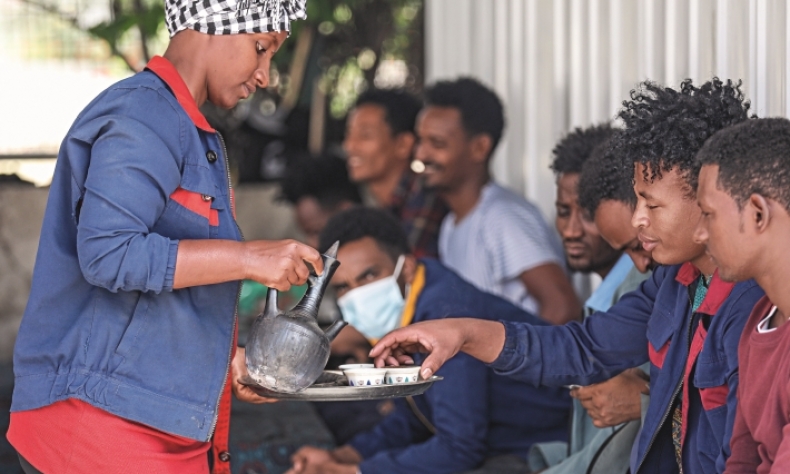
Only through mutual respect, practical cooperation and a shared commitment to development can countries of the Global South realise their potential.
In the early morning in Addis Ababa, sunlight filters through the highland mist as a clay pot simmers over charcoal, releasing the rich aroma of freshly roasted coffee. In Ethiopia’s centuries-old coffee ceremony, three rounds of coffee are served, progressing from bitter to sweet. Similarly, alongside the slow brewing of the coffee, disagreements soften through patient conversation, and consensus gradually emerges.
I have come to see this simple act of “sitting down to talk” as more than a cultural practice. It reflects a deeper logic of governance – one rooted in patience, dialogue and mutual understanding. This belief was reinforced during my three years of study at Peking University’s Institute of South-South Cooperation and Development (ISSCAD).
Before 2016, I served as state minister for public participation and mobilisation in the prime minister’s office. At the time, the country was navigating a complex transition, marked by rising demands from diverse ethnic groups alongside mounting development pressures. Like many policymakers, I was searching for workable solutions.
Through frequent participation in China-Ethiopia political exchanges and policy dialogues, I grew increasingly curious about China’s development trajectory. Like Ethiopia, China was also a large developing country with intricate governance challenges. But China achieved remarkable economic growth in just a few decades, while maintaining policy continuity and strong implementation capacity.
What struck me most was that the governing philosophy of “people-centred development” in China was not just rhetoric; it was firmly embedded in governance. It is put into practice through structured systems of cadre selection, rigorous discipline and a highly effective policy execution process. The Five-Year Plans exemplify this approach, combining long-term vision with practical adaptability by testing ideas and scaling up those that succeed. These observations reshaped my understanding of how developing countries might pursue modernisation paths suited to their own conditions.
From governance puzzles to shared learning
When I learned about the establishment of the ISSCAD at Peking University, I applied without hesitation. The programme is designed to promote intellectual exchange, experience sharing and capacity building among developing countries. Its mission is not to produce abstract theorists, but practitioners capable of addressing real development challenges. My government strongly supported my decision. Driven by a commitment to practical, problem-oriented development, I joined the institute’s first doctoral cohort.
At the institute, my journey evolved from searching for a “development framework” to understanding the deeper “logic of development.” Together with fellow students, we built collaborative platforms to share research data and policy insights. A colleague from Tanzania discussed challenges in attracting investment to industrial parks, while another from Nepal shared experiences of poverty alleviation in mountainous regions. I contributed perspectives on Ethiopia’s multi-ethnic governance challenges and development efforts. Our discussions, ranging from the localisation of special economic zones to inclusive growth strategies, were grounded in the lived realities of developing countries.
The classroom was, in essence, a platform for mutual learning. Rather than debating which system was superior, we focused on context-sensitive solutions. Each topic addressed core challenges faced by the Global South. The theoretical training I received laid a solid foundation for my later research on industrial park development in Ethiopia.
A field study in Shenzhen, a city widely seen as a symbol of China’s reform and opening up, proved to be a real eye-opener. Its transformation from a fishing village into a global innovation hub was not accidental. Drawing on my doctoral research framework, I visited industrial parks, government service centres and private enterprises, conducting in-depth interviews with managers, entrepreneurs and engineers. I came to see Shenzhen’s success as a dynamic cycle of evidence-based policymaking, effective government-business collaboration and continuous industrial upgrading. Importantly, development there remained focused on improving people’s livelihoods, creating quality employment opportunities while sustaining economic growth.

Putting knowledge into practice
This experience shaped the focus of my doctoral research: the localisation of industrial parks in Ethiopia. I selected the Eastern Industrial Zone, developed with Chinese participation, as one of my core case studies. Through repeated field trips, I observed both its achievements, including job creation and foreign exchange earnings, and its challenges, such as high labour turnover and insufficient supporting infrastructure. These findings reinforced my belief that China’s experience is not a template to be copied, but a set of adaptable governance tools.
Another important insight came from studying China’s political consultative system, particularly the role of the Chinese People’s Political Consultative Conference. In Ethiopia, I had long followed the work of the National Dialogue Commission and party forums. Under a multi-party system, consensus-building mechanisms often stall due to competing political interests. The Chinese model illustrated how institutionalised consultation platforms can help to build social consensus and reduce resistance in policy implementation. While recognising the differences between the two political systems, I concluded that the key lies in fostering broad-based participation to enhance policy effectiveness, rather than replicating institutional forms.
In 2019, after completing my doctorate, I returned to Ethiopia and was appointed head of the Intergovernmental Relations Bureau of the Amhara Regional State. This role required precisely the kind of skills I had developed: coordinating across levels of government and managing diverse stakeholders.
Rather than relying on top-down administrative orders, I applied the principles of consultative governance and multi-level coordination to address emerging challenges. Drawing on both my academic and practical experience, I helped to facilitate cross-regional forums that brought together a wide range of stakeholders. Through these platforms, we were able to strengthen development cooperation among different regions. This experience reaffirmed my belief that governance is not about unilateral control, but about collaborative problem-solving among multiple actors.
I also drew on lessons from Shenzhen to support the upgrading of industrial parks in the region. My research showed that the Eastern Industrial Zone had a labour turnover rate of up to 30 percent, largely driven by low wages and limited skills training. Adapting China’s model of linking vocational training with policy incentives, I recommended partnerships between industrial parks and Ethiopian technical schools to provide targeted training in textiles and mechanical processing.
Today, Ethiopia’s 16 public industrial parks host more than 300 enterprises, playing a vital role in job creation and foreign exchange generation. These outcomes reflect not the wholesale adoption of foreign models, but the careful localisation of development strategies.
Whenever I encounter governance challenges, I turn to the ISSCAD alumni network of the South-South programme, where peers from across the developing world share their experiences. Our discussions consistently return to a central question: how can developing countries learn from one another to forge their own paths to modernisation?
In an increasingly uncertain world marked by poverty, conflict and uneven development, no country can address these challenges alone. Only through mutual respect, practical cooperation and a shared commitment to development can countries of the Global South realise their potential. In this spirit of consultation and coexistence, we may yet write a new chapter of collective prosperity.
The author is Head of Intergovernmental Relations Bureau, Amhara Regional State, Ethiopia.