Sand Invaders to Sand Assets
 Facebook
 Twitter
 Linkedin
 Google +
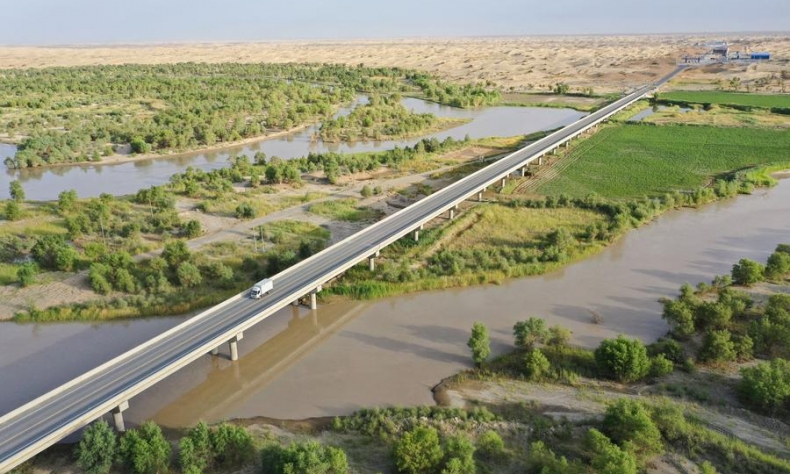
‘Locking’ of the Taklimakan desert’s edge is a beginning. The challenge now is not only to hold the line but to widen it, to make it yield economic benefits, and to ensure its long-term ecological and social viability.
Two years ago, a nearly 300-km gap in the world’s largest desert shelterbelt was finally sealed and the Taklimakan, China’s biggest and the world’s second-largest shifting sand desert, became encircled by an over 3,000-km green belt.
The Taklimakan Desert green belt project made it to the 2025 Top 10 Global Engineering Achievements listed by the World Federation of Engineering Organizations, winning global recognition. For Xinjiang, this is more than recognition; it is the validation of a decades-long campaign to push back desertification.
However, the “locking” of the desert’s edge is not the end, but a beginning. The Forestry and Grassland Bureau of Xinjiang held a briefing in February, explaining that from a singular containment focus, efforts have now shifted to a complex and sophisticated strategy of consolidation, economic integration and sustainable governance.
The challenge now is not only to hold the line but to widen it, to make it yield economic benefits, and to ensure its long-term ecological and social viability.
The giant green belt
The Taklimakan Desert covers 337,000 square km, larger than the area of Viet Nam, which has earned it the moniker “Sea of Death.”
The “locking” of this giant was a monumental achievement, closing the final breaches where sand encroachment was most aggressive.
In 2025 alone, the protective belt was widened by between 110 meters and 7.5 km, and its area was expanded by a staggering 626,000-plus hectares. From a thin defensive line, it has now become a robust, multi-layered buffer zone.
This phase of the Three-North Shelterbelt Forest Program, one of the world’s largest ecological initiatives, is defined by adaptability. The strategy is no longer a one-size-fits-all battle against the desert. As Zhang Zhigang, deputy head of the Forestry and Grassland Bureau, said at the press conference, the goal is not to “eliminate” the desert but to respect its natural systems while curbing its expansion. This is a critical conceptual evolution.
To execute this, teams of experts were assembled and three desert research stations were given the task of developing key technologies. Multiple local standards for ecological construction were established while special provincial-level science funds were set up to promote close collaboration between universities, research institutions and enterprises. Research stations in different regions were supported to conduct studies on plant species suitable for growing in the desert, optimal management models, and the most effective technical combinations for desert control.
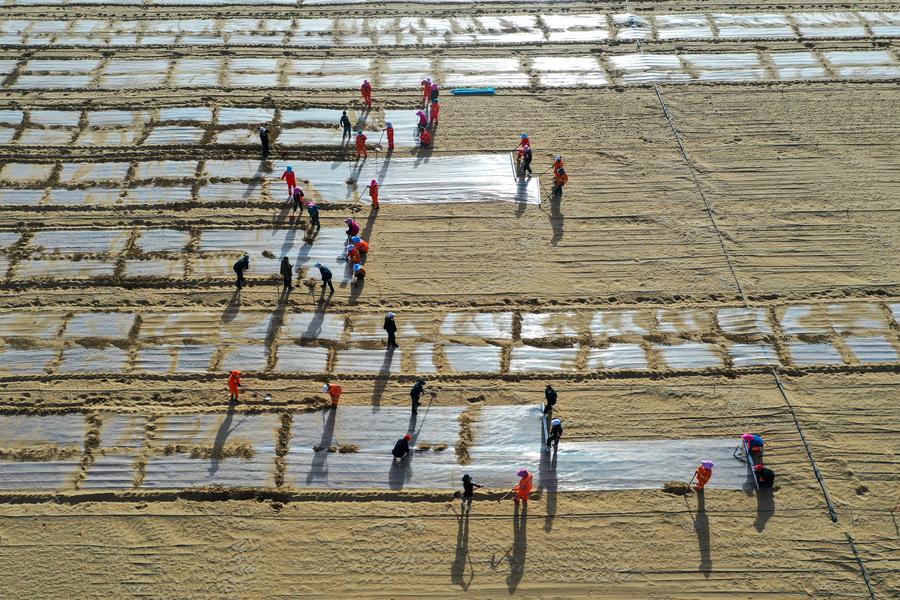
New project management approaches were introduced, and mechanisms to connect with farmers and benefit them were improved. This enabled a wide range of stakeholders to take part in the construction and maintenance of the Three-North Shelterbelt Forest Program, including state-owned enterprises, private companies, non-profit organizations, and local farmers and herders.
The results are tangible. The once-unrelenting advance of sand has been halted. Across China, the Sixth National Survey on Desertification and Sandification, using 2019 as the benchmark year, showed that from 2009 to 2019, the area of desertified land decreased by 50,000 square km, and the area of sandy land decreased by 43,300 square km. In Xinjiang, preliminary data from the 2024 land resource survey show a net decrease of over 5,229 square km of desertified land and more than 1,507 square km of sandy land compared to the results of the Sixth National Survey on Desertification and Sandification published in 2022. In places frequently battered by sandstorms in the past, sandstorm days have dropped from 179 to 128 annually. The ecological buffer is working, providing a more stable foundation for the next, and most critical phase in building a sustainable ecosystem.
Money grows on trees
The most compelling aspect of Xinjiang’s current strategy is the drive to monetize the green barrier. The principle of “ecological industrialization” and “industrial ecologization” is the central pillar of the region’s plan to ensure the project’s long-term survival. The logic is simple: A shelterbelt that pays for itself and enriches the people who tend it is a shelterbelt that will last.
The desert is being reframed as an asset with three increasingly integrated industrial models. The first is the foundational “cash crop under the canopy.” Xinjiang now boasts over 722,000 hectares of sand-based economic crops, generating a staggering 28.97 billion yuan ($4.2 billion) in output value.
For example, Yutian, a county that was once one of the most devastated by sandstorms, now produces about 85 percent of China’s cistanche, a highly valued medicinal plant also known as desert ginseng.
This model provides a direct, annual revenue stream for tens of thousands of households, transforming them from passive recipients of government aid into active stakeholders in the ecological infrastructure.
The second model, photovoltaic (PV) desert control, offers a glimpse into a hi-tech, synergistic future. The solar panels generate power and plants grow in the shade of the panels as well as between them, a model of multi-dimensional land use. In places like Ruoqiang and Shaya counties, PV installations are not just clean energy sources, they are tools for water management.
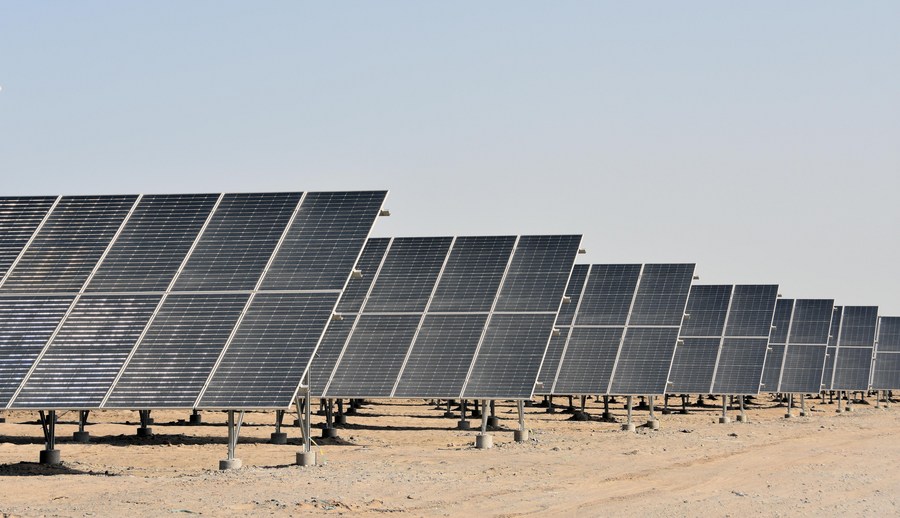
Solar panels generate electricity on-site to run water pumps that extract underground salty water, water that would otherwise be unusable. Moreover, the projects create jobs for locals. For example, the Guosheng Dual-carbon Silicon Industrial Park in Ruoqiang, a major PV industrial investment aimed at developing high-efficiency solar technology, is expected to employ over 1,200 people in its phase one alone. Once completed, the park will create more than 5,000 jobs.
This second model directly addresses two of the biggest hurdles in desert control—energy costs for irrigation and long-term funding—by turning the desert’s abundant solar resource into a capital-generating asset.
Finally, there is the fusion of ecology and culture: desert ecotourism. Landscapes like the Shaya poplar forests on the northern edge of the Taklimakan and the Hetian (Hotan) Jade Lake on the desert’s southern rim have become popular tourist destinations, spurring the growth of rural tourism and agricultural product processing.
In 2025, Yutian welcomed over 2 million visitors, a clear sign that the narrative of the desert is shifting from a place to fear to a place of fascination and economic opportunity.
The ingenuity of this three-pronged approach is its creation of a multi-temporal revenue stream. Farmers get short-term income from understory crops, mid-term returns from processing and selling them, and long-term revenue from tourism and land appreciation. This diversified portfolio reduces the economic risk for individual households, making them more resilient and more committed to the cause.
The model is replicable and hinges on its strong technology transfer potential, deep integration with local communities, and a seemingly insatiable market for its high-quality, sand-grown products.
As Xinjiang looks to the future, with a target of consolidating current achievement, its ambition extends beyond its borders. The Taklimakan project is now positioned as a “global solution.” By packaging its technical know-how, its policy frameworks and its community engagement models, Xinjiang aims to become a key partner for participating countries of the Belt and Road Initiative grappling with desertification.
The green belt around the desert is a prototype for a new kind of arid-land governance—one where the line between conservation and commerce is deliberately, and brilliantly blurred.