Behind a 500-Billion-Yuan Trade Breakthrough
 Facebook
 Twitter
 Linkedin
 Google +
Once viewed as China’s remote western frontier, Xinjiang is emerging as a dynamic nexus—linking Chinese and international markets and industries while promoting people-to-people exchanges.
Despite a weakening global recovery and slower trade growth worldwide in 2025, Xinjiang defied the trend. According to data released by the Urumqi Customs on January 23, Xinjiang’s total exports and imports reached 520.37 billion yuan ($74 billion) last year, surpassing the 500-billion-yuan ($72-billion) threshold for the first time. The year-on-year growth rate stood at 19.9 percent, the fastest among all provincial-level regions in the country.
Over the past five years, Xinjiang’s foreign trade has maintained a steady upward trajectory, achieving four consecutive years of record highs after surpassing 200 billion yuan ($29 billion) in 2021. The cumulative regional foreign trade volume of this period hit 1.71 trillion yuan ($246 billion), an increase of 144.3 percent compared with the previous five years’ total.
This sustained rise underscores Xinjiang’s growing role as a pivotal hub in Eurasian trade networks and highlights the region’s economic resilience. Behind the numbers lie three interlocking drivers: the modernization of transport infrastructure, the steady improvement of the business environment and the deepening of international cooperation.
Transforming trade corridors
Xinjiang borders eight countries—Mongolia, Russia, Kazakhstan, Kyrgyzstan, Tajikistan, Afghanistan, Pakistan and India—and connects Asia with Europe. In recent years, the region has sought to convert this strategic location from a mere transit advantage into a foundation for industrial and trade development.
Urumqi Customs has focused on enhancing cross-border logistics efficiency at highway, railway and aviation ports by integrating infrastructure upgrades with regulatory reforms.
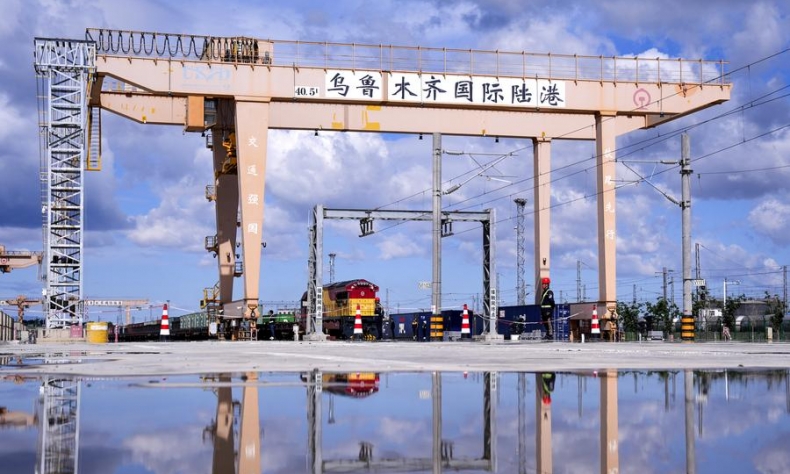
On the highway front, the rollout of the “local clearance, direct exit” model has addressed long-standing bottlenecks. Under this arrangement, once a company completes declaration and inspection procedures with local customs, its goods can be transported directly to the exit port for release—eliminating redundant checks and expediting cross-border movement. At the Urumqi International Land Port, for example, the average clearance time for outbound cargo has been reduced from two or three days to just four hours. This model has been adopted at 13 highway ports across Xinjiang, becoming a signature reform of the China (Xinjiang) Pilot Free Trade Zone.
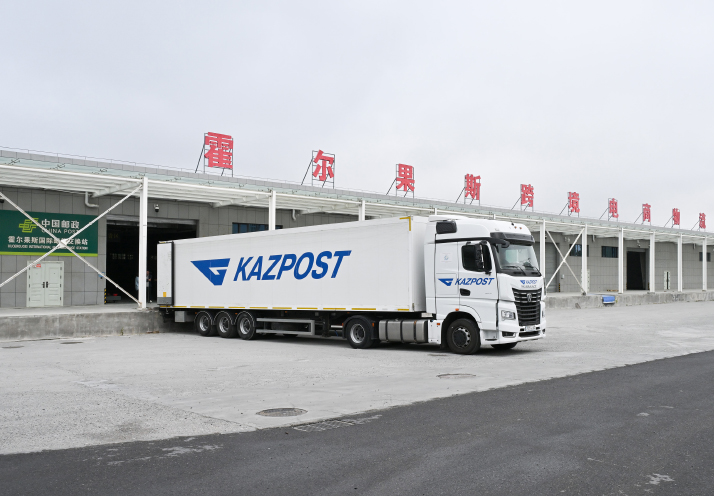
At Huoerguosi (Khorgas or Horgos), one of China’s busiest land ports on its border with Kazakhstan, customs authorities introduced a fast-track system for automobile exports. Vehicles are driven across the border by drivers and released instantly after a QR code containing key information is scanned. The system has sharply reduced manpower and time costs for exporters. In 2025 alone, Huoerguosi handled the exports of 450,000 vehicles, making it China’s largest land port for overseas shipment of automobiles.
Railway crossings have also undergone a significant transformation. By integrating “smart railway ports” with streamlined clearance and inspection processes at local customs, the entire workflow has been digitized and front-loaded, effectively lowering logistics costs and shortening companies’ capital turnover cycles.
Last year, Xinjiang’s railway ports handled 30.67 million tons of import and export cargo, an 11.5-percent increase from the previous year. Customs authorities supervised 18,000 China-Europe and China-Central Asia freight trains, up 7.4 percent year on year. These freight services, often described as “steel camel caravans,” have become a stable artery of Eurasian trade, carrying machinery, agricultural products, chemicals and consumer goods across continents.
The functions of airports have been greatly enhanced. For instance, Urumqi’s aviation hub has introduced practices including allowing cargo to move immediately upon landing without warehouse delays. In 2025, air cargo throughput at the Urumqi airport rose by more than 150 percent year on year, while international cargo flights increased by over 80 percent, signaling the region’s shift from a traditional logistics node to a dynamic platform for opening up.
Improving the business environment
In 2025, the Urumqi Customs placed greater emphasis on resolving the pressing difficulties and problems that concern market entities most, focusing on policy support, precise services and institutional innovation.
Xinjiang has built a comprehensive framework covering the entire trade chain. Last year, new measures targeting port operations, agricultural and food exports, cross-border e-commerce and China-Europe freight trains were rolled out in a coordinated manner, offering tailored support to different types of businesses.
In 2025, Urumqi was selected as the only city in northwest China for a national pilot program aimed at improving cross-border trade facilitation. The designation signals that Xinjiang’s trade environment has reached standards comparable to those in China’s more developed coastal regions.
Tax and fee reductions played a parallel role. In 2025, Xinjiang granted 92 million yuan ($13 million) in tax exemptions and reductions to foreign trade firms. Through targeted guidance, customs authorities helped companies—particularly for small and medium-sized enterprises—fully utilize preferential tariff and value-added tax policies, easing their cash flow pressures.
Service improvements have also delivered remarkable benefits. A unified administrative system simplifies licensing procedures, cutting processing times. An upgraded online platform enables companies to communicate directly with customs authorities, resolve clearance issues in real time and stay compliant with evolving regulations. New inspection methods, including remote video checks, greatly reduce waiting times.

Private enterprises, as the cornerstone of Xinjiang’s foreign trade, have received particular attention. Efforts to expand participation in the Authorized Economic Operator (AEO) program, which grants certified companies expedited customs treatment worldwide, have yielded tangible benefits. Participating firms enjoy faster customs clearance and improved access to financial services.
Institutional innovation within the China (Xinjiang) Pilot Free Trade Zone has amplified these gains. Since its establishment in November 2023, the zone has accounted for more than one third of Xinjiang’s total trade volume. Several regulatory innovations, such as bonded mineral blending at land ports and joint inspection mechanisms for imported copper concentrate, have reduced operational costs of businesses while maintaining robust oversight. Some of these practices are being duplicated nationwide.
Together, these policies have bolstered the vitality and competitiveness of Xinjiang’s private sector. In 2025, private firms accounted for more than 90 percent of the region’s trade. Exports of Chinese-branded products, particularly the “new trio”—electric vehicles, lithium-ion batteries and solar equipment, expanded rapidly, reflecting a gradual shift toward higher-value trade.
Cooperation and shared growth
Xinjiang’s trade expansion is inseparable from the Belt and Road Initiative, which was proposed by China in 2013 to boost connectivity along and beyond the ancient Silk Road routes.
Central Asia remains Xinjiang’s major market. The five Central Asian countries accounted for roughly half of Xinjiang’s total foreign trade in 2025. At the same time, trade with Southeast Asia has increased rapidly, emerging as a new growth driver, and robust expansion of economic ties with Africa, the Middle East and Latin America has strengthened market diversification.
Institutional cooperation has deepened alongside trade flows. Customs agreements under multilateral frameworks such as the China-Central Asia Summit and the Shanghai Cooperation Organization have facilitated smoother cross-border movement of goods through Xinjiang.
Efforts to boost agricultural trade have been particularly significant. Expanded “green channels” for perishable goods have significantly accelerated customs clearance for fruits, grains and other food products—enhancing market access for exporting countries and ensuring fresher, more diverse supplies for Chinese consumers.
At the heart of Eurasia, the ancient Silk Road is being reimagined for a new era. Once viewed as China’s remote western frontier, Xinjiang is emerging as a dynamic nexus—linking Chinese and international markets and industries while promoting people-to-people exchanges. Through upgraded transport infrastructure, a more enabling business environment and deepening international partnerships, the region is positioning itself as a pivotal node in high-quality Belt and Road cooperation.