A New Era of Green Development
 Facebook
 Twitter
 Linkedin
 Google +
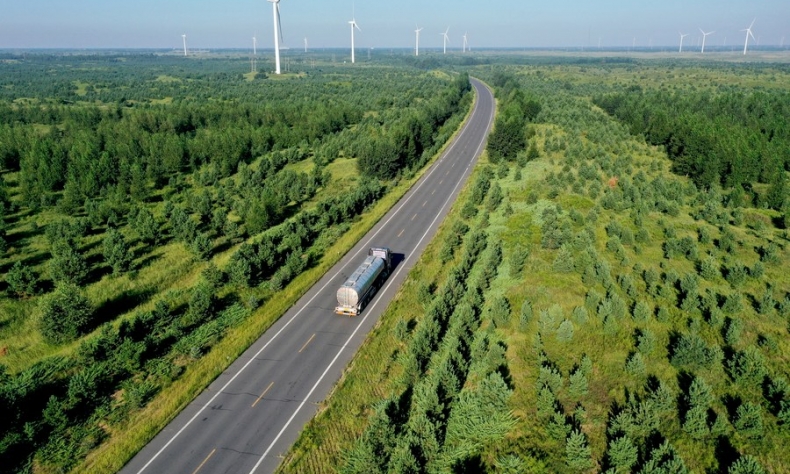
As the new legislation further balances economic development and environmental protection, China will accelerate its progress in turning the vision of a Beautiful China defined by clear waters, green mountains and clean air, into reality.
On March 12, the National People’s Congress, China’s top legislature, passed the landmark Ecological and Environmental Code at the closing meeting of its eight-day annual session in Beijing. As China’s second formal statutory code, following the adoption of the Civil Code in 2020, the new legislation creates a more solid legal foundation for advancing the Beautiful China Initiative (a top-level development blueprint detailing specific targets for the country’s green and high-quality development—Ed.)
Comprising 1,242 articles across five chapters, the Code integrates over 30 existing environmental laws, more than 100 administrative regulations and numerous other legal documents, developing a unified system covering areas including pollution control, ecological protection and low-carbon development. It is set to take effect on August 15.
Notably, the Code is the first legislation in China that has a dedicated section on green and low-carbon development, translating the country’s dual carbon goals—peaking carbon emissions before 2030 and achieving carbon neutrality before 2060—into a long-term, stable and predictable legal framework.
A timely legislation
The introduction of the Code is a response to the evolution of the importance China attaches to green development. Over the past four decades, the country has developed an extensive environmental legal framework, but fragmentation, overlapping provisions and weak coordination have created challenges for businesses, the public and enforcement authorities alike.
To address these issues, the Code consolidates existing legislative achievements and institutional innovations, and more fully incorporates the harmonious coexistence between humanity and nature into China’s modernization path. It also offers the global community China’s insights on coping with common challenges and promoting sustainable development.
With the core objective of protecting public health and environmental rights, the code establishes a comprehensive governance framework spanning the entire chain of ecosystem protection. At the same time, it underscores the national focus on low-carbon transformation to reduce pollution sources.
China’s ecosystem protection strategy is not merely about pollution control, but also about fostering new engines of economic growth. Green manufacturing and clean energy are not only generating new industries and jobs, but also increasing investment, particularly in low-carbon technology research and development. These are among the reasons governments at all levels are prioritizing green industries in their development strategies.

The Code also places people’s wellbeing at its core. It introduces stricter standards for environmental protection and encourages the public to adopt eco-friendly practices such as waste sorting, green consumption and low-carbon travel. This way, environmental protection will become a greater part of daily life, including through having more sustainable food on the table, convenient green transportation networks and pocket parks—small and micro green spaces—within communities.
Green practices
The Chinese Government declared war on air pollution in 2013, launching its Air Pollution Prevention and Control Action Plan, a comprehensive national policy framework for pursuing air quality improvement. Under the action plan, Beijing has taken the lead among Chinese cities, pursuing institutional innovation and regional collaboration for improving air quality.
According to the Beijing Municipal Ecology and Environment Bureau, the city made steady progress in improving air quality in 2025. The number of days with good air quality reached 311, an increase of 135 days since 2013. The number of heavily polluted days dropped from 58 in 2013 to just one in 2025, a reduction of 98.3 percent.
The Beijing Municipal Government has also strengthened efforts on biodiversity protection and the development of the green economy. An index assessing the Beijing Municipal Government’s biodiversity conservation efforts, produced by Capital University of Economics and Business, increased by 27.6 percent between 2012 and 2024.
Nevertheless, global comparisons suggest there is still room for improvement. Cities such as New York in the United States and London in the United Kingdom offer valuable lessons in areas ranging from green jobs and sustainable transport to renewable energy use and urban green space. Drawing on these experiences, China can continue refining its green transformation.
Chinese authorities should improve carbon data transparency and expand green finance through platforms such as the China Beijing Green Exchange, a market platform for trading environmental equities. Governments should also accelerate innovation in key sectors including green manufacturing, energy storage, sustainable construction and low-carbon transport.
As the new legislation further balances economic development and environmental protection, China will accelerate its progress in turning the vision of a Beautiful China defined by clear waters, green mountains and clean air, into reality.
The author is a professor at Capital Top Think Tanks/School of Finance, Capital University of Economics and Business in Beijing.