Building a Data Ecosystem
 Facebook
 Twitter
 Linkedin
 Google +

After the WDO is fully operational, it is expected to play a significant role in global data governance by fostering a more open, inclusive and equitable global data ecosystem.
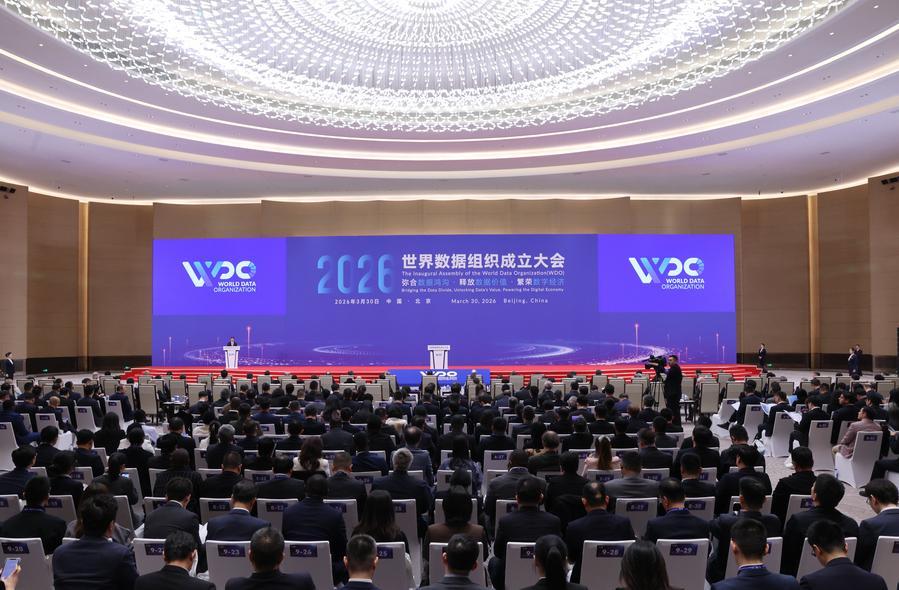
The World Data Organization (WDO), a professional, non-governmental and non-profit international body inaugurated in Beijing on March 30, aims to provide a platform for global collaboration. To gain insights into the WDO’s role in international data governance, Beijing Review spoke to Gao Yi, an associate research fellow at the Chinese Academy of Science and Technology for Development. Gao specializes in international science and technology relations as well as innovation policy and governance. Edited excerpts of the interview follow:
Beijing Review: Could you explain in straightforward terms what “data resources” actually mean? And how significant are they in today’s era of intelligence and digital transformation?
Gao Yi: From a technological perspective, the informatization of the national economy and society is actually a process of producing data. Informatization is to the Information Age what industrialization was to the Industrial Age. Data is recorded and after a large amount of usable information is accumulated it forms data resources.
In today’s era of intelligence and digital transformation, data resources are essential to ensure the quality and equitable delivery of public services for individuals. For enterprises, they are the core of competitiveness. For countries, they are becoming a new engine of economic growth. China is advancing the Digital China Initiative and treating data resources as a strategic asset.
Data is related to the efficiency of public services, the precision of social governance, and the ability to address global challenges such as climate change and public health. What global needs does the WDO’s establishment address and what goals will it pursue?
The WDO is the world’s first international body dedicated to promoting data development and governance practices. Its establishment aims to address three major global challenges in the current Information Age: First is uneven development capacity, second is fragmented rules and standards, and third is insufficient coordination of the industrial ecology. It will serve as an open, inclusive, professional and neutral cooperation platform for the international community to coordinate rules, foster industry collaboration and build capacity.
The primary goals of the WDO are the following: First is to “break down barriers,” which refers to solving the problem of inconsistent data policies among countries; promoting the formation of industry consensus, standard recommendations and best practices; providing reference for governments and research institutions around the world; and helping multinational enterprises reduce data compliance costs. Second is to “build an ecosystem,” which means to apply data to real scenarios such as healthcare, education and energy to promote project implementation and industrial innovation; strengthen talent cultivation; and especially to help countries in the Global South enhance their data capabilities and bridge the data divide.
In his congratulatory message marking the founding of the organization, President Xi Jinping emphasized the importance of working with all stakeholders to build consensus on data governance rules. At the moment, in what areas does the international community agree on data governance rules and what are the key points of disagreement or divergence?
In the field of data governance, the international community has reached consensus on a few fundamental issues, but there are significant and deepening differences in regulatory paths, core principles and governance models.
Establishing a global data governance framework has become a universal consensus and an urgent priority of the international community. Countries increasingly consider the protection of minors from Internet-related harms and the security of critical information infrastructure as areas that must be strictly regulated. On the broader governance agenda, more and more countries recognize the need to establish regulations for AI governance, and generally pay attention to transparency, risk classification and copyright issues.
Currently, the most intense dispute directly affecting enterprises centers on cross-border data flows. The United States treats data flows as a national security issue and has established laws to prohibit the transfer of sensitive personal data to “countries of concern.” The EU, grounded in its strong commitment privacy protection, has imposed stringent restrictions on the transmission of data outside the bloc through the General Data Protection Regulation. China emphasizes the need for balance between development and security, seeking to reconcile the free flow of data and data security protection through regulatory means.
What is China’s proposed framework for addressing these issues? And what experiences or best practices can China share with other countries?
At the inaugural assembly of the WDO, China proposed three specific initiatives based on the characteristics of data.
Leverage the high liquidity of data. Efficient flow and utilization of data should be promoted by open cooperation. Upholding the principle of achieving shared growth through consultation and collaboration, WDO members will advance the formulation, alignment and mutual recognition of related rules and standards, so as to effectively remove barriers to cross-border data flows.
Leverage the high empowerment potential of data to achieve inclusive sharing and common development. Accelerating the implementation of the United Nations Global Digital Compact (a landmark, consensus-adopted international framework intended to create an open, secure and human-centered digital future—Ed.), WDO members will jointly advance technological research and development and facilitate the application of related outcomes, in order to enable the benefits of data to better serve people around the world.
Address the high sensitivity of data through coordinated governance to safeguard security baselines. International digital governance rules reflecting the interests of all parties and respecting their rights should be established, strictly protecting personal privacy, trade secrets and the security of critical data, and effectively countering risks such as cyberattacks and data crimes.
According to the Typical Experiences of Trusted Data Space Pilot Projects released by China’s National Data Administration, urban trusted data areas are being developed, utilizing technologies such as privacy computing to achieve “data available but not accessible,” which means data should be able to be used without identifiers such as individual or company information being visible, or without actually being able to access the data itself, so as to safeguard the rights and interests of all parties. Examples include Nanjing, capital of Jiangsu Province, establishing a Data Element Innovation Center to explore the use of data resources in finance, scientific research, AI and other fields, and the creation of environmental risk profiles for polluting enterprises, with the premiums for high-risk enterprises being increased by 15-25 percent.
Lastly, what is your idea of success for the WDO? What global impact will it have once it’s fully functional?
After the WDO is fully operational, it is expected to play a significant role in global data governance by fostering a more open, inclusive and equitable global data ecosystem. The development vision is to serve as an internationally influential platform and a trust hub in the data field by around 2030. This includes establishing widely adopted industry standards to reduce institutional costs of global data flows, providing capacity-building platforms for Global South countries, promoting a diverse and symbiotic governance framework, and facilitating a new paradigm of cross-regional cooperation.