Run, Robot, Run: Beijing’s Humanoid Half-Marathon Breaks New Ground
 Facebook
 Twitter
 Linkedin
 Google +
Judging by recent progress, that future may come sooner than expected.
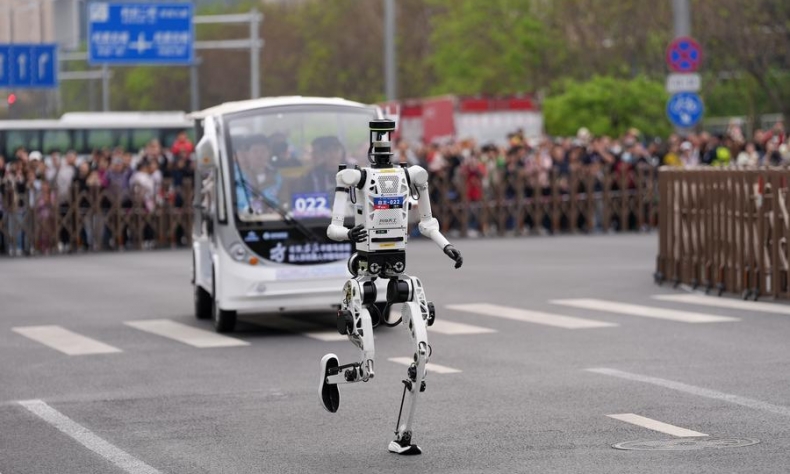
On a cool morning in Beijing’s Chaoyang district, the familiar crack of a starting gun signaled an unfamiliar race. Over 12,000 runners lined up alongside more than 100 humanoid robots in a half-marathon that, until recently, would have seemed like a mere tech stunt. But this event wasn’t about spectacle or viral moments; it was a genuine test of how far China’s humanoid robotics have come—and how close they are to real-world deployment. The novelty remains, but now it supports a more meaningful goal: validation.
From controlled demos to real humanoid autonomy
The most important change this year was not visual but structural, embedded in a rule meant to redefine the competition: robots that relied on human assistance would have their finishing times multiplied by 1.2. On paper, it sounds like a minor adjustment, but in reality, it pushed teams to confront robotics main challenge: autonomy. Nearly 40 percent of humanoid competitors ran the race entirely on their own, a figure that signals a shift in industry norms. The emphasis is no longer on building humanoids that can operate under supervision, but on developing their ability to recognize, decide, and act independently in real time.
China’s current wave of innovation is clear. Instead of just developing stronger joints or better batteries, engineers focused on the “brains” of robots, mainly AI for perception, planning, and control. Companies such as Unitree, Tien Kung, and Honor made the race a contest of software rather than just hardware. With standard humanoid body types, real progress now hinges on smarter algorithms and better intelligence.
Humanoid robot innovation is being developed in months, not years
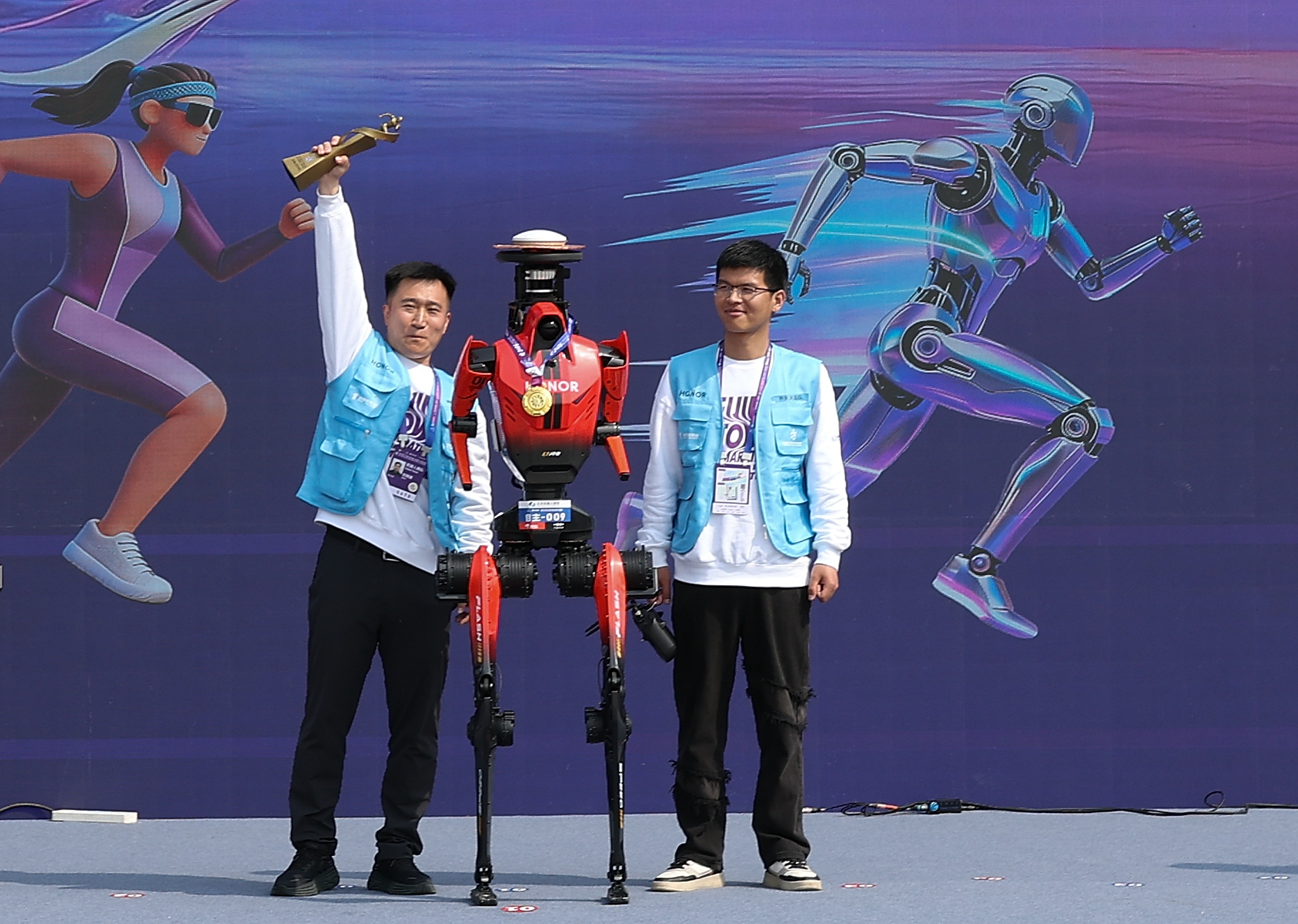
The results highlight just how quickly progress is accelerating. The fastest autonomous humanoid, built by the Shenzhen-based tech company Honor, finished the half-marathon in 50 minutes and 26 seconds, six minutes faster than the human world record. Last year’s top robot took 2 hours and 40 minutes to complete the same race. This leap shows rapid advances in embodied AI, particularly in integrating high-level decision-making with precise motor control. Engineers call this the coordination between the “big brain” and “small brain,” allowing robots to adjust stride, pace, and balance as needed, not just follow pre-set routines.
Even differences in running styles among the robots pointed to deeper experimentation: some adopted an unconventional pace, such as inward V-shaped strides, while others mimicked the upright posture of human long-distance runners, each approach representing a different answer to the challenges of efficiency and stability. At the same time, the race did not hide the technology’s imperfectness. One leading robot failed to stop in time and collided with a safety barrier, a moment that drew both cheers and concern but ultimately reinforced an important point: these machines are no longer confined to perfect lab conditions, and their shortcomings are now visible in the real world, where unpredictabilities are part of the test for getting it right.
Engineering beyond the lab
The course design itself made that test unavoidable, introducing more than 10 types of terrain, slopes up to 8 percent, narrow paths, sharp turns, and obstacles that required precision to navigate effectively. This was not a controlled or forgiving environment, and that was precisely the intention. For humanoid robots to move beyond demonstration and into practical use, they must be able to handle variability, which traditional testing environments often fail to provide. By including a wide range of obstacles in the race, the half-marathon organizers forced engineers to solve multiple human weaknesses on the fly, including balance, perception, energy management, and decision-making.
Events like this are important for innovation. They accelerate development by exposing problems quickly and publicly, creating immediate feedback that is tough to replicate in isolated testing. The presence of international teams from Germany, France, Portugal, and Brazil further stressed the global relevance of what is happening in Beijing. While the attention from foreign leaders earlier this year highlighted that China’s progress in robotics is no longer viewed as a niche development, but rather as part of a broader tech industry closely watched around the world.
From racecourse to real-life deployment
Despite the attention the race received, the true goal isn’t building robots that can run marathons. It’s about developing systems that work in real-world settings where human labor is scarce, risky, or inefficient. Across China, this shift is already happening. Robotics companies are testing humanoid machines in factories, where consistency and endurance matter, and in cities, where adaptability and interaction are crucial.
Early demonstrations, like robots completing entire shifts on assembly lines or assisting with traffic management, are still in their early stages but show a clear path toward everyday integration. This approach aligns with China’s policy direction, which sees embodied intelligence as a key future industry and expects substantial market growth by 2030. Notably, China frames robotics not as a replacement for people, but as a tool for handling dangerous, repetitive, or undesirable work. This practical approach shapes how the technology is seen, both in China and internationally.
A race that is just getting started
At first glance, the Beijing humanoid half-marathon appears to be a publicity stunt. But its real value is what it shows about today’s technology. This event marks a shift—from robots on display in labs to systems running independently in public. Challenges such as reliability, safety, and cost remain, but progress is accelerating, driven by innovation, policy, and real-world testing. The robots weren’t just racing for speed. They were part of a larger effort to answer a key question: not whether humanoids can work outside the lab, but how quickly they’ll become practical products on scale. Judging by recent progress, that future may come sooner than expected.