Living Archive of Global Exchange
 Facebook
 Twitter
 Linkedin
 Google +
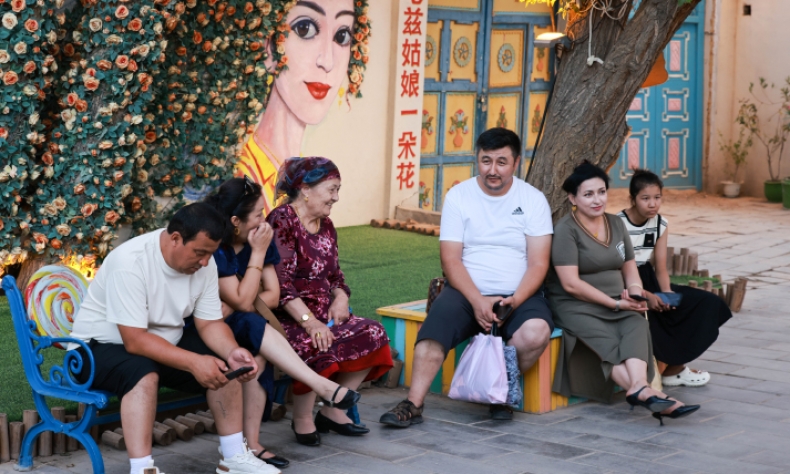
From the enticing grasslands and rugged mountains of the north to the ancient ruins and surviving cities of the Silk Road, Xinjiang offers a legacy of movement—of people, goods and communication—and of the ways that movement has shaped, and is shaping, societies.
Journey back to 1951. The People’s Republic of China (PRC) was young. Yook Kearn Wong, an eager military recruit from Guangdong Province, and his new comrades in the People’s Liberation Army ventured westward through the fortress of Jiayuguan, Gansu Province, the terminus of the Great Wall, past the legendary cliffs of Dunhuang, with their magnificent muraled caves, beyond the crumbling glory of the Jade Gate (Yumen Pass), through the high plains, desert sands and yellow earth until they reached their posts at the edge of the country.
In his book At the Edge of Empire, Yook Kearn Wong’s son, New York Times correspondent Edward Wong, chronicles China’s far western frontier as a region defined not just by its distance from Beijing, but by its proximity to many things: to Central Asia, to history, to disparate cultures. But while Xinjiang may be the western edge of China, it is, and has long been, a center—a nexus of the movement of people and ideas and commerce across continents.
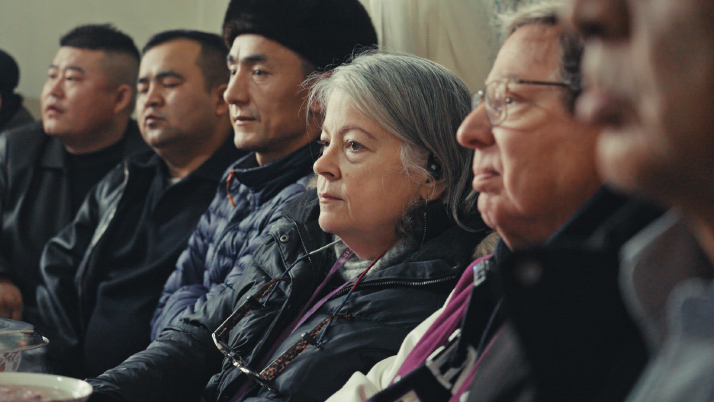
That idea stayed with me as I moved through Xinjiang Uygur Autonomous Region with my wife and some Chinese journalist friends—north into the Ili River Valley near the border with Kazakhstan, and south into the ancient oasis city of Kuqa (Kucha). As a history-major-turned-journalist and journalism professor, I found myself seeing Xinjiang not only as a tourist destination, but as a living archive of global exchange. The region is often framed today through geopolitics or political controversy. But to understand Xinjiang fully, one must step back and see it as a crossroads of civilization for nearly two millennia.
Beyond the edge
Standing amid the ancient ruins in Kuqa, I began a conversation with my traveling companions: How far are we, I wondered, from the centers of the ancient world? Our smartphones provided instant answers. Beijing, where Marco Polo would travel, lies thousands of km to the east—roughly 3,000 km, a long but now routine journey by modern transport. Looking westward, the ancient travelers were well on their way to Baghdad, once the world’s largest city, about 4,500 km away; Constantinople, the great hinge between Europe and Asia, is 5,000 km distant; and Rome, the symbolic endpoint of the ancient Silk Road in the Western imagination, is a trek of some 7,000 km.
The area now called Xinjiang became a conduit for cultural and intellectual exchange. From the west came horses, metals and artistic influences. From the east came paper, silk and technological innovations that would transform societies far beyond China. Languages mixed, religions spread and identities evolved.
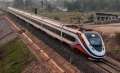
Today’s Xinjiang is still a midpoint in a network that connects economies and ideas across continents. As a key part of China’s Belt and Road concept, Xinjiang connects the nation’s commercial centers of the east with Pakistan and the Global South through the China-Pakistan Economic Corridor, and to London and other points in Europe via the “Iron Camel Caravan,” officially known as the China-Europe Railway Express. (The China-proposed Silk Road Economic Belt and the 21st-Century Maritime Silk Road, collectively known as the Belt and Road Initiative, aim to boost connectivity along and beyond the ancient Silk Road routes—Ed.)
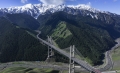
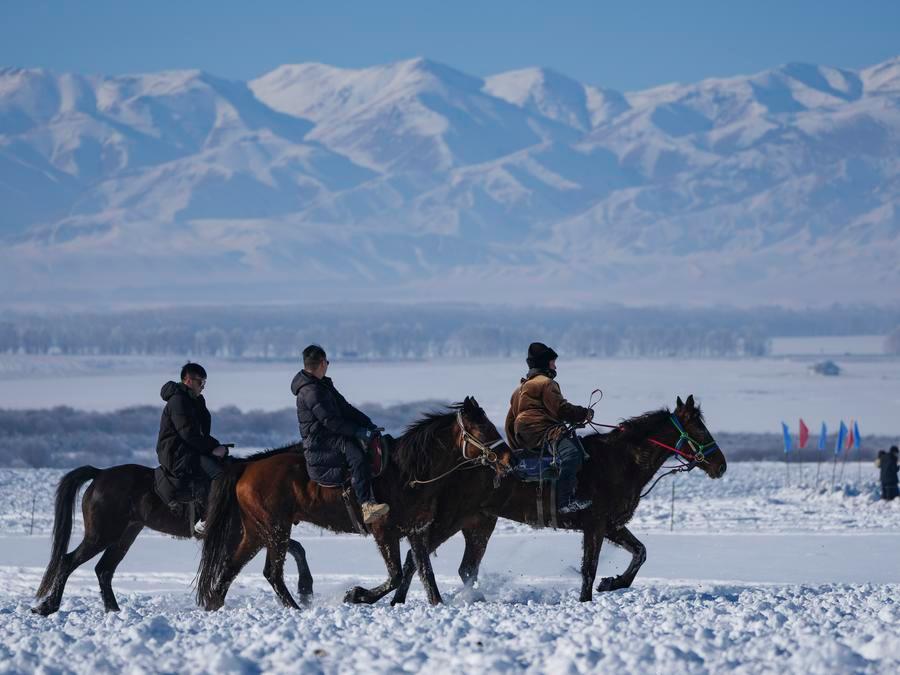
Xinjiang’s role in world history begins with its contrasting geography, which creates commercial corridors between societies. In the north, the Ili River Valley opens into rolling grasslands framed by the Tianshan Mountains—a landscape that feels closer to Central Asia than to east China. In winter, the mountains are stark and imposing; in summer, they give way to pastureland long used by Kazak herders. We rode horses through those mountains and hiked through the snows. It was a long way from Beijing.
In the south lies a very different world: the Tarim Basin, dominated by the vast Taklimakan Desert (the world’s second largest shifting desert, behind the Sahara—Ed.). Along its edges sit oasis cities with large Uygur populations like Kuqa, which once thrived as critical stops along the Silk Road’s southern routes.
Together, these landscapes created the network of passageways between East and West. Traders, pilgrims and armies moved along these corridors, linking China to Central Asia, the Middle East and Europe. In Kuqa, just outside the modern city, the ruins of ancient settlements and the nearby Kizil caves offer a glimpse into this world. The murals, some faded but still dramatic, tell stories of Buddhism’s arrival in China, carried along these trade routes by monks and merchants.
The power of context
As a journalist, I often consider how information travels: How stories move across borders and are reinterpreted in the process. The Silk Road was, in many ways, an early version of a transnational information network, a camel-powered Internet, if you will. Xinjiang was one of its key transmission nodes.
Over centuries, Xinjiang’s history has been shaped by shifting powers—from early Indo-European communities in the Tarim Basin to Han (206 B.C.-A.D. 220) and Tang (618-907) expansion, and to Qing (1644-1911) and PRC consolidation.
The diversity of Xinjiang’s geography and population creates dual identities: oasis and steppe, settled and nomadic. Historically, until modern times, it has never been defined by a single culture or political system. Instead, it has absorbed and reflected influences from multiple directions.
Xinjiang is often described as a frontier. But historically, it has functioned as a meeting ground. Traveling through Xinjiang earlier this year, I was struck by how these historical patterns remain visible.
In the Tianshan Mountains, herders move across winter landscapes that have supported pastoral life for generations. The setting—wide open, wind-swept, edged by mountains—felt timeless. It was easy to imagine being in the exact same setting with similar Kirgiz or Kazak herders in centuries past, following seasonal rhythms that long predate modern borders.
Kuqa’s ruins and caves are reminders of a time when this was a vibrant junction in a transcontinental network. Standing there, it becomes clear that what we now think of as “globalization” has deep historical roots. Long before container ships and digital networks, goods and ideas were moving across Eurasia, linking distant societies in complex ways.
While teaching multimedia reporting, I often emphasize the importance of context—helping audiences understand not just what is happening, but why it matters. Xinjiang’s history shows that today’s global economy is built on patterns of exchange that stretch back thousands of years.
It also challenges simple narratives. Xinjiang is not easily categorized. It is shaped by influences from China’s heartland, Central Asia and the broader Eurasian region, all layered over time.
Xinjiang is complex. Much of the news coverage of the region has relied on oversimplified narratives. As a longtime Washington journalist, I am not going to use this platform to criticize the factual basis of any international reporting. I will say, however, that Xinjiang deserves nuanced and fact-based coverage.
The divisiveness of the media attention often overshadows Xinjiang’s historical role. From the enticing grasslands and rugged mountains of the north to the ancient ruins and surviving cities of the Silk Road, the region offers a legacy of movement—of people, goods and communication—and of the ways that movement has shaped, and is shaping, societies.
The author is former co-director of the Global Business Journalism program at Tsinghua University, a veteran Washington journalist and former president of the National Press Club in the U.S.