Why So Many People in China Cried at a Film About Letters
 Facebook
 Twitter
 Linkedin
 Google +

A letter is someone reaching across an impossible distance to say: you are still mine, even from here.
A grandson goes to Bangkok to find a grandfather he never met. The grandfather is supposed to be rich. For fifty years, money came home across the water, letter after letter, enough to keep a family fed in a poor Teochew village. The grandson arrives to collect what he is owed and discovers the man died long ago. The money came from someone else. A woman, a stranger, who kept sending it anyway.
That is Dear You, the film hit huge audience in China through this year. Made for about 14 million yuan (about $ 2.06 million), with no stars and performed almost entirely in the Chaoshan dialect, it beat the season’s blockbusters through word of mouth and became one of the highest-rated Chinese films in a decade.
Now it’s traveling. It will screen in more than a dozen countries, serve as the closing film of the New York Asian Film Festival this month, and reach American theaters in September, with awards talk following it across the world. If it reaches a screen near you, go.
I want to tell you why people wept at it; the reason is larger than the film and larger than China.
People did not simply admire Dear You. They wept in a way no one in the industry predicted or has fully explained. I think the reason is very old and simple.
Everyone comes from somewhere else. Go back far enough in any family, and you find someone who left. Someone stood on a dock, a station platform, or a ship’s deck and left, by choice or by force, toward a life they could not picture, so that someone they loved might one day have a better one. Most of them never fully came home. We are the downstream of that leaving. We live on a sacrifice we never saw and can never repay, made by people whose faces we sometimes do not even know.
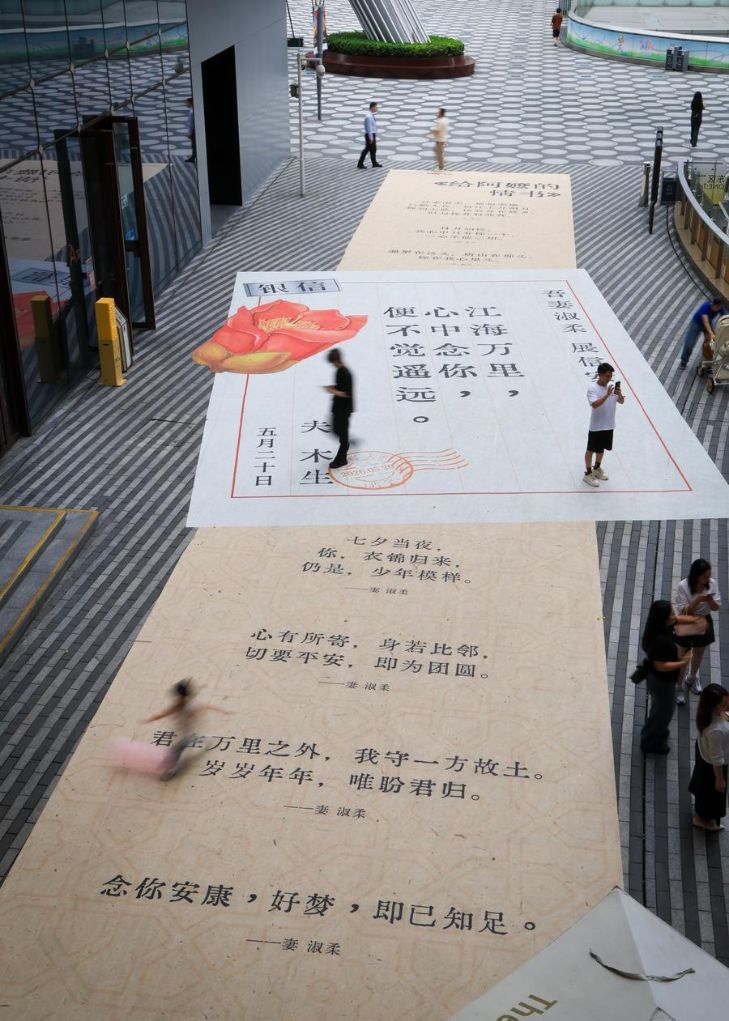
The film puts that debt on the screen and makes it almost unbearable. The money that fed the family came not from the grandfather they had imagined but from a stranger who asked nothing in return and kept sending it. Those letters had a name, “qiaopi,” a unique historical hybrid of family letters and remittance receipts widely used by overseas Chinese migrants throughout the 20th century. For a century, they were the only thread linking those who left and those who stayed. That is what love across distance looks like when it is real. It is quiet, unglamorous, and usually unthanked, because the people it was meant for rarely learn the whole of it until too late.
And being too late is the other thing the film understands. The grandson crosses an ocean to find a man, only to find a grave. Anyone who has ever meant to call, meant to ask, meant to write the story down while the person was still alive to tell it, knows that particular grief. It is not only the grief of losing someone. It is the grief of the questions you can no longer ask.
I did not watch it the way most of the audience did.
I am American by birth and Chinese by descent, and I live in Beijing now. The crossing the film describes is, in a sense, my own family’s story told in reverse.
My great-grandfather, on my mother’s side, was Liao Entao. His younger brother was Liao Zhongkai, born in San Francisco in 1877, the son of an overseas Chinese household. As a young man, Liao Zhongkai did what the people in the film could only dream of. He crossed back over the water. He returned to a country he had barely lived in, joined Sun Yat-sen’s revolution, and gave it everything, including his life, before he was assassinated in 1925.
A hundred years later, in a smaller and far luckier life, I made the crossing again. I came back.
I can tell you what coming back felt like because the film doesn’t show it, and most of the audience can only imagine it. For as long as I can remember, since I was a child, I felt a pull. Something across the water drew me steadily toward it, wordless, that I could neither explain nor shake. It was simply there, a direction my life kept turning toward. Coming back did not fill an absence. It answered a pull I had felt my whole life, one I had never been able to name.
What had been pulling me was a civilization. It does not stay behind when its people scatter. It goes with them, folded into a grandmother’s cooking, a mother’s silences, and a hundred things handed down without a word, and it keeps calling their children home long after the country itself has changed past knowing. It is the true cargo of the letters in the film. For a hundred years, when China itself was too broken to hold anyone, the civilization carried in those letters held a scattered people across the water together. The Jew who has never seen Jerusalem knows this pull. So does the Armenian, and the grandchild of any exile who feels it and cannot say why.
And being there explained my parents to me, my mother most of all. Born in San Francisco, she was guarded about China in a way I did not understand until I was standing in the country she had left.
Liao Zhongkai’s son, Liao Chengzhi, was my grandmother’s first cousin, and he rose to become a senior leader of the Communist Party of China (CPC) who spent many years working on overseas Chinese affairs. My mother could not afford to say his name. In the America of the 1950s and 1960s, with the country locked in a cold war against the new People’s Republic of China and Chinese Americans already targets of suspicion, a blood tie to one of its leaders was the kind of thing that could bring federal agents to your door and undo everything your family had built. It was something you buried. Her silence was a mother putting distance between her children and a history that could have been turned against them.
That is the quiet engine of Dear You. The grandson crosses the water and, at last, understands the grandfather: why he left, what the silence held, who had really been sending the money home. I crossed it and at last understood my mother. And the pull I had carried since childhood, the one I could never explain, went quiet, the way a question goes quiet once it is answered.
A letter is someone reaching across an impossible distance to say: you are still mine, even from here. That is why the ones in the film undo people. Most of us have stopped writing them. We should start again.
Go see Dear You. Then sit with the question it leaves you thinking. If a letter were the only thing that could cross, what would you write, and to whom?
The article reflects the author’s opinions, and not necessarily the views of China Focus.