Charting a Fairer Global AI Governance Path: China’s Ideas and Practices
 Facebook
 Twitter
 Linkedin
 Google +
Only by upholding genuine multilateralism, advancing digital equity and collective security with a vision of shared progress can the world achieve win-win outcomes for all humanity in the intelligent era.
The 2026 World Artificial Intelligence Conference (WAIC) and its parallel High-Level Meeting on Global Artificial Intelligence Governance deliver a clear, forward-looking strategic message. The keynote speech delivered by President Xi Jinping systematically elaborates on China’s philosophy for AI governance, putting forward constructive ideas to advance fair rule-setting amid global technological competition.
It signals that discussions over AI have gone far beyond pure technological and industrial rivalry, evolving into a core agenda for shaping the international landscape and global governance architecture.
Faced with the new round of technological revolution, a narrow focus on expanding computing power and model parameters — or even leveraging technological edges to build closed, exclusive blocs dubbed “small yards with high fences” — represents a short-sighted strategic choice. As underlying algorithms increasingly shape critical societal decisions and technological breakthroughs constantly test ethical boundaries, the international community faces an unavoidable shared question: how can we build a fair and reasonable global AI governance system? This stands as the core mission of this conference, as well as a shared priority for all countries to safeguard sovereignty and security.
This conference serves not only as a systematic elaboration of China’s governance philosophy, but also a concrete demonstration of its commitment to sharing development opportunities with the Global South. Among extensive exchanges at the venue, the concept of digital equity has struck the deepest chord. For a long time, a handful of countries with first-mover technological advantages have sought to weaponize AI and form exclusive blocs, risking a wider intelligence divide that could surpass historical digital gaps.

China advocates the principles of universal benefits, inclusiveness and leaving no country behind, which fully responds to the collective aspirations of a large number of developing nations. True digital equity means breaking barriers of technological inequality, and ensuring countries of the Global South have an equal voice in global rule-making, rather than merely accepting norms formulated by a small number of advanced technological economies.
Meanwhile, as digital technologies expand to all sectors, AI-related sovereign security risks have become a shared concern worldwide. Cross-border data flows, disinformation and misuse of advanced technology cannot be addressed by any single state alone; fragmented governance lacking global consensus will hardly deliver tangible results.
The value of China’s governance proposals lies in its departure from zero-sum frameworks that pit security against development. China firmly champions inclusive multilateral governance centered on the UN. All nations should stand together to establish unified baseline standards preventing technological abuse, while opposing the arbitrary overstretching of national security rationales in AI that prioritizes one country’s interests over the shared security of all.
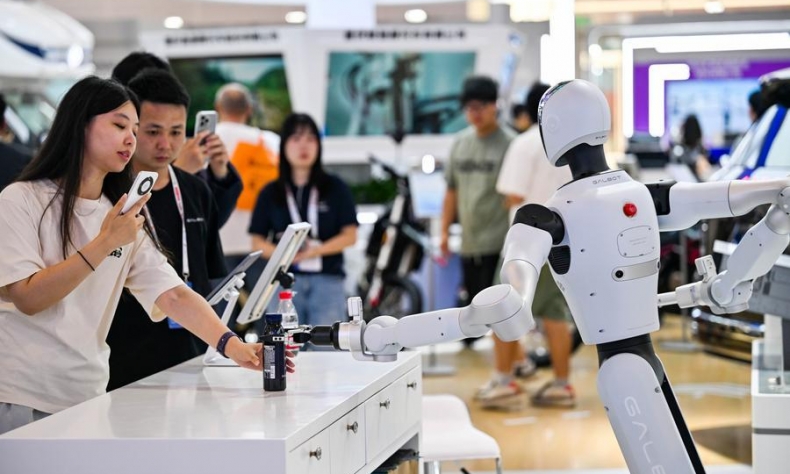
The credibility of any governance vision rests on tangible real-world practice. The wide range of AI application cases showcased at this conference lays a solid practical foundation for China’s governance ideas. China’s AI development takes a pragmatic path focused on empowering the real economy, upgrading grassroots governance and optimizing public services, rather than overemphasizing conceptual speculation and capital hype. Iterations driven by massive real-world scenarios and data have endowed China’s AI industry with robust resilience, and offered the world a practical, people-centered model of technology for the common good.
At this crossroads where global AI rules are being defined, overreliance on computing power advantages cannot secure long-term sustainable development. Only by upholding genuine multilateralism, advancing digital equity and collective security with a vision of shared progress can the world achieve win-win outcomes for all humanity in the intelligent era. This systematic, mature set of governance perspectives from China is being translated into tangible global cooperation actions, reshaping international expectations for the future of artificial intelligence.
The author is the director of the international relations center of the Academy of Contemporary China and World Studies.
The article reflects the author’s opinions, and not necessarily the views of China Focus.