China Half Year Economic Resilience: An International Comparison
 Facebook
 Twitter
 Linkedin
 Google +
China’s growth needs cooperation with the rest of the world, and in turn, will contribute significantly to world economic growth.
China announced a GDP growth of 4.7 percent in the first half of 2026 compared to the same time last year, with 5.0 percent growth in Q1, and 4.3 percent growth in Q2. The growth in the first half of 2026 was lower than the 2025 annual growth rate of 5.0 percent; however, it was well within the 4.5-5.0 percent target range set at the Two Sessions this past March.
The 4.7 percent GDP growth was achieved against the backdrop of Middle East tensions and the blockade of the Strait of Hormuz, which lead to global oil shock, a reignition of inflation, and an economic slowdown, underscoring the outstanding stability and strength of the Chinese economy.
The IMF’s July 8 World Economic Outlook (WEO) Update projected a general slowdown in the world economy amid an oil shock and the reignition of inflation. The report scaled down world output growth for 2026 by 0.1 percentage point to 3 percent, with 0.1 percent off in the U.S., Japan, and India, and 0.2 percent off in Eurozone. China’s projection, on the contrary, scaled up by 0.2 percent to 4.6 percent. In other words, China is the only major economy resisting the global economic drag.
Rising inflation worldwide is mainly due to the U.S.-Israel conflict with Iran. According to the WEO, inflation and expectations increased for three straight months from March to May, with overall inflation growing by almost 4 percent. Global consumer prices are expected to rise by 4.7 percent in 2026. In May, U.S. and Eurozone inflation rates were 4.3 percent and 3.2 percent, dropping to 3.5 percent and 2.8 percent in June after oil prices fell, but these levels are still high. In contrast, China’s inflation stayed low, with a 1.0 percent increase in CPI and 1.5 percent in PPI.
China kept its energy supply stable despite global oil disruptions. This was possible thanks to large reserves of oil and gas, as well as significant stores of alternative energy like solar, wind, and electric vehicles.
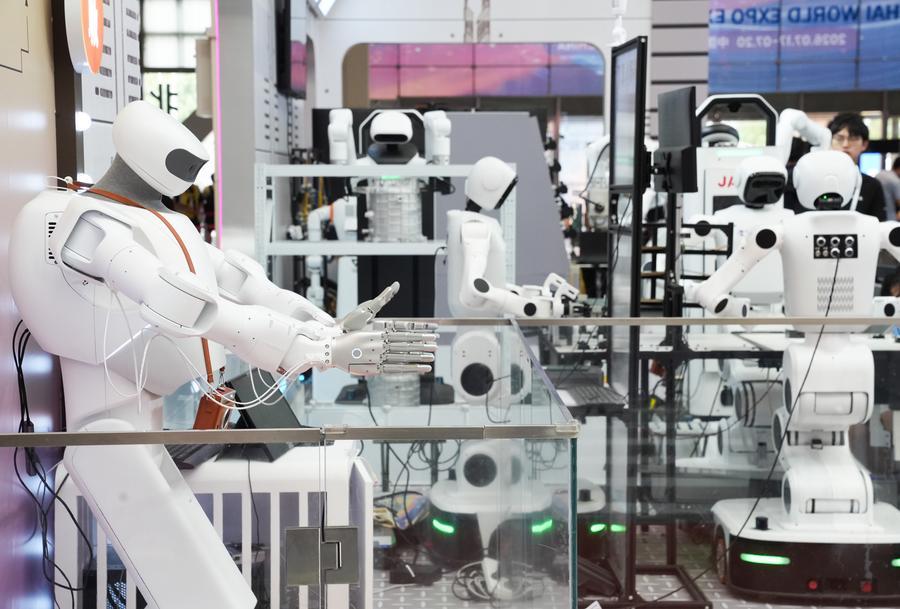
The fundamental engine of China’s steady and resilient economic performance is “NEW”– powered by AI related frontier technologies and high-tech industries. During H1, 2026, China’s industry added value increased by 5.4 percent, faster than GDP growth (4.7 percent), and high-tech manufacturing production increased by 13.3 percent. Production of three new items: 3D printing, lithium batteries and industrial robots rose by 48.5 percent, 39.3 percent and 28.0 percent, respectively. The WEO reported that the “global economy is in crosscurrents of war and technology”, and that “tech momentum offsets war drag”. China has provided a convincing example in this regard. In comparison, the U.S., though undoubtedly world largest AI power, has done less to apply AI advantages in upgrade its manufacturing. FED data shows that the U.S. manufacturing production index stood at 97.9 in May 2026, only 1.4 percent higher than a year ago, and well below 2017, the base year (100.0).
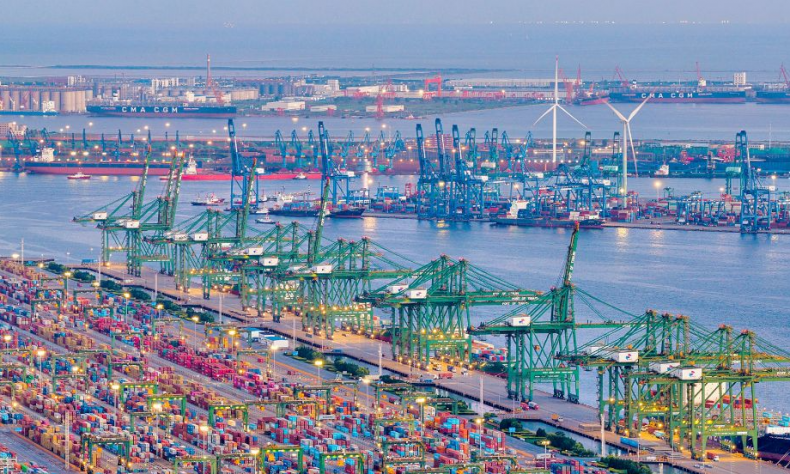
The success of China’s imports and exports during H1 2026 eloquently demonstrates its manufacturing power. Amid the various headwinds in the world economy and trade restrictions on China, its exports shot up by 17.6 percent, three times faster than in 2025, while its import performance was even more striking, up 26.6 percent. China’s exports were supported by its powerful high-tech manufacturing sector, with integrated circuit (IC) exports up 99 percent, automatic data processing equipment up 41.3 percent, automobiles up 53.9 percent, ships up 29.4 percent and high-tech exports up 38.5 percent.
Chinese imports showcased even better results, thanks in large part to high-tech products. Its IC import shot up by 55.8 percent, hitting $ 298.0 billion, more than $ 100 billion net growth in six months. Its high-tech import growth also hit 39.6 percent. As a result, China’s overall trade surplus shrank.
High-tech growth is, to a large extent, driven by a number of private innovative businesses. Apart from Huawei, BYD, DeepSeek, etc, the world’s largest lithium battery producers are CATL and Gotion Hi-Tech. The fast-rising chip memory producer—Changxin Memory Tech, based in Hefei, will likely become the world third-largest DRAM provider, exceeding Micron by the end of the year. In late June, the World Economic Forum announced 16 new lighthouse factories worldwide, and all of them are in China. Contrary to what the U.S. and Europe say, Chinese economic growth is not the result of “government subsidies or planning” but, ultimately, of dynamic innovation and market forces.
Beyond any doubt, China also faces several structural problems. The inadequate domestic demand, especially consumer capacity on one hand, and over-capacity in selected industries on the other, remains key issues. The massive trade surplus needs to be tackled seriously towards a more balanced trade. Whether in maintaining the high-tech led growth momentum, or in tackling all the structural problems, China will keep its door wide open, providing vast, ever-expanding market opportunities to the world. China’s growth needs cooperation with the rest of the world, and in turn, will contribute significantly to world economic growth.
The article reflects the author’s opinions, and not necessarily the views of China Focus.